

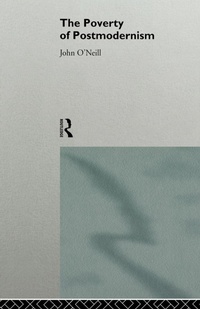
The Poverty of Postmodernism
1st Edition
Published on 20. October 1994
Book
Paperback/Softback
216 pages
978-0-415-11687-9 (ISBN)
Description
The Poverty of Postmodernism rejects the current celebration of knowledge and value relativism. This is on the grounds that it renders critical reason and commonsense incapable of resisting the superifical ideologies of minoritarianism that leave the hard core of global capitalism unanalyzed. In this book John O'Neill examines the postmodern turn in the social sciences. From a phenomenological standpoint (Husserl, Merleau Ponty, Schutz, Winch), he challenges Lyotard's postrationalist reading of Wittgenstein and Habermas in order to defend commonsense reason and values that are constitutive of the everyday life-world. In addition he argues from the standpoint of Vico and Marx on the civil history of embodied mind that the post-rationalist celebration of the arts of superificiality undermines the recognition of the cultural debt each generation owes to past and post-generations. In a positive way O'Neill develops an account of the historical vocation of reason and of the charitable accountability of science to commonsense that is necessary to sustain the basic institutions of civic democracy.
More details
Series
Language
English
Place of publication
London
United Kingdom
Publishing group
Taylor & Francis Ltd
Target group
College/higher education
Dimensions
Height: 216 mm
Width: 140 mm
Thickness: 13 mm
Weight
311 gr
ISBN-13
978-0-415-11687-9 (9780415116879)
Copyright in bibliographic data and cover images is held by Nielsen Book Services Limited or by the publishers or by their respective licensors: all rights reserved.
Schweitzer Classification
Other editions
Additional editions
John O'Neill
The Poverty of Postmodernism
Book
10/1994
1st Edition
Routledge
€261.60
Shipment within 15-20 days
Person
John O'Neill is Distinguished Research Professor of Sociology, York University, Toronto.
Content
Introduction: the two politics of knowledge-alterity and mutuality Part I The politics of disciplinary knowledge 1 Postmodernism and (post) Marxism 2 The therapeutic disciplines: from Parsons to Foucault 3 The disciplinary society: from Weber to Foucault 4 The phenomenological concept of modern knowledge and the Utopian method of Marxist economics 5 Orphic Marxism Part II The politics of mutual knowledge 6 'Posting' modernity: Bell and Jameson on the social bond-with an allegory of the body politic 7 On the regulative idea of a critical social science 8 Mutual knowledge 9 The mutuality of science and common sense: an essay on political trust Conclusion: the common-sense case against post-rationalism