

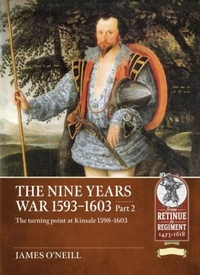
The Nine Years War 1593-1603 Part 2
The turning point at Kinsale 1598-1603
Will be published approx. on 15. February 2026
Book
Paperback/Softback
160 pages
978-1-80451-728-4 (ISBN)
Description
Tyrone's Rebellion reshaped Ireland as Mountjoy's disciplined campaign shattered Tyrone's network and restored Crown authority.
The Nine Years' War (1593-1603), sometimes known as Tyrone's Rebellion, was one of the most devastating and brutal conflicts ever to sweep the island. Never before had the English Crown come so close to losing its grip on Ireland. The war arose from a volatile combination of English misrule, Irish ambition, and the fortuitous creation of political ties with Spain. A confederation of Irish lords, led by the charismatic and exceptionally gifted Hugh O'Neill, Earl of Tyrone, swept from one victory to another. Part 2 of this series examines how the English recovered from the brink of defeat.
Hugh O'Neill's victory over the English at the Battle of the Yellow Ford ignited a fire that consumed the English plantation in Munster and significantly weakened the Crown's position in Ireland. Queen Elizabeth's favourite, the Earl of Essex, was dispatched to restore control, but his blundering leadership left Crown authority on the island close to collapse. The arrival of Charles Blount, Lord Mountjoy, at the start of 1600, however, transformed English fortunes. After seven years of near-continuous setbacks, Mountjoy turned the tide against Tyrone's confederation.
Unlike his predecessors, Mountjoy did not underestimate his enemies. He developed an island-wide strategy designed to dismantle Tyrone's network of alliances and restored order and confidence within the Crown's army by adopting many of the Irish military reforms. Supported by capable commanders such as Sir George Carew, Mountjoy rolled back Irish gains and carried the war into Tyrone's Ulster heartlands. His strategy was costly in English lives, but its success was undeniable, as relentless campaigning steadily wrested ground from Tyrone.
The fate of all sides converged with the Spanish landing of 4,000 troops at Kinsale, which led to a ferocious winter siege and the pivotal Battle of Kinsale. Mountjoy's victory on Christmas Eve 1601 shattered Tyrone's military power, but the war was not yet over. Its bloodiest phase still lay ahead, as English armies unleashed scorched-earth tactics and massacres on an unprecedented scale. Only af er Ulster was laid waste and Ireland ravaged by famine did Tyrone finally submit in 1603, bringing the war to an end and completing the Tudor conquest of Ireland.
The Nine Years' War (1593-1603), sometimes known as Tyrone's Rebellion, was one of the most devastating and brutal conflicts ever to sweep the island. Never before had the English Crown come so close to losing its grip on Ireland. The war arose from a volatile combination of English misrule, Irish ambition, and the fortuitous creation of political ties with Spain. A confederation of Irish lords, led by the charismatic and exceptionally gifted Hugh O'Neill, Earl of Tyrone, swept from one victory to another. Part 2 of this series examines how the English recovered from the brink of defeat.
Hugh O'Neill's victory over the English at the Battle of the Yellow Ford ignited a fire that consumed the English plantation in Munster and significantly weakened the Crown's position in Ireland. Queen Elizabeth's favourite, the Earl of Essex, was dispatched to restore control, but his blundering leadership left Crown authority on the island close to collapse. The arrival of Charles Blount, Lord Mountjoy, at the start of 1600, however, transformed English fortunes. After seven years of near-continuous setbacks, Mountjoy turned the tide against Tyrone's confederation.
Unlike his predecessors, Mountjoy did not underestimate his enemies. He developed an island-wide strategy designed to dismantle Tyrone's network of alliances and restored order and confidence within the Crown's army by adopting many of the Irish military reforms. Supported by capable commanders such as Sir George Carew, Mountjoy rolled back Irish gains and carried the war into Tyrone's Ulster heartlands. His strategy was costly in English lives, but its success was undeniable, as relentless campaigning steadily wrested ground from Tyrone.
The fate of all sides converged with the Spanish landing of 4,000 troops at Kinsale, which led to a ferocious winter siege and the pivotal Battle of Kinsale. Mountjoy's victory on Christmas Eve 1601 shattered Tyrone's military power, but the war was not yet over. Its bloodiest phase still lay ahead, as English armies unleashed scorched-earth tactics and massacres on an unprecedented scale. Only af er Ulster was laid waste and Ireland ravaged by famine did Tyrone finally submit in 1603, bringing the war to an end and completing the Tudor conquest of Ireland.
More details
Series
Language
English
Place of publication
Solihull
United Kingdom
Illustrations
10 b/w illustrations, 10 b/w photos, 15 color illustrations, 10 color photos, 5pp color plates 2 b/w maps, 5 color maps
Dimensions
Height: 242 mm
Width: 177 mm
Thickness: 15 mm
Weight
500 gr
ISBN-13
978-1-80451-728-4 (9781804517284)
Copyright in bibliographic data and cover images is held by Nielsen Book Services Limited or by the publishers or by their respective licensors: all rights reserved.
Schweitzer Classification
Person
Dr O'Neill worked in the heritage sector Northern Ireland for over 30 years, where he specialised in battlefield archaeology and Twentieth Century defence heritage. He received his doctorate at Queens University Belfast in 2013 and has published extensively on the Nine Years War including a monograph titled The Nine Years War 1593-1603: O'Neill, Mountjoy and the Military Revolution, and part 1 of this series 'The ascendancy of Irish arms and the road to Yellow Ford, 1593-1598'. He works as the Collections Officer at the Northern Ireland War Memorial Museum in Belfast.