

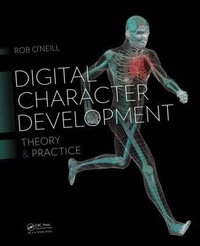
Digital Character Development
Theory and Practice, Second Edition
2nd Edition
Published on 10. September 2015
Book
Hardback
332 pages
978-1-4822-5077-0 (ISBN)
Description
Digital characters are a driving force in the entertainment industry today. Every animated film and video game production spends a large percentage of its resources and time on advancing the quality of the digital characters inhabiting the world being created. This book presents the theory and practice behind the creation of digital characters for film and games using software-agnostic descriptions that apply to any animation application. It provides insight from a real production environment and the requirements that such an environment imposes.
Digital Character Development: Theory and Practice, Second Edition covers the following key topics that are valuable to professionals across a wide spectrum of disciplines:
Evolution and history of digital characters, which is critical to understanding the theory and techniques behind how characters are developed
Contemporary issues, such as the "Uncanny Valley" phenomenon, that affect character design decisions
Process of building characters: anatomical considerations, character motion systems, deformation (muscle and skin) systems, facial setup, and rig synthesis and construction
Animation technology: keyframe strategies, curve interpolation, motion capture, procedural animation, artificial intelligence, crowd simulations, and interactive characters
Future of digital characters, including research questions that remain outstanding and the challenges for work beyond them
The second edition of this book has been significantly updated to reflect the latest trends and innovations in digital character development. It includes interviews with 15 leading character development professionals that provide unique insights into the challenges and ingredients for success in this field. With rich illustrations and visual code examples throughout, this book provides a comprehensive roadmap to character development for both professionals and students.
Digital Character Development: Theory and Practice, Second Edition covers the following key topics that are valuable to professionals across a wide spectrum of disciplines:
Evolution and history of digital characters, which is critical to understanding the theory and techniques behind how characters are developed
Contemporary issues, such as the "Uncanny Valley" phenomenon, that affect character design decisions
Process of building characters: anatomical considerations, character motion systems, deformation (muscle and skin) systems, facial setup, and rig synthesis and construction
Animation technology: keyframe strategies, curve interpolation, motion capture, procedural animation, artificial intelligence, crowd simulations, and interactive characters
Future of digital characters, including research questions that remain outstanding and the challenges for work beyond them
The second edition of this book has been significantly updated to reflect the latest trends and innovations in digital character development. It includes interviews with 15 leading character development professionals that provide unique insights into the challenges and ingredients for success in this field. With rich illustrations and visual code examples throughout, this book provides a comprehensive roadmap to character development for both professionals and students.
More details
Edition
2nd edition
Language
English
Place of publication
Oakville
Canada
Target group
Professional and scholarly
Professional Practice & Development
Product notice
sewn/stitched
Cloth over boards
Illustrations
140 s/w Abbildungen, 5 s/w Tabellen
5 Tables, black and white; 140 Illustrations, black and white
Dimensions
Height: 238 mm
Width: 191 mm
Thickness: 20 mm
Weight
758 gr
ISBN-13
978-1-4822-5077-0 (9781482250770)
Copyright in bibliographic data and cover images is held by Nielsen Book Services Limited or by the publishers or by their respective licensors: all rights reserved.
Schweitzer Classification
Other editions
Additional editions
E-Book
10/2015
2nd Edition
A K Peters
€97.49
Available for download
E-Book
10/2015
2nd Edition
CRC Press
€97.49
Available for download
Previous edition
Book
11/2008
1st Edition
Focal Press
€68.08
Article exhausted; check for reprint
Person
Rob O'Neill is a Character Technical Director Supervisor at DreamWorks Animation. Prior to joining DreamWorks, he was an Assistant Professor at Pratt Institute where he was Director of the Digital Arts Research Lab, and a founding partner of Kickstand Animation.
Content
An Introduction to Digital Characters. Overview. Contemporary Issues Related to Digital Characters. Interview: Josh Carey, Rigging Supervisor, Reel FX Creative Studio. History of Digital Characters. Interview: Tim McLaughlin, Associate Professor and Department Head Department of Visualization, College of Architecture, Texas A&M University. Character Technology and Code. Interview: Daniel Dawson, Lead Character Technical Director, DreamWorks Animation. Character Technology. Introduction To Character Technology. Interview: Wade Ryer, Character Technical Director. Anatomy for Character Setup. Interview: Lee Wolland, Character Technical Director, Consultant. Motion Systems. Interview: Cara Malek, Character Technology Body Lead, DreamWorks Animation. Deformation Systems. Interview: Robert Helms, Lead Character Technical Director, DreamWorks Animation. Face Setup. Interview: Nico Scapel, Creative Director, Faceshift. Rig Synthesis. Interview: Stephen Mann, CG Supervisor, Shade VFX. Rig Construction. Animation Technology. Introduction to Animation Technology. Interview: Javier Solsona, Senior Character Technical Director, Sony Imageworks. Traditional Animation Techniques. Interview: Stephen Candell, Lead Character Technical Director, DreamWorks Animation. Motion Capture. Interview: Brad Clark, Character Technical Director, Consultant. Procedural Animation. Interview: Terran Boylan, Lead Character Technical Director, DreamWorks Animation. Case Studies in Character Interactivity. Interview: David Hunt-Bosch, Rigging Tech Art Lead, Bungie. Conclusions. The Frontiers of Digital Character Development. Interview: Ken Perlin, Professor, Media Research Laboratory, Courant Institute of Mathematical Sciences, New York University.