

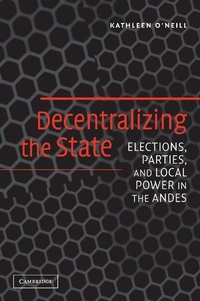
Decentralizing the State
Elections, Parties, and Local Power in the Andes
Published on 6. June 2005
Book
Paperback/Softback
286 pages
978-0-521-60970-8 (ISBN)
Description
This book, first published in 2005, explores the location and dynamics of power within the state, focusing on a recent wave of decentralizing reforms that have swept across both developed and developing countries in recent years. Variation in the timing of reform across countries only vaguely relates to the genesis of an international consensus pushed by big lenders and development banks or the reemergence of democracy in decentralizing countries. The book develops a theory linking decentralization's adoption to the electoral concerns of political parties: decentralization represents a desirable strategy for parties whose support at subnational levels appears more secure than their prospects in national elections. It examines this argument against experiences in Bolivia, Colombia, Ecuador, Peru and Venezuela and speculates on how recent political changes may affect decentralization's shape and extent in coming years.
Reviews / Votes
"O'Neill takes on a fundamental puzzles in comparative politics -- Why would national-level politicians decentralize power to subnational governments? She finds theories based on economic efficiency and crisis, external pressure from international actors, and internal ethnic heterogeneity lacking, proposes an alternative, electoral theory of decentralization, and tests it against five cases from the Andean region. The research strategy is elegant and clearly stated, and the results are impressive. This is a terrific contribution to our understanding of decentralization."John Carey, Dartmouth College "Why would a central government give up some of its power by promoting decentralizing reforms that shift decision-making and resources to the subnational level? In this excellent book, Kathleen O'Neill examines this important question, focusing on five Andean countries (Bolivia, Chile, Ecuador, Peru, and Venezuela). She develops an original and compelling argument that presidents will promote decentralization if their parties are skeptical they will win the next presidential election but are well poised to win executive power in some subnational districts. The research, analysis, and writing are outstanding."
Scott Mainwaring, University of Notre Dame "Decentralizing the State explores the dynamics of decentralization in an innovative fashion. It starts from several intellectual puzzles, noting that countries do not decentralize because of international technocratic pressure to 14improve governance12 or because decentralization supposedly follows from democratization. Instead, OaNeill argues that decentralization is a function of the dynamics of domestic party politics - in particular of politiciansa electoral strategies to ensure their future political survival. The argument is powerful and the evidence is strong, and the book should serve as an important source for scholars and policy practitioners alike."
David Samuels, University of Minnesota "This original argument, its solid grounding in qualitative and quantitative analyses, and its testing and refinement through case studies of all five of the increasingly troubled Andean countries, make this volume a major contribution to our understanding of important features of contemporary politics. It is an essential primer for politicians and policymakers seeking to understand the intersection of electoral politics and institutional design."
Donna Lee Van Cott, Tulane University O'Neill presents a wealth of masterfully compiled information on the five cases, and by combining different research strategies (formal modelling and statistical analysis with in-depth qualitative case studies) she provides a convincing example of the merits of methodological pluralism."
Ana Maria Bejarno, University of Toronto, CJLACS/RCELAC "O'Neill's carefully constructed work sets a useful baseline for others who might be interested in exploring how electoral incentives intersect with other factors that determine why and when decentralization occurs." - Daniel Ziblatt, Harvard University
More details
Language
English
Place of publication
Cambridge
United Kingdom
Target group
Professional and scholarly
College/higher education
Product notice
Paperback (trade)
Illustrations
37 Tables, unspecified; 7 Line drawings, unspecified
Dimensions
Height: 229 mm
Width: 152 mm
Thickness: 17 mm
Weight
468 gr
ISBN-13
978-0-521-60970-8 (9780521609708)
Copyright in bibliographic data and cover images is held by Nielsen Book Services Limited or by the publishers or by their respective licensors: all rights reserved.
Schweitzer Classification
Other editions
Additional editions
E-Book
07/2005
1st Edition
Cambridge University Press
€24.99
Available for download
Book
06/2005
Cambridge University Press
€106.60
Shipment within 15-20 days
Person
Content
Part I. Electoral Theory and Comparative Evidence: 1. Introduction; 2. A political theory of decentralization; 3. Decentralization in comparative perspective; Part II. In-Depth Country Studies: 4. The Colombian experience; 5. The Bolivian experience; 6. Ecuador, Peru, and Venezuela; Part III. Comparisons, Conclusions, and Extensions: 7. Comparisons, conclusions, and extensions; 8. Afterword.