

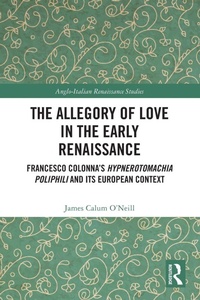
The Allegory of Love in the Early Renaissance
Francesco Colonna's Hypnerotomachia Poliphili and its European Context
1st Edition
Published on 18. December 2024
Book
Paperback/Softback
280 pages
978-1-032-38985-1 (ISBN)
Description
Described as 'the most beautiful book ever printed' previous research has focused on the printing history of the Hypnerotomachia and its copious literary sources. This monograph critically engages with the narrative of the Hypnerotomachia and with Poliphilo as a character within this narrative, placing it within its European literary context. Using narratological analysis, it examines the journey of Poliphilo and the series of symbolic, allegorical, and metaphorical experiences narrated by him that are indicative of his metamorphosing interiority. It analyses the relationship between Poliphilo and his external surroundings in sequences of the narrative pertaining to thresholds; the symbolic architectural, topographical, and garden forms and spaces; and Poliphilo's transforming interior passions including his love of antiquarianism, language, and Polia, the latter of which leads to his elegiac description of lovesickness, besides examinations of numerosophical symbolism in number, form, and proportion of the architectural descriptions and how they relate to the narrative.
More details
Series
Language
English
Place of publication
London
United Kingdom
Publishing group
Taylor & Francis Ltd
Target group
College/higher education
Professional and scholarly
Academic, Postgraduate, and Undergraduate Advanced
Illustrations
23 s/w Abbildungen, 23 s/w Photographien bzw. Rasterbilder, 4 s/w Tabellen
4 Tables, black and white; 23 Halftones, black and white; 23 Illustrations, black and white
Dimensions
Height: 229 mm
Width: 152 mm
Thickness: 16 mm
Weight
429 gr
ISBN-13
978-1-032-38985-1 (9781032389851)
Copyright in bibliographic data and cover images is held by Nielsen Book Services Limited or by the publishers or by their respective licensors: all rights reserved.
Schweitzer Classification
Other editions
Additional editions
James Calum O'Neill
The Allegory of Love in the Early Renaissance
Francesco Colonna's Hypnerotomachia Poliphili and its European Context
Book
07/2023
1st Edition
Routledge
€232.10
Shipment within 10-20 days
James Calum O'Neill
The Allegory of Love in the Early Renaissance
Francesco Colonna's Hypnerotomachia Poliphili and its European Context
E-Book
07/2023
1st Edition
Routledge
€55.49
Available for download
James Calum O'Neill
The Allegory of Love in the Early Renaissance
Francesco Colonna's Hypnerotomachia Poliphili and its European Context
E-Book
07/2023
1st Edition
Routledge
€55.49
Available for download
Person
James Calum O'Neill is a literary and art historian specialising in Italian medieval and Renaissance literature, fine art and architecture. His PhD was conducted at Durham University on 'Self-Transformation in the Hypnerotomachia Poliphili' which is now published by Routledge under the title The Allegory of Love in the Early Renaissance: Francesco Colonna's Hypnerotomachia Poliphili and its European Context. Currently, O'Neill's research focuses on botanical, architectural, antiquarian and narratological analysis in the Hypnerotomachia Poliphili as a locus for the convergence of philosophic, elegiac, antiquarian and medical traditions, pertaining to both medieval and humanist cultures, with a focus on northern Italian and Venetian society during the fourteenth and fifteenth centuries.
Content
List of Figures
List of Tables
Preface
Acknowledgments
Abbreviations
Introduction
1. Thresholds of Transformation
2. Self-transformation and Architecture
3. Poliphilo, Connoisseurship and Self-transformation
4. Travel Writing and Topographical Interiority
5. Walking and Self-transformation in the Gardens of Eleuterylida and Telosia
6. Love and Self-transformation in Book I
7. Lovesickness, Honestum, and Initiation in Book II
Conclusion
Bibliography
Index
List of Tables
Preface
Acknowledgments
Abbreviations
Introduction
1. Thresholds of Transformation
2. Self-transformation and Architecture
3. Poliphilo, Connoisseurship and Self-transformation
4. Travel Writing and Topographical Interiority
5. Walking and Self-transformation in the Gardens of Eleuterylida and Telosia
6. Love and Self-transformation in Book I
7. Lovesickness, Honestum, and Initiation in Book II
Conclusion
Bibliography
Index