

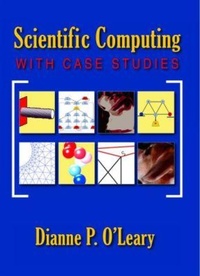
Scientific Computing with Case Studies
Published on 30. December 2008
Book
Paperback/Softback
399 pages
978-0-89871-666-5 (ISBN)
Description
Learning through doing is the foundation of this book, which allows readers to explore case studies as well as expository material. The book provides a practical guide to the numerical solution of linear and nonlinear equations, differential equations, optimization problems, and eigenvalue problems. It treats standard problems and introduces important variants such as sparse systems, differential-algebraic equations, constrained optimization, Monte Carlo simulations, and parametric studies. Stability and error analysis is emphasized, and the MATLAB (R) algorithms are grounded in sound principles of software design and in the understanding of machine arithmetic and memory management.
Nineteen case studies allow readers to become familiar with mathematical modeling and algorithm design, motivated by problems in physics, engineering, epidemiology, chemistry, and biology. A website provides solutions to the challenges that are offered throughout the book and also supplies relevant MATLAB codes, derivations, and supplementary notes and slides.
Nineteen case studies allow readers to become familiar with mathematical modeling and algorithm design, motivated by problems in physics, engineering, epidemiology, chemistry, and biology. A website provides solutions to the challenges that are offered throughout the book and also supplies relevant MATLAB codes, derivations, and supplementary notes and slides.
More details
Language
English
Place of publication
New York
United States
Target group
Professional and scholarly
College/higher education
Product notice
Paperback (trade)
Unsewn / adhesive bound
Dimensions
Height: 247 mm
Width: 174 mm
Thickness: 17 mm
Weight
812 gr
ISBN-13
978-0-89871-666-5 (9780898716665)
Copyright in bibliographic data and cover images is held by Nielsen Book Services Limited or by the publishers or by their respective licensors: all rights reserved.
Schweitzer Classification
Person
Dianne Prost O'Leary is a professor of computer science at the University of Maryland, and also holds an appointment in the university's Institute for Advanced Computer Studies (UMIACS) and in the Applied Mathematics and Scientific Computing Program. She earned a B.S. from Purdue University and a Ph.D. from Stanford University. Her research is in computational linear algebra and optimization, with applications to solution of ill-posed problems, image deblurring, information retrieval, and quantum computing. She has authored over 90 research publications on numerical analysis and computational science and 30 publications on education and mentoring.
Content
Preface
Part I: Preliminaries: Mathematical Modeling, Errors, Hardware, and Software
Chapter 1: Errors and Arithmetic
Chapter 2: Sensitivity Analysis: When a Little Means a Lot
Chapter 3: Computer Memory and Arithmetic: A Look Under the Hood
Chapter 4: Design of Computer Programs: Writing Your Legacy
Part II: Dense Matrix Computations
Chapter 5: Matrix Factorizations
Chapter 6: Case Study: Image Deblurring: I Can See Clearly Now
Chapter 7: Case Study: Updating and Downdating Matrix Factorizations: A Change in Plans
Chapter 8: Case Study: The Direction-of-Arrival Problem
Part III: Optimization and Data Fitting
Chapter 9: Numerical Methods for Unconstrained Optimization
Chapter 10: Numerical Methods for Constrained Optimization
Chapter 11: Case Study: Classified Information: The Data Clustering Problem
Chapter 12: Case Study: Achieving a Common Viewpoint: Yaw, Pitch, and Roll
Chapter 13: Case Study: Fitting Exponentials: An Interest in Rates
Chapter 14: Case Study: Blind Deconvolution: Errors, Errors, Everywhere
Chapter 15: Case Study: Blind Deconvolution: A Matter of Norm
Part IV: Monte Carlo Computations
Chapter 16: Monte Carlo Principles
Chapter 17: Case Study: Monte-Carlo Minimization and Counting One, Two, Too Many
Chapter 18: Case Study: Multidimensional Integration: Partition and Conquer
Chapter 19: Case Study: Models of Infections: Person to Person
Part V: Ordinary Differential Equations
Chapter 20: Solution of Ordinary Differential Equations
Chapter 21: Case Study: More Models of Infection: It's Epidemic
Chapter 22: Case Study: Robot Control: Swinging Like a Pendulum
Chapter 23: Case Study: Finite Differences and Finite Elements: Getting to Know You
Part VI: Nonlinear Equations and Continuation Methods
Chapter 24: Nonlinear Systems
Chapter 25: Case Study: Variable-Geometry Trusses
Chapter 26: Case Study: Beetles, Cannibalism, and Chaos
Part VII: Sparse Matrix Computations, with Application to Partial Differential Equations
Chapter 27: Solving Sparse Linear Systems: Taking the Direct Approach
Chapter 28: Iterative Methods for Linear Systems
Chapter 29: Case Study: Elastoplastic Torsion: Twist and Stress
Chapter 30: Case Studt: Fast Solvers and Sylvester Equations: Both Sides Now
Chapter 31: Case Study: Eigenvalues: Valuable Principles
Chapter 32: Multigrid Methods: Managing Massive Meshes
Bibliography
Index
Part I: Preliminaries: Mathematical Modeling, Errors, Hardware, and Software
Chapter 1: Errors and Arithmetic
Chapter 2: Sensitivity Analysis: When a Little Means a Lot
Chapter 3: Computer Memory and Arithmetic: A Look Under the Hood
Chapter 4: Design of Computer Programs: Writing Your Legacy
Part II: Dense Matrix Computations
Chapter 5: Matrix Factorizations
Chapter 6: Case Study: Image Deblurring: I Can See Clearly Now
Chapter 7: Case Study: Updating and Downdating Matrix Factorizations: A Change in Plans
Chapter 8: Case Study: The Direction-of-Arrival Problem
Part III: Optimization and Data Fitting
Chapter 9: Numerical Methods for Unconstrained Optimization
Chapter 10: Numerical Methods for Constrained Optimization
Chapter 11: Case Study: Classified Information: The Data Clustering Problem
Chapter 12: Case Study: Achieving a Common Viewpoint: Yaw, Pitch, and Roll
Chapter 13: Case Study: Fitting Exponentials: An Interest in Rates
Chapter 14: Case Study: Blind Deconvolution: Errors, Errors, Everywhere
Chapter 15: Case Study: Blind Deconvolution: A Matter of Norm
Part IV: Monte Carlo Computations
Chapter 16: Monte Carlo Principles
Chapter 17: Case Study: Monte-Carlo Minimization and Counting One, Two, Too Many
Chapter 18: Case Study: Multidimensional Integration: Partition and Conquer
Chapter 19: Case Study: Models of Infections: Person to Person
Part V: Ordinary Differential Equations
Chapter 20: Solution of Ordinary Differential Equations
Chapter 21: Case Study: More Models of Infection: It's Epidemic
Chapter 22: Case Study: Robot Control: Swinging Like a Pendulum
Chapter 23: Case Study: Finite Differences and Finite Elements: Getting to Know You
Part VI: Nonlinear Equations and Continuation Methods
Chapter 24: Nonlinear Systems
Chapter 25: Case Study: Variable-Geometry Trusses
Chapter 26: Case Study: Beetles, Cannibalism, and Chaos
Part VII: Sparse Matrix Computations, with Application to Partial Differential Equations
Chapter 27: Solving Sparse Linear Systems: Taking the Direct Approach
Chapter 28: Iterative Methods for Linear Systems
Chapter 29: Case Study: Elastoplastic Torsion: Twist and Stress
Chapter 30: Case Studt: Fast Solvers and Sylvester Equations: Both Sides Now
Chapter 31: Case Study: Eigenvalues: Valuable Principles
Chapter 32: Multigrid Methods: Managing Massive Meshes
Bibliography
Index