

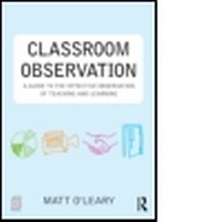
Classroom Observation
A guide to the effective observation of teaching and learning
1st Edition
Published on 26. September 2013
Book
Paperback/Softback
196 pages
978-0-415-52579-4 (ISBN)
Description
Classroom Observation explores the pivotal role of lesson observation in the training, assessment and development of new and experienced teachers. Offering practical guidance and detailed insight on an aspect of training that is a source of anxiety for many teachers, this thought-provoking book offers a critical analysis of the place, role and nature of lesson observation in the lives of education professionals.
Illustrated throughout with practical examples from a range of education settings, it considers observation as a means of assessing teaching and learning and also as a way of developing teachers' skills and knowledge. Key topics include:
The purposes and uses of lesson observation
The socio-political and historical context in which lesson observation has developed
Practical guidance on a range of observation models and methods
Teacher autonomy and professional identity
Performance management, professional standards and accountability
Peer observation, self-observation and critical reflection
Using video in lesson observation.
Written for all student and practising teachers as well teacher educators and those engaged in educational research, Classroom Observation is an essential introduction to how we observe, why we observe and how it can be best used to improve teaching and learning.
Illustrated throughout with practical examples from a range of education settings, it considers observation as a means of assessing teaching and learning and also as a way of developing teachers' skills and knowledge. Key topics include:
The purposes and uses of lesson observation
The socio-political and historical context in which lesson observation has developed
Practical guidance on a range of observation models and methods
Teacher autonomy and professional identity
Performance management, professional standards and accountability
Peer observation, self-observation and critical reflection
Using video in lesson observation.
Written for all student and practising teachers as well teacher educators and those engaged in educational research, Classroom Observation is an essential introduction to how we observe, why we observe and how it can be best used to improve teaching and learning.
More details
Language
English
Place of publication
London
United Kingdom
Publishing group
Taylor & Francis Ltd
Target group
College/higher education
Professional and scholarly
Illustrations
4 s/w Abbildungen, 34 s/w Tabellen, 4 s/w Zeichnungen
4 Line drawings, black and white; 34 Tables, black and white; 4 Illustrations, black and white
Dimensions
Height: 246 mm
Width: 171 mm
Weight
372 gr
ISBN-13
978-0-415-52579-4 (9780415525794)
Copyright in bibliographic data and cover images is held by Nielsen Book Services Limited or by the publishers or by their respective licensors: all rights reserved.
Schweitzer Classification
Other editions
New editions
Book
05/2020
2nd Edition
Routledge
€48.20
Shipment within 10-20 days
Additional editions
Book
10/2013
1st Edition
Routledge
€170.84
Article exhausted; check for reprint
Person
Matt O'Leary is Principal Lecturer and Research Fellow in Post-Compulsory Education at the Centre for Research and Development in Lifelong Education, University of Wolverhampton, UK.
Content
Part One - Exploring the role of classroom observation in teaching and learning 1. Introducing the book: focus, content and structure 2. Classroom observation in context: understanding the background to its emergence and use in the teaching profession 3. A review of classroom observation in the English education system: understanding its role in schools, colleges and universities Part Two - Classroom observation as a means of assessing teaching and learning 4. Classroom observation as a method for studying teaching and learning: ways of recording what you see 5. Typologies of classroom observation: contexts, models and purposes 6. Being an effective teacher: models of teacher effectiveness Part Three - Classroom observation as a means of promoting teacher learning and development 7. Classroom observation as a tool for expansive professional learning: observing practice and the role of critical reflection 8. Moving beyond conventional models of classroom observation: lesson study, unseen observation and remote video technology as alternative case studies 9. Conclusion References Appendices