

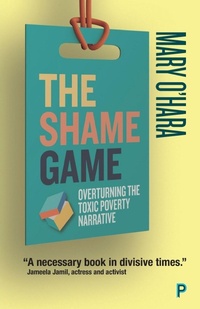
The Shame Game
Overturning the Toxic Poverty Narrative
1st Edition
Published on 27. February 2020
Book
Paperback/Softback
232 pages
978-1-4473-4926-6 (ISBN)
Description
What does it mean to be poor in Britain and America? For decades the primary narrative about poverty in both countries is that it has been caused by personal flaws or 'bad life decisions' rather than policy choices or economic inequality. This misleading account has become deeply embedded in the public consciousness with serious ramifications for how financially vulnerable people are seen, spoken about and treated.
Drawing on a two-year multi-platform initiative, this book by award-winning journalist and author Mary O'Hara, asks how we can overturn this portrayal once and for all. Crucially, she turns to the real experts to try to find answers - the people who live it.
Drawing on a two-year multi-platform initiative, this book by award-winning journalist and author Mary O'Hara, asks how we can overturn this portrayal once and for all. Crucially, she turns to the real experts to try to find answers - the people who live it.
Reviews / Votes
"A necessary book in divisive times." Jameela Jamil, actress and activist "Following up on Austerity Bites, Mary O'Hara shows us why poverty sucks. Not just for the obvious reasons of struggle and deprivation, but because poverty is produced by a specific style of politics that revels in the shame of others, a politics where the US and the UK are past masters." Mark Blyth, Brown University and author of Austerity: The history of a dangerous idea "The Shame Game is the book we need right now. Real stories, by people who have lived that story, smashing apart the divisive narratives around poverty that are so damaging to all of us." Kerry Hudson, Author, Lowborn "In a time of extreme social and economic division, Mary O'Hara lifts the lid on who truly benefits from keeping us divided and how we can flip the script of poverty to make a fairer society for all. A powerful and important book." Mahsuda Snaith, author of How to Find Home "Rich people should be required to read this book and poor people should be allowed to. I have rarely seen a more broad and beautiful picture of people who have done more with less than this book. O'Hara has woven a rich tapestry of joy and terror and talent and lost opportunities and the picture she draws is the most comprehensive description of poverty I've seen yet." Linda Tirado, journalist and author of "Hand to mouth "I worked with Mary, and she sees the potential of talent and magic in every kid and every adult. This book explores the absolute travesty of blaming each other." Conrad Murray, BAC Beatbox AcademyMore details
Edition
First Edition
Language
English
Place of publication
Bristol
United Kingdom
Publishing group
Bristol University Press
Target group
Professional and scholarly
Illustrations
Not illustrated
Dimensions
Height: 216 mm
Width: 140 mm
Thickness: 23 mm
Weight
543 gr
ISBN-13
978-1-4473-4926-6 (9781447349266)
Copyright in bibliographic data and cover images is held by Nielsen Book Services Limited or by the publishers or by their respective licensors: all rights reserved.
Schweitzer Classification
Other editions
Additional editions
E-Book
02/2020
1st Edition
Policy Press
€30.99
Available for download
E-Book
02/2020
1st Edition
Policy Press
€23.49
Available for download
Person
Mary O'Hara is an award-winning journalist, author and producer. Her journalism appears in publications including The Guardian and Mosaic Science. She is the author of two books: The Shame Game: Overturning the Toxic Poverty Narrative (2020) & Austerity Bites: A Journey to the Sharp End of Cuts in the UK (2014) and is founder of the multi-platform anti-poverty initiative, Project Twist-It. Mary has directed/produced short films, run a comedy club, been a Fulbright Scholar at UC Berkeley and a producer and consultant on Getting Curious podcast with Jonathan Van Ness. In 2020 she was named Best Foreign Columnist at the Southern California Journalism Awards.
Content
PART I : The inconvenient truth: poverty is real
A short prologue
Introduction
1 Who are these 'poor' people anyway? Being on the breadline in Britain
2 What? There are poor people in the richest nation on earth?
PART II: Turning the screw on poor people: shame, stigma and cementing of a toxic poverty narrative
3 A twisted tale: evolution of a the poverty narrative
4 Lights, camera, vilification: the narrative in action
5 The games we play: weaponising the narrative
6 Shame on you: making the toxic narrative stick
PART III: Flipping the script: challenging the narrative war on the poor
7 Feeling it: the truth about living in poverty
8 Changing times: fighting poverty, not the poor
9 New generation: young people writing their own script
10 Altered images: constructing a new narrative
A short prologue
Introduction
1 Who are these 'poor' people anyway? Being on the breadline in Britain
2 What? There are poor people in the richest nation on earth?
PART II: Turning the screw on poor people: shame, stigma and cementing of a toxic poverty narrative
3 A twisted tale: evolution of a the poverty narrative
4 Lights, camera, vilification: the narrative in action
5 The games we play: weaponising the narrative
6 Shame on you: making the toxic narrative stick
PART III: Flipping the script: challenging the narrative war on the poor
7 Feeling it: the truth about living in poverty
8 Changing times: fighting poverty, not the poor
9 New generation: young people writing their own script
10 Altered images: constructing a new narrative