

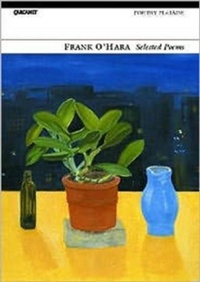
Selected Poems
4th Edition
Published on 27. January 2005
Book
Paperback/Softback
180 pages
978-1-85754-771-9 (ISBN)
Description
Frank O'Hara (1926-66) is among the most delightful and radical poets of the twentieth century. He is celebrated for his apparently unpremeditated poems, autobiographical and immediate ('any time, any place'). This is not the whole O'Hara: he may have scribbled poems on serviettes, but others he worked on with intense concentration, creating sequences that are inexhaustibly nuanced, full of surprise, heartbreak and laughter. There are analogies between his work and that of the painters he championed, Pollock, Kline and de Kooning among them.
He is resolutely metropolitan, and his metropolis is New York City. He brilliantly captured the pace and rhythms, quandaries and exhilarations, of its mid-twentieth-century life.
He is resolutely metropolitan, and his metropolis is New York City. He brilliantly captured the pace and rhythms, quandaries and exhilarations, of its mid-twentieth-century life.
Reviews / Votes
'O'Hara's hip, glamorous, freewheeling self-celebrations both reflected and helped disseminate a new kind of confidence and daring in American poetry.'Mark Ford Kate North,The North, 8th December 2005
The chronological arrangement of a selection of Frank O'Hara's work must have been a joy to compile.Not only considered 'among the most delightful and radical poets of the twentieth century' O'Hara is also recognised as a champion of dynamic artists such as Jackson Pollock, as well as a descendent of the traditions of W C Williams and Apollinaire.
For those familiar with O'Hara's work, you will find the classic staples such as 'Personism: A Manifesto' and 'The Day Lady Died'.He is largely known for his casual, everyday attitude, in his language and his approach to writing which is apparent when we remember that he only published two collections during his lifetime.Further work had to be salvaged posthumously from sock drawers and discovered in notebooks.Many of his poems were left untitled, which further underlines his relaxed attitude.
However, I also think that the point carries with it a nod towards the energetic and eager way he continually looked to the next new experience, the next moment in his life.Two stanzas that sum this up for me are also to be found in this collection at the beginning of one of his nameless pieces,
The eager note on my door said 'Call me,
call me when you get in!' so I quickly threw
a few tangerines into my overnight bag,
straightened my eyelids and shoulders, and
headed straight for the door.It was autumn
by the time I got around the corner, oh all
unwilling to be either pertinent or bemused, but
the leaves were brighter than grass on the sidewalk!
O'Hara is seen as a writer who was highly influential to many poets who came after him, both American and British.His experimental approach displays a singular passion for the acoustic and spoken undulations of syntax and language.Many poems in the collection reflect this, as here for instance in 'Second Avenue':
Quips and players, seeming to vend astringency off-hours,
celebrate diced excesses and sardonics, mixing pleasures,
as if proximity were staring at the margin of a plea...
For an authoritative review of O'Hara's work, or for an introduction into his world, this book is a first choice. Frank O'Hara's collection is full of spontaneity and wildness.
It's nearly 40 years since the first publication of this important selection. In that time Frank O'Hara has transformed from a coterie figure into one regularly cited as a key influence by mainstream and more experimental poets alike. His standing has never been higher.
O'Hara was, in a radical sense, a writer of the occasional, responding constantly to events and people immediately around him (many poems were written for and about his wide circle of friends). We can get some idea of this by looking at Friday 7 August, 1959. On that day O'Hara was to have lunch with his flatmate Joe LeSueur and the painter Norman Bluhm. LeSueur phoned him at his office in the late morning to announce that he'd written a poem for Bluhm and daring O'Hara to produce his own. Reluctantly he took on the challenge. 'Adieu to Norman, Bon Jour to Joan and Jean Paul' is one of the highlights of Selected Poems. It begins with the precise nature of the occasional, of the moment:
It is 12:10 in New York and I am wondering
if I will finish this in time to meet Norman for lunch
And finish it he did, producing one of his greatest pieces. It moves away from close, quick-fire details and builds to an impassioned, playful hymn to survival, to keeping going: 'the only thing to do is simply continue / is that simple / yes, it is simple because it is the only thing to do / can you do it / yes, you can because it is the only thing to do / blue light over the Bois de Boulogne it continues / the Seine continues / the Louvre stays open it hardly closes at all'. The idea of survival is crucial to O'Hara's poetry; it's what drives his work and, even though he's best known for this kind of 'I do this I do that' writing, his style had been continually shifting and adapting since the late 40s.
At Harvard, after serving in the Pacific during the second world war, he wrote poems delighting in a barbed sense of fun, infatuated with the novels of Ronald Firbank. When he arrived in New York at the end of 1951 (after receiving a Hopwood Award in creative writing at Ann Arbor) he launched himself enthusiastically into more chaotic, energetic works that looked both to the example of Dada and the vigorous canvases of the Abstract Expressionists (many of whom O'Hara befriended). These intoxicating poems, swerving between high camp and a kind of violent insouciance, brandish the vulgar, eager to smash through any sense of diction or restraint. He also began producing poems about his experience of cruising, what he later called his 'under the counter' writing.
It wasn't until 1956, after his 30th birthday and the death of his close friend Bunny Lang, that the 'I do this, I do that' pieces started to appear. The surreal devices are toned down and a distinctive intimate voice emerges, delivering the close at hand. As he says in a poem to the painter Robert Rauschenberg: 'Yes, it's necessary, I'll do / what you say, put everything / aside but what is here.' By 1961, however, these had evolved into a series of charismatic, fragmented poems spinning on colloquial phrases and half-glimpsed details, scattering themselves in pieces across the page.
There's always been some controversy about how O'Hara's work should be presented in book form. The poems published in his own lifetime weren't always reflections of his best writing and when his Collected Poems was produced in 1971 (five years after his early death), its sheer scale and length surprised even his closest friends. In making any selection, which side of O'Hara's writing do you emphasise?
The 1974 Selected Poems edited by Donald Allen (which Carcanet are here reprinting) contains 140 poems touching on a broad range of O'Hara's output. But, inevitably, it's not without problems; there are several works missing that, over the years, have been recognised as central - 'A Party Full of Friends', 'At the Old Place', 'Poem/The fluorescent tubing burns like a bobby-soxer's ankles', 'Poem/Lana Turner has collapsed!' (a piece written 50 years ago this February that brilliantly embodies O'Hara's gift for 'photographing the instant'). What the book does deliver, however, is the brasher, messier, more avant-garde side of O'Hara, typified by the rich and challenging textures of 'Easter' and 'Second Avenue'. An alternative approach can be found in the 2008 Selected Poems edited by Mark Ford that, gathering together his lighter, frequently more accessible works (including the final version of the excellent one act play 'Try, Try!'), stresses the camp O'Hara, O'Hara as the groundbreaking gay writer. Both books, however, agree on the central importance of the 'I do this, I do that' pieces he was producing throughout 1959.
For O'Hara a poem was most of all a performance, the declaration of a moment, rather than a display of craft or control. Looking to Whitman, Mayakovsky and Benjamin Peret he expressed a flamboyant disregard for the built resonances of le mot juste, the traditional sanctities of versification. He wanted something closer to the idea of spontaneity and wildness, to a kind of camp version of the sublime - 'the wilderness wish / of wanting to be everything to everybody everywhere'. And regardless of emphasis, it's always this sense of boundless potential, of excitement, of irrepressible restlessness, that dominates O'Hara's poetry; the extraordinary immediacy of a voice that seems clearer now than ever before.
More details
Edition
4th edition
Language
English
Place of publication
Manchester
United Kingdom
Dimensions
Height: 216 mm
Width: 154 mm
Thickness: 19 mm
Weight
373 gr
ISBN-13
978-1-85754-771-9 (9781857547719)
Copyright in bibliographic data and cover images is held by Nielsen Book Services Limited or by the publishers or by their respective licensors: all rights reserved.
Schweitzer Classification
Persons
Frank O'Hara was born in Baltimore, Maryland, in 1926, and grew up in Grafton, Massachusetts. He served in the US navy (1944-46) in the South Pacific, and attended the universities of Harvard and Michigan. In 1951 O'Hara settled in Manhattan, and soon became a central figure in a number of the city's artistic circles. For most of the fifteen years that he lived in New York he worked at the Museum of Modern Art, graduating from the front desk to become Associate Curator. He was a passionate advocate of Abstract Expressionist painters such as Willem de Kooning, Jackson Pollock, and Franz Kline. O'Hara wrote an enormous quantity of poetry, little of which was published during his lifetime, but which was much admired by friends such as John Ashbery, Kenneth Koch, V.R. 'Bunny' Lang, James Schuyler, Fairfield Porter and Larry Rivers. He died on 25 July 1966, from injuries sustained in a beach-buggy accident on Fire Island. He is buried at Green River Cemetery, East Hampton, Long Island. His Collected Poems (edited by Donald Allen) was published in 1971, and won the National Book Award for Poetry. Donald Merriam Allen was a writer, editor, publisher and translator of contemporary American literature. He is best known for his project The New American Poetry 1945-1960, just one of the anthologies of contemporary American writing he released.