

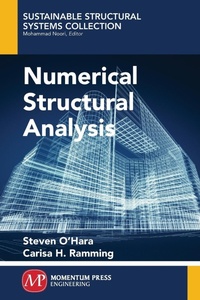
Numerical Structural Analysis
Published on 17. December 2014
Book
Paperback/Softback
277 pages
978-1-60650-488-8 (ISBN)
Description
As structural engineers move further into the age of digital computation and rely more heavily on computers to solve problems, it remains paramount that they understand the basic mathematics and engineering principles used to design and analyze building structures.
The link between the basic concepts and appliatcion to real world problems is one of the most challenging learning endeavors that structural engineers face. The primary purpose of this book is to assist structural engineering students with developing the ability to solve complex structural analysis problems.
It covers numerical techniques to solve mathematical formulations, which are necessary in developing the analysis procedures for structural engineering. Once the numerical formulations are understood, engineers can then develop structural analysis methods that use these techniques. This will be done primarily with matrix structural stiffness procedures. Finally, advanced stiffness topics will be developed and presented to solve unique structural problems, including member end releases, non-prismatic, shear, geometric, and torsional stiffness.
The link between the basic concepts and appliatcion to real world problems is one of the most challenging learning endeavors that structural engineers face. The primary purpose of this book is to assist structural engineering students with developing the ability to solve complex structural analysis problems.
It covers numerical techniques to solve mathematical formulations, which are necessary in developing the analysis procedures for structural engineering. Once the numerical formulations are understood, engineers can then develop structural analysis methods that use these techniques. This will be done primarily with matrix structural stiffness procedures. Finally, advanced stiffness topics will be developed and presented to solve unique structural problems, including member end releases, non-prismatic, shear, geometric, and torsional stiffness.
More details
Series
Language
English
Place of publication
Highland Park
United States
Target group
Professional and scholarly
Dimensions
Height: 229 mm
Width: 152 mm
Thickness: 16 mm
Weight
441 gr
ISBN-13
978-1-60650-488-8 (9781606504888)
Copyright in bibliographic data and cover images is held by Nielsen Book Services Limited or by the publishers or by their respective licensors: all rights reserved.
Schweitzer Classification
Persons
Stillwater, OK; Assistant Professor of Architectural Engineering and Licensed Engineer; Oklahoma State University School of Architecture