

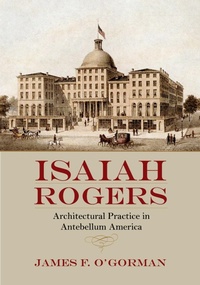
Isaiah Rogers
Architectural Practice in Antebellum America
Will be published approx. on 28. February 2015
Book
Paperback/Softback
366 pages
978-1-62534-122-8 (ISBN)
Description
When Isaiah Rogers died in 1869, the Cincinnati Daily Times noted that "in his profession he was, perhaps, better known than any other person in the country." Yet until now there has been no study that fully examines his remarkable, influential, and instructive career. Based largely on Rogers's own diary, this book tells his story and adds much to our understanding of architectural practice in the United States before the Civil War.
In 1944 the distinguished historian Talbot Hamlin wrote of New York's Merchant Exchange (1836-42) that the building had "been so grandly conceived, so simply and directly planned, and so beautifully detailed . . . [that] the whole was welded inextricably into one powerful organic conception that shows Rogers as a great architect in the fullest sense of the word." Rogers's Tremont House in Boston has been called the world's first modern hotel; it spawned many progeny, from his first Astor House in New York to his Burnet House in Cincinnati and beyond.
Rogers designed buildings from Maine to Georgia and from Boston to Chicago to New Orleans, supervising their construction while traveling widely to procure materials and workmen for the job. He finished his career as Architect of the Treasury Department during the Civil War. In this richly illustrated volume, James F. O'Gorman offers a deft portrait of an energetic practitioner at a key time in architectural history, the period before the founding of the American Institute of Architects in 1857.
In 1944 the distinguished historian Talbot Hamlin wrote of New York's Merchant Exchange (1836-42) that the building had "been so grandly conceived, so simply and directly planned, and so beautifully detailed . . . [that] the whole was welded inextricably into one powerful organic conception that shows Rogers as a great architect in the fullest sense of the word." Rogers's Tremont House in Boston has been called the world's first modern hotel; it spawned many progeny, from his first Astor House in New York to his Burnet House in Cincinnati and beyond.
Rogers designed buildings from Maine to Georgia and from Boston to Chicago to New Orleans, supervising their construction while traveling widely to procure materials and workmen for the job. He finished his career as Architect of the Treasury Department during the Civil War. In this richly illustrated volume, James F. O'Gorman offers a deft portrait of an energetic practitioner at a key time in architectural history, the period before the founding of the American Institute of Architects in 1857.
More details
Language
English
Place of publication
Massachusetts
United States
Product notice
Paperback (trade)
Unsewn / adhesive bound
Illustrations
86 illustrations
Dimensions
Height: 251 mm
Width: 175 mm
Thickness: 20 mm
Weight
635 gr
ISBN-13
978-1-62534-122-8 (9781625341228)
Copyright in bibliographic data and cover images is held by Nielsen Book Services Limited or by the publishers or by their respective licensors: all rights reserved.
Schweitzer Classification
Person
James F. O'Gorman is Grace Slack McNeil Professor Emeritus in the Wellesley College Department of Art and a widely acclaimed lecturer, historian, and author of numerous books, including Accomplished in All Departments of Art: Hammatt Billings of Boston, 1818-1874 (University of Massachusetts Press, 1998).