

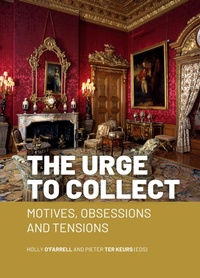
The Urge to Collect
Motives, Obsessions and Tensions
1st Edition
Published on 15. January 2024
Book
Hardback
106 pages
978-94-6426-231-5 (ISBN)
Description
Why do we collect? Where does the urge to collect come from? This book explores the phenomenon of collecting in various contexts. Collecting is an illustration of a strong human-thing entanglement. It can be caused by psychological incentives that are deeply rooted in human doubts and anxieties. It is also related to building a pleasant, unthreatening, and even paradisical, environment to compensate for the uncertainties of everyday life.The chapters in this book range from psychological perspectives in the Habsburg empire to Rococo collecting in France, from a fanatic English book collector to a 16th/17th century encyclopaedic Dutch collector. And finally the fascinating story of Baron Edmond de Rothschild's boxes.The contributions to this book were first presented as papers at the seminar "The Psychology of Collecting" in June 2022, organised by the Interdisciplinary Research Group "Museums, Collections and Society" of Leiden University, Netherlands.
More details
Edition
1. Auflage
Language
English
Place of publication
Leiden
Netherlands
Target group
Professional and scholarly
Illustrations
24fc
Dimensions
Height: 236 mm
Width: 170 mm
Thickness: 12 mm
Weight
437 gr
ISBN-13
978-94-6426-231-5 (9789464262315)
DOI
https://doi.org/10.59641/l02554ox
Copyright in bibliographic data and cover images is held by Nielsen Book Services Limited or by the publishers or by their respective licensors: all rights reserved.
Schweitzer Classification
Persons
Holly O'Farrell comes from a PhD at the University of Limerick, Ireland. The focus of her research as a PhD candidate has been to look at nineteenth and early twentieth century exhibitions of Middle Eastern culture and question how social constructs intersect and influence the production of and reaction to such displays. The work questions how constructs such as gender, race and class can be mechanisms for implying, creating or maintaining hierarchies and stereotypes about the Middle East in Western minds and the use of exhibitions in supporting the imperialist project.
O'Farrell's work with Museums, Collections and Society research group at Leiden University focuses on collectors and their collections during the late nineteenth and early twentieth centuries. She is currently working on collections in Leiden and hope to expand the project from there.
The project seeks to understand whether collections by women were independent and reflected their own choices or was there a male presence behind the bulk of the collections. In a similar manner, Holly analyses women's supporting role in expeditions, as companions and silent participants in the work of archaeologists, anthropologists and colonialists.
Working with Museums, Collections and Society, Holly O'Farrell's work focuses on women collectors during the nineteenth and twentieth centuries. This lecture is an introduction to this topic and to the idea of photography as a form of collecting which women took part in. A number of women's collections from the Museum of World Cultures will be explored as part of the lecture, as will some internationally famous collections. Ethnographic photographic collections have often been overlooked and it is important now to highlight their significance and contribution to museums, collections and knowledge. Pieter ter Keurs (1956) is professor of Museums, Collections and Society at the faculties of Archaeology and Humanities. Ter Keurs is also Academic Director of the LDE Centre for Global Heritage and Development. He specializes in critical museums studies and the study of material culture. He wants to stimulate the use of academic and museum collections in scholarly research and scientific eduation.
O'Farrell's work with Museums, Collections and Society research group at Leiden University focuses on collectors and their collections during the late nineteenth and early twentieth centuries. She is currently working on collections in Leiden and hope to expand the project from there.
The project seeks to understand whether collections by women were independent and reflected their own choices or was there a male presence behind the bulk of the collections. In a similar manner, Holly analyses women's supporting role in expeditions, as companions and silent participants in the work of archaeologists, anthropologists and colonialists.
Working with Museums, Collections and Society, Holly O'Farrell's work focuses on women collectors during the nineteenth and twentieth centuries. This lecture is an introduction to this topic and to the idea of photography as a form of collecting which women took part in. A number of women's collections from the Museum of World Cultures will be explored as part of the lecture, as will some internationally famous collections. Ethnographic photographic collections have often been overlooked and it is important now to highlight their significance and contribution to museums, collections and knowledge. Pieter ter Keurs (1956) is professor of Museums, Collections and Society at the faculties of Archaeology and Humanities. Ter Keurs is also Academic Director of the LDE Centre for Global Heritage and Development. He specializes in critical museums studies and the study of material culture. He wants to stimulate the use of academic and museum collections in scholarly research and scientific eduation.
Content
Foreword
The Urge to Collect: An Introduction
Pieter ter Keurs
What Drives the Collector? The Case of Rococo Collecting
Caroline van Eck
From Hegel to Freud. Imperial Museums and the Rise of Psychology in the History of Culture, between Triumphalism and Criticism
Pascal Griener
Tulips, Rabies and Books
Cécilia Hurley-Griener
How to Form a Wunderkammer in 1600? The Encyclopedic Collection of Bernardus Paludanus (1550-1633)
Marika Keblusek
Storing and Staging: Baron Edmond's Boxes
Juliet Carey
The Urge to Collect: An Introduction
Pieter ter Keurs
What Drives the Collector? The Case of Rococo Collecting
Caroline van Eck
From Hegel to Freud. Imperial Museums and the Rise of Psychology in the History of Culture, between Triumphalism and Criticism
Pascal Griener
Tulips, Rabies and Books
Cécilia Hurley-Griener
How to Form a Wunderkammer in 1600? The Encyclopedic Collection of Bernardus Paludanus (1550-1633)
Marika Keblusek
Storing and Staging: Baron Edmond's Boxes
Juliet Carey