

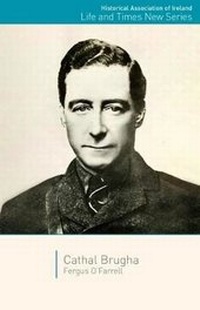
Cathal Brugha
Published on 9. September 2018
Book
Paperback/Softback
96 pages
978-1-910820-27-8 (ISBN)
Description
Cathal Brugha was a figure of central importance to the Irish Revolution. Active in the Gaelic League, GAA, IRB, and Irish Volunteers, he first rose to public prominence when he led an advanced column of Volunteers in the Howth gun-running of July 1914. He went on to hold important leadership positions during the 1916 Rising, in the Irish Volunteers and in Dail cabinets until his death in July 1922. Despite this, he is almost totally neglected in the history of this period. This is the first dedicated English-language biography to focus on this fascinating figure.
Using new archival material from the Bureau of Military History, Fergus O'Farrell documents Brugha's career as a revolutionary. This closely-researched work examines Brugha's complex attitudes to violence as well as illuminating his commitment to political methods. Historians have previously stressed Brugha's commitment to militancy over politics and he has been portrayed as a strong advocate of violence and distrustful of politics. This simplistic outlook is here challenged, showing that Brugha sought to marry force with politics in the pursuit of Irish independence.
Using new archival material from the Bureau of Military History, Fergus O'Farrell documents Brugha's career as a revolutionary. This closely-researched work examines Brugha's complex attitudes to violence as well as illuminating his commitment to political methods. Historians have previously stressed Brugha's commitment to militancy over politics and he has been portrayed as a strong advocate of violence and distrustful of politics. This simplistic outlook is here challenged, showing that Brugha sought to marry force with politics in the pursuit of Irish independence.
Reviews / Votes
'What emerges is Brugha's complex attitudes towards violence. He was willing to lead a suicidal mission into the House of Commons to assassinate the people who he saw as directly responsible for the violence in Ireland. However, he removed names from Michael Collins' list of spies who were to be executed by the squad on what became known as Bloody Sunday.'; Fergus O'Farrell in the Irish Times.;'If you wiped out every Black and Tan in Ireland tomorrow, you'd have shiploads of them pouring in again, the day after. And if you wiped every soul of them out, double as many shiploads would come in, the day after that... To save Ireland, you have got to wipe out the guilty ones who sent the Black and Tans here. We have got to wipe out every member of the British Cabinet.';Fergus O'Farrell writing about one of Cathal Brugha's elaborate plans to wipe out the British cabinet.; 'Richard Mulcahy, in particular, has attempted to abjure his role in the mission. There are several reasons for this. Following the revolution, Mulcahy had a long career in politics with Cumman na nGeadheal and later Fine Gael, often viewed as the parties of law and order.';Fergus O'Farrell writing in The Irish Story;More details
Series
Language
English
Place of publication
Ireland
Dimensions
Height: 185 mm
Width: 120 mm
ISBN-13
978-1-910820-27-8 (9781910820278)
Copyright in bibliographic data and cover images is held by Nielsen Book Services Limited or by the publishers or by their respective licensors: all rights reserved.
Schweitzer Classification
Other editions
Additional editions
Person
Fergus O'Farrell has a BA and MA from UCD. His writing has appeared in The Irish Times, the London School of Economics Review of Books and History Ireland. He lives in London.