

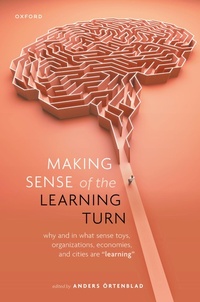
Making Sense of the Learning Turn
Why and In What Sense Toys, Organizations, Economies, and Cities are "Learning"
Published on 6. June 2024
Book
Hardback
480 pages
978-0-19-286597-7 (ISBN)
Description
From "learning toy" and "learning society" to "learning city" and "learning organization", what is meant by "learning"?
The main focus of this volume is to increase our understanding of the "learning turn" referring, in this book, to the frequent occurrence and usage of terms in the last few decades where the word "learning" is the premodifier. The authors also offer insights into the use of the word "learning" as a premodifier in the future and discuss what, if anything, may replace it, such as "knowledge" (as in "knowledge management") and "smart" (as in "smart city").
An extensive range of academic disciplines are covered including political science, economics, human geography, philosophy, linguistics, higher education, working life science, management and organization, and marketing.
While a single, overall, unified conclusion is not provided, Making Sense of the Learning Turn presents a variety of voices and perspectives. Some contributors are critical towards the learning turn, explaining it in terms of fashion-following, manipulation, and seduction. Others interpret the learning turn more lightly or suggest a more collective form of learning as an alternative to the individualization of learning that some authors argue has been the case thus far.
The main focus of this volume is to increase our understanding of the "learning turn" referring, in this book, to the frequent occurrence and usage of terms in the last few decades where the word "learning" is the premodifier. The authors also offer insights into the use of the word "learning" as a premodifier in the future and discuss what, if anything, may replace it, such as "knowledge" (as in "knowledge management") and "smart" (as in "smart city").
An extensive range of academic disciplines are covered including political science, economics, human geography, philosophy, linguistics, higher education, working life science, management and organization, and marketing.
While a single, overall, unified conclusion is not provided, Making Sense of the Learning Turn presents a variety of voices and perspectives. Some contributors are critical towards the learning turn, explaining it in terms of fashion-following, manipulation, and seduction. Others interpret the learning turn more lightly or suggest a more collective form of learning as an alternative to the individualization of learning that some authors argue has been the case thus far.
Reviews / Votes
Making Sense of the Learning Turn is not an easy feat. OErtenblad and the other twenty authors bravely tackle this quest addressing the significance, value, and consequences of the "learnification". They chart and critically assess its turn-of-century heyday, minutiously examining and interrogating "learning" as a premodifier of such things as cities, regions, communities, toys, groups, and organizations while also tracing and heeding a warning on the emerging new words replacing it. The multidisciplinary breadth, critical depth, and clarity of this book are impressive making it a "go-to" reference for anyone interested in understanding the terms of "learning". * Alessia Contu, Professor of Management, College of Management, University of Massachusetts, Boston * Insofar as data, information and knowledge have become the engines of growth in late modern societies, learning is their necessary corollary (another is "open"). Yet, strangely, for all its proliferation, we have not had systematic interdisciplinary treatments of learning across time, fields, and contexts. Now, thanks to this wonderful volume we do. Anders OErtenblad, not for the first time, has masterfully brought together several authors who provide highly illuminating analyses of "learning" as a premodifier. Their insights significantly enhance our learning about learning. This is a brilliant volume that I anticipate to make an impact. * Haridimos Tsoukas, University of Cyprus & University of Warwick * This is an extraordinary book. Its scholarship is of the highest standards throughout, it is edited wisely to provide a coherent publication, and it is exciting, informative, original, and important in equal measure. This book opens the window of assumption, a clearing, where the essence of learning is explored, clarified, and advocated. It confronts much of the appropriation of learning as a premodifier to support other ideas rendered weak without it. The book awakens us to this and other related issues and in so doing should be welcomed and read, many times! * Paul Gibbs, Emeritus Professor of Higher Education, Middlesex University *More details
Language
English
Place of publication
Oxford
United Kingdom
Target group
Professional and scholarly
Product notice
sewn/stitched
Cloth over boards
Dimensions
Height: 224 mm
Width: 163 mm
Thickness: 48 mm
Weight
885 gr
ISBN-13
978-0-19-286597-7 (9780192865977)
Copyright in bibliographic data and cover images is held by Nielsen Book Services Limited or by the publishers or by their respective licensors: all rights reserved.
Schweitzer Classification
Other editions
Additional editions
Anders Örtenblad
Making Sense of the Learning Turn
Why and In What Sense Toys, Organizations, Economies, and Cities are "Learning"
E-Book
07/2024
1st Edition
OUP eBook
€143.99
Available for download
Anders Örtenblad
Making Sense of the Learning Turn
Why and In What Sense Toys, Organizations, Economies, and Cities are "Learning"
E-Book
05/2024
1st Edition
OUP eBook
€143.99
Available for download
Person
Anders OErtenblad is Professor of Working Life Science at the University of Agder, Norway. With his keen interest in learning and education, as both phenomena and concepts, he has extensively researched and authored on the idea of the learning organization, organizational learning, and management education. He has edited numerous books and journals, including The Oxford Handbook of the Learning Organization (OUP, 2019) and The Oxford Handbook of Metaphor in Organization Studies (OUP, 2024). He is a keen advocate of research as open, academic debate.
Content
Norman Longworth: Foreword
List of Contributors
PART I. THE LEARNING TURN: A BACKGROUND AND INTRODUCTION
1: Anders OErtenblad: Toward an Increased Understanding of the Learning Turn: Background and Introduction
2: Anders OErtenblad: On the Usage of the Premodifier Learning Among Scholars and Practitioners
3: Bertus van Rooy: Linguistic Modifiers and the Construction of Concept Meaning
PART II. REFLECTING ON LEARNING AND ITS USE AS A PREMODIFIER
4: Marianna Papastephanou: Learnification, Premodifiers and Learning(s)
5: Anke Redecker: Recognition in a Learning World - Topics of Global Education
6: Malcolm Tight: Learning Your Place
7: Leonard Holmes: What is Learning that an Organization (or Anything Else) Can Do It?
8: Rob F. Poell: Is Learning Viewed as a Synonym of Training?
PART III. EXAMINING SINGLE TERMS IN WHICH LEARNING IS THE PREMODIFIER
9: Tyson E. Lewis: "Learning Toys" as Education through Commodification
10: Norman V. Jackson: The Impossibility of the Learning Organization
11: Max Visser: Learning Climate
12: John A. Cotsomitis: The Learning Economy: What do we Mean by the Modifier Learning?
13: Frederik Hertel and Michelle Wicmandy: The Global Learning Economy
14: Hans Chr. Garmann Johnsen and Jon P. Knudsen: Can Regions Learn?
15: Bertus van Rooy and Roosmarijn Rentier: The Meanings of "Learning Organization" from the Perspective of Usage
PART IV. EXAMINING MULTIPLE TERMS IN WHICH LEARNING IS THE PREMODIFIER
16: Michael Reynolds and Russ Vince: Being Alone Together: A Critical Exploration of Learning in "Learning Group" and "Learning Community"
17: Philip Cooke: "Fortune Favors the Prepared Mind": Learning Knowledge without Experience is Not so Smart
18: Anders OErtenblad: Comparing Two Similar Terms in which Learning is the Premodifier: A Study of Seven Term Couples
19: Anders OErtenblad: Belonging and Being Unique: The Dual Function of the Learning Premodifier
PART V. BEYOND LEARNING: ON ITS WAY TOWARD BEING REPLACED BY OTHER COGNITION-ORIENTED PREMODIFIERS SUCH AS KNOWLEDGE AND SMART
20: Marianna Papastephanou: Interpreting the Decline in the Common Use of the Learning Premodifier
21: Anders OErtenblad: Learning City, Knowledge City, Smart City: Three Mountains in the Same Range
Ken Spours: Afterword: Reflections on the Learning Premodifier and the Learning Turn
List of Contributors
PART I. THE LEARNING TURN: A BACKGROUND AND INTRODUCTION
1: Anders OErtenblad: Toward an Increased Understanding of the Learning Turn: Background and Introduction
2: Anders OErtenblad: On the Usage of the Premodifier Learning Among Scholars and Practitioners
3: Bertus van Rooy: Linguistic Modifiers and the Construction of Concept Meaning
PART II. REFLECTING ON LEARNING AND ITS USE AS A PREMODIFIER
4: Marianna Papastephanou: Learnification, Premodifiers and Learning(s)
5: Anke Redecker: Recognition in a Learning World - Topics of Global Education
6: Malcolm Tight: Learning Your Place
7: Leonard Holmes: What is Learning that an Organization (or Anything Else) Can Do It?
8: Rob F. Poell: Is Learning Viewed as a Synonym of Training?
PART III. EXAMINING SINGLE TERMS IN WHICH LEARNING IS THE PREMODIFIER
9: Tyson E. Lewis: "Learning Toys" as Education through Commodification
10: Norman V. Jackson: The Impossibility of the Learning Organization
11: Max Visser: Learning Climate
12: John A. Cotsomitis: The Learning Economy: What do we Mean by the Modifier Learning?
13: Frederik Hertel and Michelle Wicmandy: The Global Learning Economy
14: Hans Chr. Garmann Johnsen and Jon P. Knudsen: Can Regions Learn?
15: Bertus van Rooy and Roosmarijn Rentier: The Meanings of "Learning Organization" from the Perspective of Usage
PART IV. EXAMINING MULTIPLE TERMS IN WHICH LEARNING IS THE PREMODIFIER
16: Michael Reynolds and Russ Vince: Being Alone Together: A Critical Exploration of Learning in "Learning Group" and "Learning Community"
17: Philip Cooke: "Fortune Favors the Prepared Mind": Learning Knowledge without Experience is Not so Smart
18: Anders OErtenblad: Comparing Two Similar Terms in which Learning is the Premodifier: A Study of Seven Term Couples
19: Anders OErtenblad: Belonging and Being Unique: The Dual Function of the Learning Premodifier
PART V. BEYOND LEARNING: ON ITS WAY TOWARD BEING REPLACED BY OTHER COGNITION-ORIENTED PREMODIFIERS SUCH AS KNOWLEDGE AND SMART
20: Marianna Papastephanou: Interpreting the Decline in the Common Use of the Learning Premodifier
21: Anders OErtenblad: Learning City, Knowledge City, Smart City: Three Mountains in the Same Range
Ken Spours: Afterword: Reflections on the Learning Premodifier and the Learning Turn