

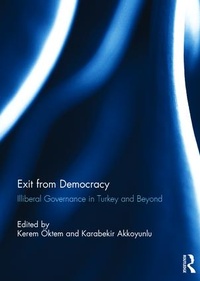
Exit from Democracy
Illiberal Governance in Turkey and Beyond
1st Edition
Published on 28. November 2017
Book
Hardback
232 pages
978-1-138-50400-4 (ISBN)
Description
Democratic government is facing unprecedented challenges at a global scale. Yet, Turkey's descent into conflict, crisis and autocracy is exceptional. Only a few years ago, the country was praised as a successful Muslim-majority democracy and a promising example of sustainable growth. In Turkey's Exit from Democracy, the contributors argue that President Recep Tayyip Erdogan and the Justice and Development Party government have now effectively abandoned the realm of democratic politics by attempting regime change with the aim to install a hyper-presidentialist system. Examining how this power grab comes at the tail end of more than a decade of seemingly democratic politics, the contributors also explore the mechanisms of de-democratization through two distinctive, but interrelated angles: A set of comparative analyses explores illiberal forms of governance in Turkey, Russia, Southeast Europe and Latin America. In-depth studies analyse how Turkey's society has been reshaped in the image of a patriarchal habitus and how consent has been fabricated through religious, educational, ethnic and civil society policies. Despite this comprehensive authoritarian shift, the result is not authoritarian consolidation, but a deeply divided and contested polity. Analysing an early example of democratic decline and authoritarian politics, this volume is relevant well beyond the confines of regional studies. Turkey exemplifies the larger forces of de-democratization at play globally. Turkey's Exit from Democracy provides the reader with generalizable insights into these transformative processes. These chapters were originally published as a special issue in Southeast European and Black Sea Studies.
More details
Language
English
Place of publication
London
United Kingdom
Publishing group
Taylor & Francis Ltd
Target group
College/higher education
Dimensions
Height: 246 mm
Width: 174 mm
Weight
453 gr
ISBN-13
978-1-138-50400-4 (9781138504004)
Copyright in bibliographic data and cover images is held by Nielsen Book Services Limited or by the publishers or by their respective licensors: all rights reserved.
Schweitzer Classification
Other editions
Additional editions
Book
12/2019
1st Edition
Routledge
€52.07
Shipment within 15-20 days
E-Book
12/2018
1st Edition
Routledge
€59.49
Available for download
E-Book
12/2018
1st Edition
Routledge
€59.49
Available for download
Persons
Kerem OEktem is Professor of Southeast European Studies and Modern Turkey at the Centre for Southeast European Studies, University of Graz.
Karabekir Akkoyunlu is Assistant Professor of Modern Turkey at the Centre for Southeast European Studies, University of Graz.
Karabekir Akkoyunlu is Assistant Professor of Modern Turkey at the Centre for Southeast European Studies, University of Graz.
Content
Introduction: Turkey's Exit from Democracy Kerem OEktem, Karabekir Akkoyunlu Making Sense of Turkey's Transition 1. Understanding Turkey's democratic breakdown: old vs. new and indigenous vs. global authoritarianism Murat Somer 2. Existential insecurity and the making of a weak authoritarian regime in Turkey
Karabekir Akkoyunlu, Kerem OEktem Illiberal governance in comparative perspective 3. Decoding the authoritarian code: exercising 'legitimate' power politics through ruling parties in Turkey, Macedonia and Serbia Cengiz Guenay and Vedran Dzihic 4. Examining state capacity in the context of electoral authoritarianism, regime formation and consolidation in Russia and Turkey David White and Marc Herzog 5. Strong presidents and weak institutions: populism in Turkey, Venezuela and Ecuador Orcun Selcuk Hegemonic struggles: Manufacturing consent and discontent 6. Populism as the problem child of democracy: the AKP's enduring appeal and the use of meso-level actors Bilge Yabanci 7. Turkey's Diyanet under AKP rule: from protector to imposer of state ideology?
Ahmet Erdi OEztuerk 8. Creating a pious generation: youth and education policies of the AKP in Turkey Demet Luekueslue 9. Conflict and reconciliation between Turks and Kurds: the HDP as an agonistic actor OEmer Tekdemir 10. The ambiguities of democratic autonomy: the Kurdish movement in Turkey and Rojava Michiel Leezenberg
Karabekir Akkoyunlu, Kerem OEktem Illiberal governance in comparative perspective 3. Decoding the authoritarian code: exercising 'legitimate' power politics through ruling parties in Turkey, Macedonia and Serbia Cengiz Guenay and Vedran Dzihic 4. Examining state capacity in the context of electoral authoritarianism, regime formation and consolidation in Russia and Turkey David White and Marc Herzog 5. Strong presidents and weak institutions: populism in Turkey, Venezuela and Ecuador Orcun Selcuk Hegemonic struggles: Manufacturing consent and discontent 6. Populism as the problem child of democracy: the AKP's enduring appeal and the use of meso-level actors Bilge Yabanci 7. Turkey's Diyanet under AKP rule: from protector to imposer of state ideology?
Ahmet Erdi OEztuerk 8. Creating a pious generation: youth and education policies of the AKP in Turkey Demet Luekueslue 9. Conflict and reconciliation between Turks and Kurds: the HDP as an agonistic actor OEmer Tekdemir 10. The ambiguities of democratic autonomy: the Kurdish movement in Turkey and Rojava Michiel Leezenberg