

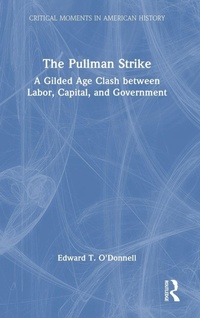
The Pullman Strike
A Gilded Age Clash between Labor, Capital, and Government
1st Edition
Published on 3. October 2024
Book
Hardback
216 pages
978-1-032-48391-7 (ISBN)
Description
This book examines the 1894 Pullman Strike, one of the most consequential clashes between labor and capital that paralyzed America's railroad system.
The Gilded Age saw rapid economic growth, expansion of industrialization, and real wage growth. Yet between 1800 and 1900 there were nearly 37,000 strikes, and the Pullman Strike reflected the broad dissatisfaction and unrest among American workers. The book consists of an engaging narrative, analysis of existing scholarship, sidebars, and primary source documents which collectively answer why the Pullman Strike is so critical to the American Experience: it exposed the limits of paternalistic capitalism, revealed the extraordinary power of big business, introduced the use of injunctions to stop strikes, and launched the career of the iconic labor leader Eugene Debs. Overall, it reveals what struggles workers encountered when forming unions, the changing role of government regarding the economy, and the threat that unchecked big business posed to democracy.
The Pullman Strike is useful for all undergraduate students who study the Gilded Age, industrial relations, and labor, urban, and economic history in the United States.
The Gilded Age saw rapid economic growth, expansion of industrialization, and real wage growth. Yet between 1800 and 1900 there were nearly 37,000 strikes, and the Pullman Strike reflected the broad dissatisfaction and unrest among American workers. The book consists of an engaging narrative, analysis of existing scholarship, sidebars, and primary source documents which collectively answer why the Pullman Strike is so critical to the American Experience: it exposed the limits of paternalistic capitalism, revealed the extraordinary power of big business, introduced the use of injunctions to stop strikes, and launched the career of the iconic labor leader Eugene Debs. Overall, it reveals what struggles workers encountered when forming unions, the changing role of government regarding the economy, and the threat that unchecked big business posed to democracy.
The Pullman Strike is useful for all undergraduate students who study the Gilded Age, industrial relations, and labor, urban, and economic history in the United States.
More details
Series
Language
English
Place of publication
London
United Kingdom
Publishing group
Taylor & Francis Ltd
Target group
College/higher education
Undergraduate Advanced and Undergraduate Core
Illustrations
1 s/w Tabelle, 7 s/w Abbildungen, 7 s/w Photographien bzw. Rasterbilder
1 Tables, black and white; 7 Halftones, black and white; 7 Illustrations, black and white
Dimensions
Height: 235 mm
Width: 157 mm
Thickness: 17 mm
Weight
485 gr
ISBN-13
978-1-032-48391-7 (9781032483917)
Copyright in bibliographic data and cover images is held by Nielsen Book Services Limited or by the publishers or by their respective licensors: all rights reserved.
Schweitzer Classification
Other editions
Additional editions
E-Book
10/2024
1st Edition
Routledge
€55.49
Available for download
Book
10/2024
1st Edition
Routledge
€63.20
Shipment within 10-20 days
E-Book
10/2024
1st Edition
Routledge
€55.49
Available for download
Person
Edward T. O'Donnell is an associate professor of history in the history department at the College of the Holy Cross in Worcester, MA, USA. He is the author of several books including Henry George and the Crisis of Inequality: Progress and Poverty in the Gilded Age (2015) and Ship Ablaze: The Tragedy of the Steamboat General Slocum (2003), and is co-author of Visions of America: A History of the United States (3rd ed. 2016). His scholarly articles have appeared in The Public Historian, Journal of Urban History, and the Journal of the Gilded Age and Progressive Era.
Content
Introduction 1. The Stupendous Results of American Enterprise 2. Millions Born to Suffering and Poverty 3. Striking to Avert Slavery and Degradation 4. To Battle Such an Extended Evil 5. Rioters Will Be Fired Upon 6. The Strong Arm of the National Government 7. Epilogue