

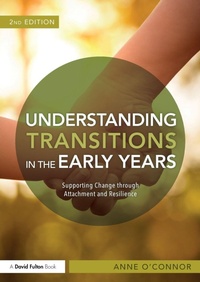
Understanding Transitions in the Early Years
Supporting Change through Attachment and Resilience
2nd Edition
Published on 19. October 2017
Book
Paperback/Softback
166 pages
978-1-138-67814-9 (ISBN)
Description
There are many transitions that children experience before they are five, including the first major transition from home to an early years setting. Successive changes can have a serious impact on young children and stress, separation and insecure attachments can affect not only a child's emotional health but also cognitive and intellectual development.
Featuring new material on provision for two year olds, school readiness, and families and transitions, this thought-provoking text explains why transitions matter and provides practical guidance on how to support young children's developing emotional resilience and equip them to embrace change in the future. Aimed at practitioners and students, this fully-updated second edition:
draws together evidence from neuroscience, attachment theory, child development and childcare practices;
provides a context for practitioners to empathise with children and families as they relate to their own understanding of the impact of change and transition;
looks at ways to reduce the number of transitions including the key person approach, and;
offers guidance and practical strategies for practitioners, managers and head teachers for supporting children through transitions.
Including case studies, examples of good practice and questions for reflection, Understanding Transitions in the Early Years emphasises the little things that practitioners can do for the individual children in their care, helping them to feel secure and confident when dealing with change.
Featuring new material on provision for two year olds, school readiness, and families and transitions, this thought-provoking text explains why transitions matter and provides practical guidance on how to support young children's developing emotional resilience and equip them to embrace change in the future. Aimed at practitioners and students, this fully-updated second edition:
draws together evidence from neuroscience, attachment theory, child development and childcare practices;
provides a context for practitioners to empathise with children and families as they relate to their own understanding of the impact of change and transition;
looks at ways to reduce the number of transitions including the key person approach, and;
offers guidance and practical strategies for practitioners, managers and head teachers for supporting children through transitions.
Including case studies, examples of good practice and questions for reflection, Understanding Transitions in the Early Years emphasises the little things that practitioners can do for the individual children in their care, helping them to feel secure and confident when dealing with change.
Reviews / Votes
Jan Marks, University of Chester, UK The issue of transitions is a key area in the Early Years sector, as such is always considered to be a current issue. This is a worthwhile and useful book, examining the areas of transition in a way that students and practitioners can understand. It has a wealth of information within it and I think that it would be useful to keep it current.Margaret Edgington, Early Years Consultant, UK It is a very useful and important book on a topic that is often skimmed over on training courses. Anne O'Connor is well known for her writing in Nursery World and for her training and consultancy - she is known to be an excellent practitioner and this will make her book attractive to many prospective readers. I also think her book should be marketed to those in the health and social work professions. Yes [to publish], this is an important book.
Lyn Trodd, University of Hertfordshire, UK I liked the approach and tone of it. It is down to earth and practical, entirely readable and seeks to communicate with the reader rather than confuse them. A particular strength is the seamless integration of practice with theory. It feels very natural for the reader to move between and link examples of practice and theories. It is an excellent introduction to the topic of Transitions.
More details
Edition
2nd edition
Language
English
Place of publication
London
United Kingdom
Publishing group
Taylor & Francis Ltd
Target group
College/higher education
Professional and scholarly
Postgraduate, Professional, Professional Practice & Development, and Undergraduate
Illustrations
11 s/w Abbildungen, 7 s/w Photographien bzw. Rasterbilder, 4 s/w Zeichnungen, 1 s/w Tabelle
1 Tables, black and white; 4 Line drawings, black and white; 7 Halftones, black and white; 11 Illustrations, black and white
Dimensions
Height: 246 mm
Width: 174 mm
Thickness: 10 mm
Weight
339 gr
ISBN-13
978-1-138-67814-9 (9781138678149)
Copyright in bibliographic data and cover images is held by Nielsen Book Services Limited or by the publishers or by their respective licensors: all rights reserved.
Schweitzer Classification
Other editions
Additional editions

Anne O'Connor
Understanding Transitions in the Early Years
Supporting Change through Attachment and Resilience
Book
10/2017
2nd Edition
Routledge
€193.13
Shipment within 10-20 days
Anne O'Connor
Understanding Transitions in the Early Years
Supporting Change through Attachment and Resilience
E-Book
10/2017
2nd Edition
Routledge
€32.99
Available for download
Anne O'Connor
Understanding Transitions in the Early Years
Supporting Change through Attachment and Resilience
E-Book
10/2017
2nd Edition
Routledge
€32.99
Available for download
Previous edition
Anne O'Connor
Understanding Transitions in the Early Years
Supporting Change through Attachment and Resilience
Book
10/2012
1st Edition
Routledge
€50.94
Article exhausted; check for reprint
Person
Anne O'Connor is an Early Years Consultant, UK. She has authored numerous articles for Nursery World including 'All About Transitions' which was included in the resource materials for the Early Years Foundation Stage (EYFS 2008).
Content
Dedication
Acknowledgements
Introduction
1. Attachment theory and transitions
2. Brain development and the impact of transitions
3. A 'Patchwork of Services' - why do young children experience so many transitions?
4. Reflecting on our own experience of transition
5. Strategies for reducing transitions in the early years
6. Strategies to support children's well-being during transition
Conclusion
References and Further Reading
Index
Acknowledgements
Introduction
1. Attachment theory and transitions
2. Brain development and the impact of transitions
3. A 'Patchwork of Services' - why do young children experience so many transitions?
4. Reflecting on our own experience of transition
5. Strategies for reducing transitions in the early years
6. Strategies to support children's well-being during transition
Conclusion
References and Further Reading
Index