

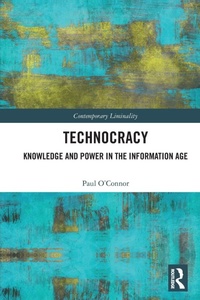
Technocracy
Knowledge and Power in the Information Age
1st Edition
Will be published approx. on 16. March 2026
Book
Paperback/Softback
234 pages
978-1-032-56162-2 (ISBN)
Description
In what is routinely described as a 'knowledge society', this book argues that contemporary knowledge is systematically filtered and distorted by the requirements of the bureaucratic-managerial organisations that constitute the structural core of hypermodernity. As knowledge becomes increasingly politicised, almost every 'fact' with which we are presented serves an agenda.
This book traces the historical and conceptual foundations of 'governmental knowledge'. It examines how problematisation, mediation, informationalisation, and substitution translate human life into abstract representations that can be managed, manipulated, and retrojected back onto social reality. The proliferation of experts and managerial intermediaries institutionalises these processes across domains as diverse as public health, education, corporate management, and everyday digital interactions. It argues that, far from being neutral, expert knowledge instrumentalises liminality and subordinates social life and individual conduct to the algorithmic logic of managerialism. Technocracy thus systematically filters out the dimensions of meaning, participation, and embodied existence, constructing a 'second reality' that blinds us to whole ranges of human experience.
A compelling study of the politics of knowledge, Technocracy: Knowledge and Power in the Information Age sheds light on the way a certain type of knowledge is used to lay claim to authority, status and resources, and how the endless expansion of such knowledge reshapes society. It will therefore appeal to scholars of sociology, anthropology and social theory with interests in the sociology of knowledge.
This book traces the historical and conceptual foundations of 'governmental knowledge'. It examines how problematisation, mediation, informationalisation, and substitution translate human life into abstract representations that can be managed, manipulated, and retrojected back onto social reality. The proliferation of experts and managerial intermediaries institutionalises these processes across domains as diverse as public health, education, corporate management, and everyday digital interactions. It argues that, far from being neutral, expert knowledge instrumentalises liminality and subordinates social life and individual conduct to the algorithmic logic of managerialism. Technocracy thus systematically filters out the dimensions of meaning, participation, and embodied existence, constructing a 'second reality' that blinds us to whole ranges of human experience.
A compelling study of the politics of knowledge, Technocracy: Knowledge and Power in the Information Age sheds light on the way a certain type of knowledge is used to lay claim to authority, status and resources, and how the endless expansion of such knowledge reshapes society. It will therefore appeal to scholars of sociology, anthropology and social theory with interests in the sociology of knowledge.
More details
Series
Language
English
Place of publication
London
United Kingdom
Publishing group
Taylor & Francis Ltd
Target group
College/higher education
Postgraduate and Undergraduate
Dimensions
Height: 234 mm
Width: 156 mm
Thickness: 12 mm
Weight
342 gr
ISBN-13
978-1-032-56162-2 (9781032561622)
Copyright in bibliographic data and cover images is held by Nielsen Book Services Limited or by the publishers or by their respective licensors: all rights reserved.
Schweitzer Classification
Other editions
Additional editions
E-Book
03/2026
Routledge
€55.49
Available for download
E-Book
03/2026
Routledge
€55.49
Available for download
Book
approx. 03/2026
1st Edition
Routledge
€213.60
Not yet published
Person
Paul O'Connor is Associate Professor of Sociology at United Arab Emirates University in Abu Dhabi. He is the author of Home: The Foundations of Belonging and the co-editor of The Technologisation of the Social: A Political Anthropology of the Digital Machine, Liminal Politics in the New Age of Disease: Technocratic Mimetism, and the Elgar Encyclopedia of Political Anthropology.
Content
Introduction 1. The Codetermination of Knowledge and Social Organisation 2. The Growth of Formal Organisation 3. The Ascendance of Technique 4. Managerial Subjectification and Knowledge 5. Detachment and Instrumentalism 6. Problematisation and Parasitism 7. Informationalisation 8. Domains of Equivalence 9. Quasi-Objects and their Institutionalisations Conclusion: Beyond the Second Reality