

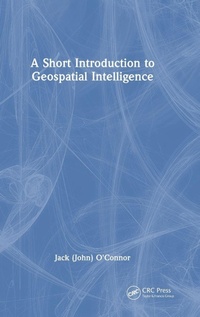
A Short Introduction to Geospatial Intelligence
1st Edition
Published on 27. October 2023
Book
Hardback
172 pages
978-1-032-56699-3 (ISBN)
Description
A Short Introduction to Geospatial Intelligence explains the newest form of intelligence used by governments, commercial organizations, and individuals. Geospatial intelligence combines late 20th century historically derived ways of thinking and early 21st century technologies of GIS, GPS, digital imaging satellites and communications satellites to identify, measure, and analyze the current risk in the world.
These ways of thinking have developed from military engineering, cartography, photointerpretation, and imagery analysis. While the oldest example dates back to the early 16th century, all the ways of spatial thinking share the common thread of being developed and refined during conflicts to help military leaders make informed decisions prior to action. In the 21st century- thanks in great part to advances in digital precision technology, miniaturization, and the commercialization of satellites- these ways of thinking have expanded from the military into various other industries and sectors including energy, agriculture, environment, law enforcement, global risk assessment, and climate monitoring.
Features:
Analyzes human and algorithmic models for dealing with the challenge of analytic attention, in an age of geospatial data overload
Establishes an original model- envisioning, discovery, recording, comprehending, and tracking- for the spatial thinking that underpins the practice and growth of this emerging discipline
Addresses the effects of small satellites on the collection and analysis of geospatial intelligence
A Short Introduction to Geospatial Intelligence describes the development of the five steps in geospatial thinking- envisioning, discovery, recording, comprehending, and tracking- in addition to addressing the challenges, and future applications, of this newest intelligence discipline.
These ways of thinking have developed from military engineering, cartography, photointerpretation, and imagery analysis. While the oldest example dates back to the early 16th century, all the ways of spatial thinking share the common thread of being developed and refined during conflicts to help military leaders make informed decisions prior to action. In the 21st century- thanks in great part to advances in digital precision technology, miniaturization, and the commercialization of satellites- these ways of thinking have expanded from the military into various other industries and sectors including energy, agriculture, environment, law enforcement, global risk assessment, and climate monitoring.
Features:
Analyzes human and algorithmic models for dealing with the challenge of analytic attention, in an age of geospatial data overload
Establishes an original model- envisioning, discovery, recording, comprehending, and tracking- for the spatial thinking that underpins the practice and growth of this emerging discipline
Addresses the effects of small satellites on the collection and analysis of geospatial intelligence
A Short Introduction to Geospatial Intelligence describes the development of the five steps in geospatial thinking- envisioning, discovery, recording, comprehending, and tracking- in addition to addressing the challenges, and future applications, of this newest intelligence discipline.
More details
Language
English
Place of publication
London
United Kingdom
Publishing group
Taylor & Francis Ltd
Target group
College/higher education
Professional and scholarly
Postgraduate and Professional Reference
Illustrations
14 s/w Abbildungen, 13 s/w Photographien bzw. Rasterbilder, 1 s/w Zeichnung
1 Line drawings, black and white; 13 Halftones, black and white; 14 Illustrations, black and white
Dimensions
Height: 240 mm
Width: 161 mm
Thickness: 15 mm
Weight
452 gr
ISBN-13
978-1-032-56699-3 (9781032566993)
Copyright in bibliographic data and cover images is held by Nielsen Book Services Limited or by the publishers or by their respective licensors: all rights reserved.
Schweitzer Classification
Other editions
Additional editions
Jack O'Connor
A Short Introduction to Geospatial Intelligence
E-Book
10/2023
1st Edition
CRC Press
€60.49
Available for download
Jack O'Connor
A Short Introduction to Geospatial Intelligence
E-Book
10/2023
1st Edition
CRC Press
€60.49
Available for download
Jack O'Connor
A Short Introduction to Geospatial Intelligence
Book
10/2023
1st Edition
CRC Press
€67.80
Shipment within 10-20 days
Person
Jack (John) O'Connor has directed the Master of Science in Geospatial Intelligence at Johns Hopkins University since 2018. For over 30 years, in the Central Intelligence Agency (CIA) and Department of Defense (DoD) organizations, he led imagery and geospatial analysis in combat support, national intelligence, diplomatic initiatives, and disaster support, as well as regional, environmental, economic, and social analysis. He has received numerous government awards, including the Intelligence Community's Galileo Award and the National Intelligence Medal of Achievement. O'Connor holds a Master of Arts from Bryn Mawr College, an Bachelor of Arts from St. Joseph's University, and an Associate of Arts from Delaware County Community College. He is a member of the US Geospatial- Intelligence Foundation and the Medmenham Association.
Content
1: The Genome of GEOINT 2: Envisioning 3: Discovery 4: Recording 5: Comprehending 6: Tracking 7: Contemporary Geospatial Intelligence 8: Future Issues for GEOINT