

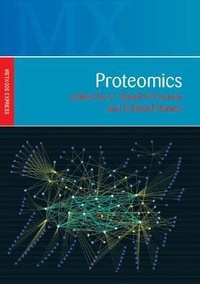
Proteomics
Methods Express
Will be published approx. on 1. November 2007
Book
Hardback
300 pages
978-1-904842-20-0 (ISBN)
Description
Proteomics: Methods Express identifies the most powerful new technologies and presents them in a way that allows their robust implementation.
The focus is on proteomic methods and strategies that are reliable and of general applicability. Each chapter presents descriptions of what can, and cannot, be achieved with the relevant procedures so that readers can make informed judgments prior to establishing the methods in-house.
Every chapter discusses the merits and limitations of various approaches then provides tried-and-tested protocols with hints and tips for success and troubleshooting for when things go wrong.
The focus is on proteomic methods and strategies that are reliable and of general applicability. Each chapter presents descriptions of what can, and cannot, be achieved with the relevant procedures so that readers can make informed judgments prior to establishing the methods in-house.
Every chapter discusses the merits and limitations of various approaches then provides tried-and-tested protocols with hints and tips for success and troubleshooting for when things go wrong.
More details
Language
English
Place of publication
Bloxham
United Kingdom
Target group
College/higher education
Dimensions
Height: 251 mm
Width: 181 mm
Thickness: 16 mm
Weight
805 gr
ISBN-13
978-1-904842-20-0 (9781904842200)
Copyright in bibliographic data and cover images is held by Nielsen Book Services Limited or by the publishers or by their respective licensors: all rights reserved.
Schweitzer Classification
Other editions
Additional editions
E-Book
11/2007
1st Edition
Scion Publishing
€44.99
Available for download
Content
1. Sample preparation and subcellular fractionation approaches: purification of membranes and their microdomains for mass spectrometry analysis
Yan Li , Phil Oh, and Jan E. Schnitzer, Sidney Kimmel Cancer Center
2. An isotope-coding strategy for quantitative proteomics
Xian Chen, Dept of Biochemistry and Biophysics, University of N. Carolina at Chapel Hill
3. Gel-based approaches
Stuart Cordwell and Ben Crossett, both at School of Molecular and Microbial Biosciences, University of Sydney, and Melanie Y. White, Minomic Pty Ltd
4. Peptide sorting by reverse-phase diagonal chromatography
Kris Gevaert and Joel Vandekerckhove, Faculty of Medicine and Health Sciences, Ghent University
5. Mass spectrometry strategies for protein identification
David R. Goodlett, University of Washington and Garry L. Corthals, University of Turku
6. Desorption electrospray ionization: proteomics studies by a method that bridges ESI and MALDI
Zoltan Takats, Justin M. Wiseman, Demian R. Ifa and R.Graham Cooks, all at Dept of Chemistry, Purdue University
7. Analysis of cellular protein complexes by affinity purification and mass spectrometry
Tilmann Buerckstuemmer and Keiryn L. Bennett, both at Research Center for Molecular Medicine of the Austrian Academy of Sciences
8. Clinical proteomic profiling and disease signatures
Rosamonde E. Banks, David A. Cairns, David N. Perkins and Jennifer H. Barrett, all at Cancer Research UK Clinical Centre, St James' s University Hospital, Leeds
9. Characterization of post-translational modifications: undertaking the phosphoproteome
W. Andy Tao, Purdue University; Bernd Bodenmiller and Ruedi Aebersold, both Institute for Molecular Systems Biology, Federal Institute of Technology, Zurich
10. Protein microarray technologies
Chien-Sheng Chen, Sheng-Ce Tao, and Heng Zhu, Dept of Pharmacology and Molecular Sciences, Johns Hopkins University School of Medicine
11. Intelligent mining of complex data: challenging the proteomic bottleneck
Dan Bach Kristensen, Maxygen and Alexandre Potelejnikov, Proxeon
12. Bioinformatic approaches in proteomics
Sandra Orchard and Henning Hermjakob, both European Bioinformatics Institute, Hinxton
List of suppliers
Index
Yan Li , Phil Oh, and Jan E. Schnitzer, Sidney Kimmel Cancer Center
2. An isotope-coding strategy for quantitative proteomics
Xian Chen, Dept of Biochemistry and Biophysics, University of N. Carolina at Chapel Hill
3. Gel-based approaches
Stuart Cordwell and Ben Crossett, both at School of Molecular and Microbial Biosciences, University of Sydney, and Melanie Y. White, Minomic Pty Ltd
4. Peptide sorting by reverse-phase diagonal chromatography
Kris Gevaert and Joel Vandekerckhove, Faculty of Medicine and Health Sciences, Ghent University
5. Mass spectrometry strategies for protein identification
David R. Goodlett, University of Washington and Garry L. Corthals, University of Turku
6. Desorption electrospray ionization: proteomics studies by a method that bridges ESI and MALDI
Zoltan Takats, Justin M. Wiseman, Demian R. Ifa and R.Graham Cooks, all at Dept of Chemistry, Purdue University
7. Analysis of cellular protein complexes by affinity purification and mass spectrometry
Tilmann Buerckstuemmer and Keiryn L. Bennett, both at Research Center for Molecular Medicine of the Austrian Academy of Sciences
8. Clinical proteomic profiling and disease signatures
Rosamonde E. Banks, David A. Cairns, David N. Perkins and Jennifer H. Barrett, all at Cancer Research UK Clinical Centre, St James' s University Hospital, Leeds
9. Characterization of post-translational modifications: undertaking the phosphoproteome
W. Andy Tao, Purdue University; Bernd Bodenmiller and Ruedi Aebersold, both Institute for Molecular Systems Biology, Federal Institute of Technology, Zurich
10. Protein microarray technologies
Chien-Sheng Chen, Sheng-Ce Tao, and Heng Zhu, Dept of Pharmacology and Molecular Sciences, Johns Hopkins University School of Medicine
11. Intelligent mining of complex data: challenging the proteomic bottleneck
Dan Bach Kristensen, Maxygen and Alexandre Potelejnikov, Proxeon
12. Bioinformatic approaches in proteomics
Sandra Orchard and Henning Hermjakob, both European Bioinformatics Institute, Hinxton
List of suppliers
Index