

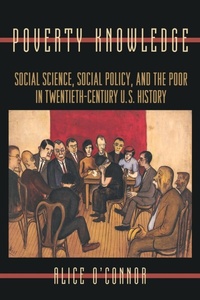
Poverty Knowledge
Social Science, Social Policy, and the Poor in Twentieth-Century U.S. History
Published on 1. September 2002
Book
Paperback/Softback
392 pages
978-0-691-10255-9 (ISBN)
Description
Progressive-era "poverty warriors" cast poverty in America as a problem of unemployment, low wages, labor exploitation, and political disfranchisement. In the 1990s, policy specialists made "dependency" the issue and crafted incentives to get people off welfare. Poverty Knowledge gives the first comprehensive historical account of the thinking behind these very different views of "the poverty problem," in a century-spanning inquiry into the politics, institutions, ideologies, and social science that shaped poverty research and policy. Alice O'Connor chronicles a transformation in the study of poverty, from a reform-minded inquiry into the political economy of industrial capitalism to a detached, highly technical analysis of the demographic and behavioral characteristics of the poor. Along the way, she uncovers the origins of several controversial concepts, including the "culture of poverty" and the "underclass."
She shows how such notions emerged not only from trends within the social sciences, but from the central preoccupations of twentieth-century American liberalism: economic growth, the Cold War against communism, the changing fortunes of the welfare state, and the enduring racial divide. The book details important changes in the politics and organization as well as the substance of poverty knowledge. Tracing the genesis of a still-thriving poverty research industry from its roots in the War on Poverty, it demonstrates how research agendas were subsequently influenced by an emerging obsession with welfare reform. Over the course of the twentieth century, O'Connor shows, the study of poverty became more about altering individual behavior and less about addressing structural inequality. The consequences of this steady narrowing of focus came to the fore in the 1990s, when the nation's leading poverty experts helped to end "welfare as we know it." O'Connor shows just how far they had traveled from their field's original aims.
She shows how such notions emerged not only from trends within the social sciences, but from the central preoccupations of twentieth-century American liberalism: economic growth, the Cold War against communism, the changing fortunes of the welfare state, and the enduring racial divide. The book details important changes in the politics and organization as well as the substance of poverty knowledge. Tracing the genesis of a still-thriving poverty research industry from its roots in the War on Poverty, it demonstrates how research agendas were subsequently influenced by an emerging obsession with welfare reform. Over the course of the twentieth century, O'Connor shows, the study of poverty became more about altering individual behavior and less about addressing structural inequality. The consequences of this steady narrowing of focus came to the fore in the 1990s, when the nation's leading poverty experts helped to end "welfare as we know it." O'Connor shows just how far they had traveled from their field's original aims.
Reviews / Votes
One of Choice's Outstanding Academic Titles for 2001 "In this thoroughly researched and clearly written book, O'Conner offers a comprehensive look at the changing ways American experts have thought about poverty in the 20th Century... A rewarding read."--Library Journal "O'Connor provides the most up-to-date history of poverty and welfare in the US in this highly recommended [book]... Her argument is unique, controversial, and convincing."--Choice "Poverty Knowledge has many strengths. It is a well-written analysis by a historian with substantial experience in the not-for-profit organizations that funded and substantively influenced much of the production of poverty knowledge over the past two decades... The descriptive materials alone will make this book an essential addition to the history of the social sciences... [It] will be essential reading for historians of the social and policy sciences."--Robert F. Kelly, Contemporary Sociology "O'Connor's book surpasses previous accounts of American approaches to poverty and makes a very significant contribution to critical writing on the welfare state."--Ruth Crocker, American Historical Review "A book that should be read by everyone engaged in poverty knowledge and social policy."--Deborah L. Little, American Journal of Sociology "This deeply researched and panoramic book is intellectual history at its best."--Thomas Jackson, The Historian "A brief review cannot do justice to the richness and subtlety of this fine study... [O'Connor's] argument is on the whole deeply compelling: over the course of the twentieth century, poverty knowledge became, despite the best intentions of its liberal practitioners, a partisan tool for those seeking to control, marginalize, or dismiss the claims of the poor, not for those working to end poverty."--Sonya Michel, IsisMore details
Series
Language
English
Place of publication
New Jersey
United States
Target group
Professional and scholarly
College/higher education
Product notice
Paperback (trade)
Dimensions
Height: 229 mm
Width: 152 mm
Thickness: 23 mm
Weight
628 gr
ISBN-13
978-0-691-10255-9 (9780691102559)
Copyright in bibliographic data and cover images is held by Nielsen Book Services Limited or by the publishers or by their respective licensors: all rights reserved.
Schweitzer Classification
Other editions
Additional editions
Alice O'Connor
Poverty Knowledge
Social Science, Social Policy, and the Poor in Twentieth-Century U.S. History
E-Book
01/2017
1st Edition
Princeton University Press
€161.95
Available for download
Person
Alice O'Connor was formerly the Assistant Director of the Project on Social Welfare and the American Future at the Ford Foundation, the Director for the Programs on Persistent Urban Poverty and International Migration at the Social Science Research Council, a National Science Foundation Postdoctoral Fellow at the University of Chicago, and a Visiting Scholar at the Russell Sage Foundation. She is currently Associate Professor of History at the University of California, Santa Barbara.
Content
Acknowledgments ix Introduction 3 PART ONE 23 Chapter 1. Origins: Poverty and Social Science in The Era of Progressive Reform 25 Chapter 2. Poverty Knowledge as Cultural Critique: The Great Depression 55 Chapter 3. From the Deep South to the Dark Ghetto: Poverty Knowledge, Racial Liberalism, and Cultural "Pathology" 74 Chapter 4. Giving Birth to a "Culture of Poverty": Poverty Knowledge in Postwar Behavioral Science, Culture, and Ideology 99 Chapter 5. Community Action 124 PART TWO 137 Chapter 6. In the Midst of Plenty: The Political Economy of Poverty in the Affluent Society 139 Chapter 7. Fighting Poverty with Knowledge: The Office of Economic Opportunity and the Analytic Revolution in Government 166 Chapter 8. Poverty's Culture Wars 196 PART THREE 211 Chapter 9. The Poverty Research Industry 213 Chapter 10. Dependency, the "Underclass," and a New Welfare "Consensus": Poverty Knowledge for a Post-Liberal, Postindustrial Era 242 Chapter 11. The End of Welfare and the Case for a New Poverty Knowledge 284 Notes 297 Index 359