

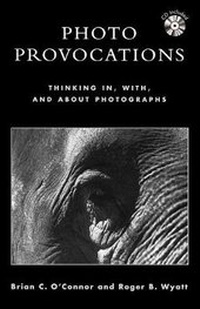
Photo Provocations
Thinking In, With, and About Photographs
Published on 8. August 2004
Book
Mixed media product
184 pages
978-0-8108-4646-3 (ISBN)
Description
Compared to verbal print media, the mechanisms for making, disseminating, and managing photographs are all quite new. At the same time, there is little precedent for how to think about pictures as items to be managed for the use of others. In Photo Provocations, O'Connor and Wyatt provide us with "threads of thought" from which can be woven into more effective systems of access and use. While some of the essays in the text are aimed directly at librarians, archivists, and those whose professional work hinges directly on deep understanding of photographs, the majority is aimed at all who want to make better use of images: whether in shooting photographs, using photographs to tell stories or make presentations, depending on photographs for evidence in numerous academic arenas, or using family photo albums to help make sense out of being human.
Reviews / Votes
In an alternating voice format, two interdisciplinary information scientists present photoessays exploring the personal, aesthetic, philosophical, word interface, and technical dimensions of still and video images. They challenge readers-viewers to reflect on the question of if a picture is worth 1000 words, which 1000 words would they be? The companion CD contains color renditions of the text's b&w images.... * Reference and Research Book News * We are exposed to thousands of images every day, many barely noticed. In Photo Provocations, O'Connor and Wyatt expose us to a few more, and in remarkably few words, examine the nature and meaning of photographs in great depth. Anyone who makes or works with photographs will find much to ponder. -- Ben Blackwell, Principal Photographer, Berkeley Art Museum/Pacific Film Archive University of California In an alternating voice format, two interdisciplinary information scientists present photoessays exploring the personal, aesthetic, philosophical, word interface, and technical dimensions of still and video images. They challenge readers-viewers to reflect on the question of "if a picture is worth 1000 words, which 1000 words would they be?" The companion CD contains color renditions of the text's b&w images. * Reference and Research Book News *More details
Language
English
Place of publication
Lanham, MD
United States
Dimensions
Height: 215 mm
Width: 165 mm
Thickness: 14 mm
Weight
295 gr
ISBN-13
978-0-8108-4646-3 (9780810846463)
Copyright in bibliographic data and cover images is held by Nielsen Book Services Limited or by the publishers or by their respective licensors: all rights reserved.
Schweitzer Classification
Persons
Brian O'Connor coordinates the Interdisciplnary Information Science Ph.D. Program at the University of North Texas. Roger Wyatt serves on the faculty of the School of Library & Information Management at Emporia State University and is co-founder of McLellan Wyatt Digital.
Content
Chapter 1 Acknowledgments Chapter 2 1. If a Picture Were Worth One Thousand Words Chapter 3 2. Why Are We Writing a Book about Photographs Chapter 4 3. Argus: Eyes Across the Years Chapter 5 4. Blow Up Redux Chapter 6 5. Butterfly Effect Chapter 7 6. Butterfly Redux Chapter 8 7. Dust Bowl in Maine Chapter 9 8. Exquisite Empiricism Chapter 10 9. Exquisite Empiricism Redux Chapter 11 10. Robocams and AACR Chapter 12 11. Digital Mindscapes Chapter 13 12. Interface Chapter 14 13. Off the Rez Chapter 15 14. The Predicament of Categories Chapter 16 15. Reflections on a Photojournal Notebook Chapter 17 16. Native Elements Chapter 18 17. Native Elements Redux Chapter 19 18. Ripples of Meaning Chapter 20 19. Pointing at Cattle and Dogs: Reflections on an Eyemodule Chapter 21 20. What's Right with This Picture Chapter 22 21. Up the Representation of a Creek with Only a Representation of a Paddle Chapter 23 22. Sum Sculpture: Flailing about in Photospace Chapter 24 23. Pictures of Boys With Guns Chapter 25 24. With Apologies to Magritte Chapter 26 25. Face of the Bull Chapter 27 26. Epilogue on Provocation Chapter 28 Bibliography Chapter 29 About the Authors