

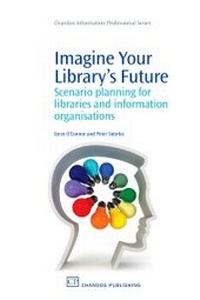
Imagine Your Library's Future
Scenario Planning for Libraries and information Organisations
Published on 25. September 2010
Book
Paperback/Softback
240 pages
978-1-84334-600-5 (ISBN)
Description
In this information age it is widely recognised that, in order to maintain relevance and to gain a competitive edge, libraries and other organisations in the business of information must continuously assess their roles, collections, services and perhaps most importantly, their business practices. Scenarios are a way of predicting and describing a future three to five years away while strongly engaging one's community in choosing the future which is preferable. The horizon in which assessments about future roles change is growing shorter and shorter. While it is almost cliched to state that change is the only constant, differing scenarios of what libraries might be allow all of us to contemplate futures we might otherwise not allow. Drawing on extensive experience in libraries in different parts of the globe, the authors provide a rich analysis of planning, managing and implementing change in information organisations through scenario planning. Through extensive practical applications, both actual and theoretical, the authors provide a strong background understanding and direct the reader through a planning process that is both readily applicable and innovative for all information organisations, irrespective of their size or client base.
Reviews / Votes
"Because of its clear language, examples, exercises and references the book can be used both as a guide for managers implementing scenario planning in libraries and for teachers providing courses on library management, managing change and innovation within library and information science curricula." --Information ResearchMore details
Series
Language
English
Place of publication
Witney
United Kingdom
Publishing group
Woodhead Publishing Ltd
Target group
Professional and scholarly
Dimensions
Height: 234 mm
Width: 156 mm
Weight
360 gr
ISBN-13
978-1-84334-600-5 (9781843346005)
Copyright in bibliographic data and cover images is held by Nielsen Book Services Limited or by the publishers or by their respective licensors: all rights reserved.
Schweitzer Classification
Other editions
Additional editions
Steve O'Connor | Peter Sidorko
Imagine Your Library's Future
Scenario Planning for Libraries and information Organisations
E-Book
09/2010
Chandos Publishing
€61.95
Available for download
Persons
Steve O'Connor is a University Librarian in Hong Kong. He has also been the CEO of a Library consortium and worked as a consultant and trainer extensively in different parts of the world, including the United States and the United Kingdom. He has written and talked extensively on issues relating to libraries, librarians and how they can not only survive but should thrive and position themselves for the benefit of their communities. He is currently working at The Hong Kong Polytechnic University. He is also the Editor of Library Management and created Library Management China (in Chinese). Peter Sidorko is the Deputy University Librarian at the University of Hong Kong. He has extensive senior management experience in academic libraries in Australia and Hong Kong. In addition to initiating, directing and managing change, from incremental to transformational, in the libraries in which he has worked, Peter has also provided consultancies on organisational change for other libraries. He has written extensively, and speaks regularly, on management issues in libraries with particular emphasis on organisational change. Peter also lectures on topics such as organisational change, contemporary library management, information in organisations and information policy in the information science courses taught at the University of Hong Kong.
Content
Dedication
Preface
Acknowledgments
List of figures, table and case studies
About the authors
Chapter 1: What are scenarios?
The future is not linear
What is the value of scenarios?
The future impacting on libraries
What is the future and does science fiction predict the future?
Change
An initial view of the Internet
Change of attitudes toward the future
Development of scenarios as a discipline
Chapter 2: The complexities of our informational environment
This chapter
What is the environment?
Libraries and their environments
Disruptive technologies
Broad disruptive technological impact on libraries
Issues in the wider environment
Open source
Open source implications
Digital content
Digital content implications
The author-publisher-library relationship
Content balance
The future of work
Implications for the future of work
Emerging trends
Chapter 3: The future and the past: models are changing
This chapter
The mirror as a powerful tool
Library models in transition
Consortia in our corporate lives
Changing roles of and pressures on consortia
What are we doing, or what is our business model?
Future business models
Chapter 4: Understanding choices
This chapter
What are choices?
Beginning to construct scenarios through choices
Keeping options open
Chapter 5: Toward a new way of thinking
This chapter
How to organise for decisions
Is it all straightforward?
Confronting sameness
Research as a group
Chapter 6: Designing your process
This chapter
Not every process is the same
Scenario construction beginnings
The suggested process
Chapter 7: Scenarios and implementation
This chapter
Preferred Library Scenario
Keeping the scenario alive
Mid-term review
The staff in the implementation of the Preferred Scenario
Chapter 8: Choice, chance and (less than) certainty
This chapter
Chance and randomness
Adoption of risk
Issue 1: abundance of data
Issue 2: search engine capability
Issue 3: avoid group thinking
Issue 4: learn to take risks
Issue 5: continue to build a trust metric for the library
Issue 6: so what is your future?
Conclusion
Chapter 9: Case studies
Case study 1: A major Hong Kong university library
Case study 2: A major Australian university library
Case study 3: CAVAL Ltd, Melbourne, Australia
Case study 4: SOLINET scenarios
Case study 5: Public library
Case study 6: The possible world of library consortia
Chapter 10: Implementation and the impact of change
This chapter
Change, demolition and reconstruction
The human side of change
Getting involved and involvement
Following through and embedding the change
Change and scenario planning
Further reading
Index
Preface
Acknowledgments
List of figures, table and case studies
About the authors
Chapter 1: What are scenarios?
The future is not linear
What is the value of scenarios?
The future impacting on libraries
What is the future and does science fiction predict the future?
Change
An initial view of the Internet
Change of attitudes toward the future
Development of scenarios as a discipline
Chapter 2: The complexities of our informational environment
This chapter
What is the environment?
Libraries and their environments
Disruptive technologies
Broad disruptive technological impact on libraries
Issues in the wider environment
Open source
Open source implications
Digital content
Digital content implications
The author-publisher-library relationship
Content balance
The future of work
Implications for the future of work
Emerging trends
Chapter 3: The future and the past: models are changing
This chapter
The mirror as a powerful tool
Library models in transition
Consortia in our corporate lives
Changing roles of and pressures on consortia
What are we doing, or what is our business model?
Future business models
Chapter 4: Understanding choices
This chapter
What are choices?
Beginning to construct scenarios through choices
Keeping options open
Chapter 5: Toward a new way of thinking
This chapter
How to organise for decisions
Is it all straightforward?
Confronting sameness
Research as a group
Chapter 6: Designing your process
This chapter
Not every process is the same
Scenario construction beginnings
The suggested process
Chapter 7: Scenarios and implementation
This chapter
Preferred Library Scenario
Keeping the scenario alive
Mid-term review
The staff in the implementation of the Preferred Scenario
Chapter 8: Choice, chance and (less than) certainty
This chapter
Chance and randomness
Adoption of risk
Issue 1: abundance of data
Issue 2: search engine capability
Issue 3: avoid group thinking
Issue 4: learn to take risks
Issue 5: continue to build a trust metric for the library
Issue 6: so what is your future?
Conclusion
Chapter 9: Case studies
Case study 1: A major Hong Kong university library
Case study 2: A major Australian university library
Case study 3: CAVAL Ltd, Melbourne, Australia
Case study 4: SOLINET scenarios
Case study 5: Public library
Case study 6: The possible world of library consortia
Chapter 10: Implementation and the impact of change
This chapter
Change, demolition and reconstruction
The human side of change
Getting involved and involvement
Following through and embedding the change
Change and scenario planning
Further reading
Index