

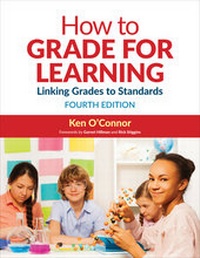
How to Grade for Learning
Linking Grades to Standards
4th Edition
Published on 20. December 2017
Book
Paperback/Softback
392 pages
978-1-5063-3415-8 (ISBN)
Description
Implement standards-based grading practices that help students succeed!
Classroom assessment and grading should help students grow and develop to their full potential, but meshing traditional grading practices with students' achievement on standards has been difficult and daunting. Making real and lasting changes to grading practices requires both knowledge and willpower.
This 4th edition of the best-selling How to Grade for Learning provides eight guidelines for good grading, offers recommendations for practical applications, and gives solid suggestions for implementing more effective grading practices. Ken O'Connor presents the latest research on motivation, mindset, learning styles, and beliefs about fairness to inform this new edition, which includes:
Both the why's and the how-to's of implementing standards-based grading practices
48 educator contributions from nationally and internationally known educators, authors, and consultants that provide ideas and testimonials for effective assessment practices
Sections on hot-button issues such as academic dishonesty, extra credit, bonus points and homework
Additional information on utilizing levels of proficiency and eliminating the use of percentages and averaging
Reflective exercises and numerous tools, including rubrics, sample letters, and case studies
Techniques for managing grading more efficiently
An invaluable resource for helping teachers assign grades that are accurate, consistent, meaningful, and supportive of learning, this book also makes an ideal staff development resource.
Classroom assessment and grading should help students grow and develop to their full potential, but meshing traditional grading practices with students' achievement on standards has been difficult and daunting. Making real and lasting changes to grading practices requires both knowledge and willpower.
This 4th edition of the best-selling How to Grade for Learning provides eight guidelines for good grading, offers recommendations for practical applications, and gives solid suggestions for implementing more effective grading practices. Ken O'Connor presents the latest research on motivation, mindset, learning styles, and beliefs about fairness to inform this new edition, which includes:
Both the why's and the how-to's of implementing standards-based grading practices
48 educator contributions from nationally and internationally known educators, authors, and consultants that provide ideas and testimonials for effective assessment practices
Sections on hot-button issues such as academic dishonesty, extra credit, bonus points and homework
Additional information on utilizing levels of proficiency and eliminating the use of percentages and averaging
Reflective exercises and numerous tools, including rubrics, sample letters, and case studies
Techniques for managing grading more efficiently
An invaluable resource for helping teachers assign grades that are accurate, consistent, meaningful, and supportive of learning, this book also makes an ideal staff development resource.
More details
Edition
4th Revised edition
Language
English
Place of publication
Thousand Oaks
United States
Publishing group
SAGE Publications Inc
Target group
Professional and scholarly
Edition type
Revised edition
Dimensions
Height: 279 mm
Width: 216 mm
Weight
992 gr
ISBN-13
978-1-5063-3415-8 (9781506334158)
Copyright in bibliographic data and cover images is held by Nielsen Book Services Limited or by the publishers or by their respective licensors: all rights reserved.
Schweitzer Classification
Other editions
Previous edition
Ken O'Connor
How to Grade for Learning, K-12
Book
07/2009
3rd Edition
Corwin Press Inc
€65.79
Article exhausted; check for reprint
Person
Ken O'Connor is an independent classroom assessment consultant with a special interest in grading and reporting. An internationally recognized speaker who has presented in 47 states in the United States, 9 provinces and one territory in Canada, and 24 other countries, he has also consulted for schools, districts, and state and provincial departments of education. He had 23 years of classroom experience from grade 7 to grade 12, and 10 years of experience as a curriculum coordinator for a large school district. Ken was born in Melbourne, Australia, but has lived most of his life in the east end of Toronto, Canada.
His major extra-curricular interest is field hockey, as a player, umpire and coach. As a coach, three of his players went on to represent Canada in the Olympics. He also umpired at the 1984 Olympic Games and the 1990 World Cup.
His major extra-curricular interest is field hockey, as a player, umpire and coach. As a coach, three of his players went on to represent Canada in the Olympics. He also umpired at the 1984 Olympic Games and the 1990 World Cup.
Content
Foreword by Rick Stiggins
Preface
Acknowledgments
About the Author
Introduction
Chapter 1: Basing Grades on Standards
Chapter 2: Using Performance Standards
Chapter 3: Grading Individual Achievement
Chapter 4: Sampling Student Performance
Chapter 5: Emphasizing More Recent Evidence
Chapter 6: Determining Grades
Chapter 7: Quality Assessment and Keeping Records
Chapter 8: Involving Students in Grading and Assessment
Chapter 9: Grading Issues
Chapter 10: Communicating Student Achievement
Chapter 11: Implementing Changes in Grading and Reporting
Chapter 12: The Way Ahead
Appendix A: A Testimonial on the Impact of Assessment and Grading for Learning
Appendix B: Guidelines for Grading in Standards-Based Systems
Appendix C: A Proposed Grading Policy
Appendix D: Bay District Schools Assessment Principles and Practices
Appendix E: NGSS Performance Expectations for a High School Chemistry Course
Appendix F: Ontario Achievement Chart for Canadian and World Studies
Appendix G: Letter to Parents About Student-Led Conferencing
Appendix H: Rubric for Sound Grading Practice
Appendix I: Glossary
References
Additional Resources
Index
Preface
Acknowledgments
About the Author
Introduction
Chapter 1: Basing Grades on Standards
Chapter 2: Using Performance Standards
Chapter 3: Grading Individual Achievement
Chapter 4: Sampling Student Performance
Chapter 5: Emphasizing More Recent Evidence
Chapter 6: Determining Grades
Chapter 7: Quality Assessment and Keeping Records
Chapter 8: Involving Students in Grading and Assessment
Chapter 9: Grading Issues
Chapter 10: Communicating Student Achievement
Chapter 11: Implementing Changes in Grading and Reporting
Chapter 12: The Way Ahead
Appendix A: A Testimonial on the Impact of Assessment and Grading for Learning
Appendix B: Guidelines for Grading in Standards-Based Systems
Appendix C: A Proposed Grading Policy
Appendix D: Bay District Schools Assessment Principles and Practices
Appendix E: NGSS Performance Expectations for a High School Chemistry Course
Appendix F: Ontario Achievement Chart for Canadian and World Studies
Appendix G: Letter to Parents About Student-Led Conferencing
Appendix H: Rubric for Sound Grading Practice
Appendix I: Glossary
References
Additional Resources
Index