

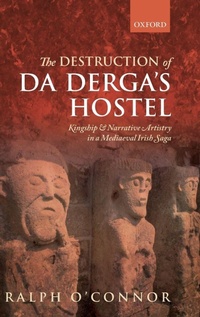
The Destruction of Da Derga's Hostel
Kingship and Narrative Artistry in a Mediaeval Irish Saga
Published on 28. February 2013
Book
Hardback
400 pages
978-0-19-966613-3 (ISBN)
Description
Irish saga literature represents the largest collection of vernacular narrative in existence from the early Middle Ages, using the tools of Christian literacy to retell myths and legends about the pagan past. This unique corpus remains marginal to standard histories of Western literature: its tales are widely read, but their literary artistry remains a puzzle to many even within Celtic studies. This book, the first to offer a systematic literary analysis of any single native Irish tale, aims to show how one particularly celebrated saga 'works' as a story: the Middle Irish tale Togail Bruidne Da Derga (The Destruction of Da Derga's Hostel), which James Carney called 'the finest saga of the early period'. This epic tale tells how the legendary king Conaire was raised by a shadowy Otherworld to the kingship of Tara and, after a fatal error of judgement, was hounded by spectres to an untimely death at Da Derga's Hostel at the hands of his own foster-brothers. By turns lyrical and laconic, and rich in native mythological imagery, the story is told with a dramatic intensity worthy of Greek tragedy, and the intricate symmetry of its narrative procedure recalls the visual patterning of illuminated manuscripts such as The Book of Kells. This book invites the reader to enjoy and understand this literary masterpiece, explaining its narrative artistry within its native, classical and biblical literary contexts. Against a historical backdrop of shifting ideologies of Christian kingship, it interprets the saga's possible significance for contemporary audiences as a questioning exploration of the challenges and paradoxes of kingship.
Reviews / Votes
O'Connor has written a book that constitutes a major step forward in the criticism of the early Irish saga. It deserves to be as stimulating of further discussion as it is persuasive in its own terms. * T.M. Charles-Edwards, Corpus Christi College, Oxford University, Cambrian Medieval Celtic Studies *More details
Language
English
Place of publication
Oxford
United Kingdom
Target group
College/higher education
Professional and scholarly
Illustrations
Black-and-white halftones; figures
Dimensions
Height: 240 mm
Width: 161 mm
Thickness: 26 mm
Weight
763 gr
ISBN-13
978-0-19-966613-3 (9780199666133)
Copyright in bibliographic data and cover images is held by Nielsen Book Services Limited or by the publishers or by their respective licensors: all rights reserved.
Schweitzer Classification
Other editions
Additional editions
Ralph O'Connor
The Destruction of Da Derga's Hostel
Kingship and Narrative Artistry in a Mediaeval Irish Saga
E-Book
02/2013
1st Edition
OUP eBook
€77.49
Available for download
Person
Ralph O'Connor studied Anglo-Saxon, Norse & Celtic and English Literature at the University of Cambridge before becoming a Junior Research Fellow in Irish and Icelandic Literature at St John's College, Cambridge. He is currently Professor of the Literature and Culture of Britain, Ireland, and Iceland at the University of Aberdeen, where he teaches in the departments of Celtic, History, and English. He has published widely on mediaeval Irish and Icelandic and modern British literature. His previous books are Icelandic Histories and Romances (Tempus, 2002), The Earth on Show: Fossils and the Poetics of Popular Science (Chicago, 2007), which won two international book prizes in 2008, and Science as Romance (Pickering & Chatto, 2012).
Content
Acknowledgements ; Note on quotations ; List of illustrations ; Introduction ; 1. The text and its authors; or, how to write a saga ; 2. A child of the Otherworld ; 3. The plunderers' dilemma ; 4. The road to Da Derga's Hostel ; 5. The house of death ; 6. The perfect spy ; 7. Sovereignty shattered ; 8. The Latin dimension: classical and biblical influence ; 9. Conaire, Saul, and sacred kingship ; 10. The message of the Togail: tract or tragedy? ; 11. Afterword: reading the Togail