

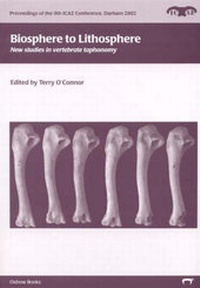
Biosphere to Lithosphere
new studies in vertebrate taphonomy
Published on 25. February 2005
Book
Hardback
176 pages
978-1-84217-118-9 (ISBN)
Description
Taphonomic studies are a major methodological advance, the effects of which have been felt throughout archaeology. Zooarchaeologists and archaeobotanists were the first to realise how vital it was to study the entire process of how food enters the archaeological record, and taphonomy brought to a close the era when the study of animal bones and plant remains from archaeological sites were regarded mainly as environmental indicators.This volume is indicative of recent developments in taphonomic studies: hugely diverse research areas are being explored, many of which would have been totally unforeseeable only a quarter of a century ago.
Reviews / Votes
packs an amazing number and variety of papers into a relatively short book.' -- International Journal of Osteoarchaeology International Journal of OsteoarchaeologyMore details
Series
Language
English
Place of publication
Oxford
United Kingdom
Target group
Professional and scholarly
Dimensions
Height: 297 mm
Width: 210 mm
ISBN-13
978-1-84217-118-9 (9781842171189)
Copyright in bibliographic data and cover images is held by Nielsen Book Services Limited or by the publishers or by their respective licensors: all rights reserved.
Schweitzer Classification
Other editions
Additional editions
E-Book
02/2005
Oxbow Books
€26.49
Available for download

E-Book
02/2005
OXBOW BOOKS
€26.49
Available for download
Person
edited by T O'Connor
Content
Preface (Peter Rowley-Conwy, Umberto Albarella and Keith Dobney)
Introduction (Terry O'Connor)
Some taphonomic investigations on reindeer (Rangifer tarandus groenlandicus) in West Greenland (Kerstin Pasda)
Magnitude of faunal accumulations by carnivores and humans in the South American Andes (Mariana Mondini)
Anthropogenic versus non-anthropogenic bird bone assemblages: New criteria for their distinction (Veronique Laroulandie)
Owls, diurnal raptors and humans: Signatures on avian bones (Zbigniew Bochenski)
Predator bias and fluctuating prey populations (Jim Williams)
Taphonomic consequences of the use of bones as fuel: Experimental data and archaeological applications (Sandrine Costamagno et al)
Taphonomic influences on cremation burial deposits: Implications for interpretation (Fay Worley)
Microfossils in Camelid dung: Taphonomic considerations for the archaeological study of agriculture and pastoralism (M Alejandra Korstanje)
Why ancient DNA research needs taphonomy (Eva-Maria Geigl)
Bone density variation between simialr animals and density variation in early life: Implications for future taphonomic analysis (Robert Symmons)
Contribution to knowledge of the Pleistocene mammal-bearing deposits of the territory of Siracusa (southwestern Sicily) (Corrado Marziano and Salvatore Chilardi)
Using comparative micromammal taphonomy to test palaeoecological hypotheses: 'Ubeidiya, a Lower Pleistocene site in the Jordan Valley, Israel, as a case study (Miriam Belmaker)
Fragments of information: Preliminary taphonomic results from the Middle Palaeolithic breccia layers of Misliya Cave, Mount Carmel, Israel (Guy Bar-Oz et al)
Bone weathering and food procurement strategies: Assessing the the reliability of our behavioural inferences (Nellie Phoca-Cosmetatou)
Social changes in the early European Neolithic: A taphonomy perspective (Arkadiusz Marciniak)
Introduction (Terry O'Connor)
Some taphonomic investigations on reindeer (Rangifer tarandus groenlandicus) in West Greenland (Kerstin Pasda)
Magnitude of faunal accumulations by carnivores and humans in the South American Andes (Mariana Mondini)
Anthropogenic versus non-anthropogenic bird bone assemblages: New criteria for their distinction (Veronique Laroulandie)
Owls, diurnal raptors and humans: Signatures on avian bones (Zbigniew Bochenski)
Predator bias and fluctuating prey populations (Jim Williams)
Taphonomic consequences of the use of bones as fuel: Experimental data and archaeological applications (Sandrine Costamagno et al)
Taphonomic influences on cremation burial deposits: Implications for interpretation (Fay Worley)
Microfossils in Camelid dung: Taphonomic considerations for the archaeological study of agriculture and pastoralism (M Alejandra Korstanje)
Why ancient DNA research needs taphonomy (Eva-Maria Geigl)
Bone density variation between simialr animals and density variation in early life: Implications for future taphonomic analysis (Robert Symmons)
Contribution to knowledge of the Pleistocene mammal-bearing deposits of the territory of Siracusa (southwestern Sicily) (Corrado Marziano and Salvatore Chilardi)
Using comparative micromammal taphonomy to test palaeoecological hypotheses: 'Ubeidiya, a Lower Pleistocene site in the Jordan Valley, Israel, as a case study (Miriam Belmaker)
Fragments of information: Preliminary taphonomic results from the Middle Palaeolithic breccia layers of Misliya Cave, Mount Carmel, Israel (Guy Bar-Oz et al)
Bone weathering and food procurement strategies: Assessing the the reliability of our behavioural inferences (Nellie Phoca-Cosmetatou)
Social changes in the early European Neolithic: A taphonomy perspective (Arkadiusz Marciniak)