

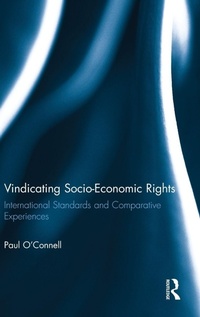
Vindicating Socio-Economic Rights
International Standards and Comparative Experiences
1st Edition
Published on 21. February 2012
Book
Hardback
248 pages
978-0-415-60988-3 (ISBN)
Description
Notwithstanding the widespread and persistent affirmation of the indivisibility and equal worth of all human rights, socio-economic rights continue to be treated as the "Cinderella" of the human rights corpus. At a domestic level this has resulted in little appetite for the explicit recognition and judicial enforcement of such rights in constitutional democracies. The primary reason for this is the prevalent apprehension that the judicial enforcement of socio-economic rights is fundamentally at variance with the doctrine of the separation of powers.
This study, drawing on comparative experiences in a number of jurisdictions which have addressed (in some cases more explicitly than others) the issue of socio-economic rights, seeks to counter this argument by showing that courts can play a substantial role in the vindication of socio-economic rights, while still respecting the relative institutional prerogatives of the elected branches of government. Drawing lessons from experiences in South Africa, India, Canada and Ireland, this study seeks to articulate a "model adjudicative framework" for the protection of socio-economic rights. In this context the overarching concern is to find some role for the courts in vindicating socio-economic rights, while also recognising the importance of the separation of powers and the primary role that the elected branches of government must play in protecting and vindicating such rights. The text incorporates discussion of the likely impact and significance of the Optional Protocol to the International Covenant on Economic, Social and Cultural Rights, and looks at the implications of the Mazibuko decision for the development of South Africa's socio-economic rights jurisprudence.
This study, drawing on comparative experiences in a number of jurisdictions which have addressed (in some cases more explicitly than others) the issue of socio-economic rights, seeks to counter this argument by showing that courts can play a substantial role in the vindication of socio-economic rights, while still respecting the relative institutional prerogatives of the elected branches of government. Drawing lessons from experiences in South Africa, India, Canada and Ireland, this study seeks to articulate a "model adjudicative framework" for the protection of socio-economic rights. In this context the overarching concern is to find some role for the courts in vindicating socio-economic rights, while also recognising the importance of the separation of powers and the primary role that the elected branches of government must play in protecting and vindicating such rights. The text incorporates discussion of the likely impact and significance of the Optional Protocol to the International Covenant on Economic, Social and Cultural Rights, and looks at the implications of the Mazibuko decision for the development of South Africa's socio-economic rights jurisprudence.
More details
Series
Language
English
Place of publication
London
United Kingdom
Publishing group
Taylor & Francis Ltd
Target group
College/higher education
Professional and scholarly
Postgraduate and Undergraduate
Dimensions
Height: 240 mm
Width: 161 mm
Thickness: 18 mm
Weight
543 gr
ISBN-13
978-0-415-60988-3 (9780415609883)
Copyright in bibliographic data and cover images is held by Nielsen Book Services Limited or by the publishers or by their respective licensors: all rights reserved.
Schweitzer Classification
Other editions
Additional editions
Book
10/2013
1st Edition
Routledge
€63.30
Shipment within 15-20 days
E-Book
02/2012
1st Edition
Routledge
€55.49
Available for download
E-Book
02/2012
1st Edition
Routledge
€55.49
Available for download
Person
Paul O'Connell is a lecturer in Law at the University of Leicester, he has published widely on socio-economic rights, and the impact of globalisation on human rights.
Content
1. Introduction 2. International Standards on Socio-Economic Rights 3. The South African Experience 4. Developing Social Rights in India 5. The Canadian Charter, Substantive Equality and Social Rights 6. The Rejection of Socio-Economic Rights in Ireland 7. A Model Adjudicative Framework 8. Conclusions