

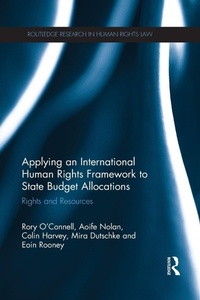
Applying an International Human Rights Framework to State Budget Allocations
Rights and Resources
1st Edition
Published on 3. March 2016
Book
Paperback/Softback
272 pages
978-1-138-66550-7 (ISBN)
Description
Human rights based budget analysis projects have emerged at a time when the United Nations has asserted the indivisibility of all human rights and attention is increasingly focused on the role of non-judicial bodies in promoting and protecting human rights. This book seeks to develop the human rights framework for such budget analyses, by exploring the international law obligations of the International Covenant on Economic, Social and Cultural Rights (ICESCR) in relation to budgetary processes. The book outlines international experiences and comparative practice in relation to economic and social rights budget analysis and budgeting.
The book sets out an ICESCR-based methodology for analysing budget and resource allocations and focuses on the legal obligation imposed on state parties by article 2(1) of ICESCR to progressively realise economic and social rights to 'the maximum of available resources'. Taking Northern Ireland as a key case study, the book demonstrates and promotes the use of a 'rights-based' approach in budgetary decision-making.
The book will be relevant to a global audience currently considering how to engage in the budget process from a human rights perspective. It will be of interest to students and researchers of international human rights law and public law, as well as economic and social rights advocacy and lobbying groups.
The book sets out an ICESCR-based methodology for analysing budget and resource allocations and focuses on the legal obligation imposed on state parties by article 2(1) of ICESCR to progressively realise economic and social rights to 'the maximum of available resources'. Taking Northern Ireland as a key case study, the book demonstrates and promotes the use of a 'rights-based' approach in budgetary decision-making.
The book will be relevant to a global audience currently considering how to engage in the budget process from a human rights perspective. It will be of interest to students and researchers of international human rights law and public law, as well as economic and social rights advocacy and lobbying groups.
More details
Series
Language
English
Place of publication
London
United Kingdom
Publishing group
Taylor & Francis Ltd
Target group
College/higher education
Illustrations
20 s/w Tabellen
20 Tables, black and white
Dimensions
Height: 234 mm
Width: 156 mm
Thickness: 14 mm
Weight
395 gr
ISBN-13
978-1-138-66550-7 (9781138665507)
Copyright in bibliographic data and cover images is held by Nielsen Book Services Limited or by the publishers or by their respective licensors: all rights reserved.
Schweitzer Classification
Other editions
Additional editions
Rory O'Connell | Aoife Nolan | Colin Harvey
Applying an International Human Rights Framework to State Budget Allocations
Rights and Resources
E-Book
01/2014
1st Edition
Routledge
€64.49
Available for download
Rory O'Connell | Aoife Nolan | Colin Harvey
Applying an International Human Rights Framework to State Budget Allocations
Rights and Resources
E-Book
01/2014
1st Edition
Routledge
€64.49
Available for download
Rory O'Connell | Aoife Nolan | Colin Harvey
Applying an International Human Rights Framework to State Budget Allocations
Rights and Resources
Book
01/2014
1st Edition
Routledge
€231.80
Shipment within 15-20 days
Persons
Rory O'Connell is Professor in Human Rights and Constitutional Law at the Transitional Justice Institute/School of Law, University of Ulster. His research and teaching interests are in the areas of human rights, equality and constitutional law.
Aoife Nolan is Professor of International Human Rights Law at the School of Law, University of Nottingham, She has published extensively in the areas of human rights, particularly in relation to economic and social rights and children's rights.
Colin Harvey is Professor of Human Rights Law, School of Law, Queen's University Belfast. He has written widely on human rights and constitutional law. He served as a Commissioner on the Northern Ireland Human Rights Commission (2005-2011) and is a former Head of the School of Law at Queen's (2007-2012).
Mira Dutschke has a postgraduate degreee in Human Rights law and 10 years research experience in Southern Africa, Northern Ireland the the United States. She teaches at the University of Cape Town and works as an environmental news and film producer, and researcher.
Eoin Rooney is a social researcher. He is currently Coordinator of the Centre for Economic Empowerment, a think tank and skills development project within the Northern Ireland Council for Voluntary Action (NCVA).
Aoife Nolan is Professor of International Human Rights Law at the School of Law, University of Nottingham, She has published extensively in the areas of human rights, particularly in relation to economic and social rights and children's rights.
Colin Harvey is Professor of Human Rights Law, School of Law, Queen's University Belfast. He has written widely on human rights and constitutional law. He served as a Commissioner on the Northern Ireland Human Rights Commission (2005-2011) and is a former Head of the School of Law at Queen's (2007-2012).
Mira Dutschke has a postgraduate degreee in Human Rights law and 10 years research experience in Southern Africa, Northern Ireland the the United States. She teaches at the University of Cape Town and works as an environmental news and film producer, and researcher.
Eoin Rooney is a social researcher. He is currently Coordinator of the Centre for Economic Empowerment, a think tank and skills development project within the Northern Ireland Council for Voluntary Action (NCVA).
Content
Part 1 1. Contexts 2. Economic and Social Rights-Based Budget Analysis: An overview 3. A Human Rights Framework: Exploring Article 2(1) ICESCR obligations 4. A Human Rights Framework: An analysis of the tripartite typology and the obligations of non-discrimination and process Part 2 5. Mental Health 6. Social Housing 7. Local meets the Global