

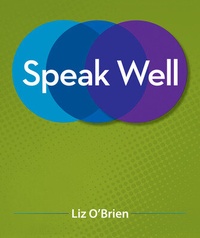
Speak Well
Published on 16. November 2012
Book
Spiral bound
456 pages
978-0-07-340674-9 (ISBN)
Description
Create, Converse, Connect - Speak Well.Liz O'Brien teaches students that to speak well is to speak responsibly, confidently, and authentically--to create well-researched and constructed speeches, and to converse, and connect with their audience. Through Speak Well's listener-centered approach to public speaking, one in which the speaker engages in a vibrant conversation with listeners rather than giving a static performance, students learn that their primary purpose as speakers is to communicate ideas. The result is reduced student anxiety about speech delivery, increased self-assurance, and more authentic, successful speeches.
In an easy-to-use handbook format, Speak Well guides students through the many choices that speakers must make when crafting and supporting a message, while a series of interactive speech preparation tools and an McGraw-Hill's proven adaptive learning system, LearnSmart, helps them master key course concepts, practice, build confidence, and achieve success in public speaking.
In an easy-to-use handbook format, Speak Well guides students through the many choices that speakers must make when crafting and supporting a message, while a series of interactive speech preparation tools and an McGraw-Hill's proven adaptive learning system, LearnSmart, helps them master key course concepts, practice, build confidence, and achieve success in public speaking.
More details
Language
English
Place of publication
United States
Publishing group
McGraw-Hill Education - Europe
Target group
College/higher education
Illustrations
Figures; Tables, color; Line drawings, color; Illustrations, color
Dimensions
Height: 208 mm
Width: 203 mm
Thickness: 20 mm
Weight
669 gr
ISBN-13
978-0-07-340674-9 (9780073406749)
Copyright in bibliographic data and cover images is held by Nielsen Book Services Limited or by the publishers or by their respective licensors: all rights reserved.
Schweitzer Classification
Other editions
Previous edition
Book
09/2008
McGraw-Hill Professional
€79.35
Article exhausted; check for reprint
Person
Liz OBrien serves as chair of the Communication/American Sign Language/Theater & Film Department at Phoenix College, one of the Maricopa Community Colleges. She earned a B.A. in communication from the University of Arizona in 1985 and an M.A in communication from the University of Maryland in 1989. She accepted her position on the communication faculty at Phoenix College in 1990 and continues to thrive on the interaction with her diverse, urban student population. She received her campus Distinguished Teaching Award in 2000, and has been honored with several NISOD awards for teaching excellence. Her creative outlets include producing and directing the Storybook Stagecoach, a Phoenix College performing troupe that brings storybooks to life on the stage for young audiences. Additionally, she is a professional watercolor artist. Liz lives in a historic home in Phoenix with her husband, two cats, a garden full of plants and a pond full of fish.
Content
Part 1: Public Speaking As Listener-Centered Communication
Chapter 1: Public Speaking is an Act of Communication
Chapter 2: Listen to the Speeches of Others
Chapter 3: Create Confident Presentations
Chapter 4: Commit to Responsible Communication: Ethical, Civil, and Credible Speaking
Part 2: Preparing for Responsible Public Communication
Chapter 5: Analyze Your Audience and the Speaking Situation
Chapter 6: Determine Your Speech Purpose, Topic, and Thesis
Chapter 7: Incorporate Research
Chapter 8: Support Your Ideas
Part 3: Developing Your Message
Chapter 9: Organize Your Ideas
Chapter 10: Outline Your Speech
Chapter 11: Create Introductions, Conclusions, and Transitions
Part 4: Presenting Your Speech
Chapter 12: Select and Incorporate Visual Support
Chapter 13: Practice Your Presentation
Chapter 14: Communicate with your Language, Voice, and Body
Part 5: Types of Public Speaking
Chapter 15: Speak to Inform
Chapter 16: Speak to Persuade
Chapter 17: Develop Your Arguments
Chapter 18: Speak During Special Occasions and in Groups
Part 6: Resources
Sample Student Speeches
Guide to Documentation Styles
Evaluation Forms:
Speaker Evaluation Form
Speaker Self-Evaluation Form
Chapter 1: Public Speaking is an Act of Communication
Chapter 2: Listen to the Speeches of Others
Chapter 3: Create Confident Presentations
Chapter 4: Commit to Responsible Communication: Ethical, Civil, and Credible Speaking
Part 2: Preparing for Responsible Public Communication
Chapter 5: Analyze Your Audience and the Speaking Situation
Chapter 6: Determine Your Speech Purpose, Topic, and Thesis
Chapter 7: Incorporate Research
Chapter 8: Support Your Ideas
Part 3: Developing Your Message
Chapter 9: Organize Your Ideas
Chapter 10: Outline Your Speech
Chapter 11: Create Introductions, Conclusions, and Transitions
Part 4: Presenting Your Speech
Chapter 12: Select and Incorporate Visual Support
Chapter 13: Practice Your Presentation
Chapter 14: Communicate with your Language, Voice, and Body
Part 5: Types of Public Speaking
Chapter 15: Speak to Inform
Chapter 16: Speak to Persuade
Chapter 17: Develop Your Arguments
Chapter 18: Speak During Special Occasions and in Groups
Part 6: Resources
Sample Student Speeches
Guide to Documentation Styles
Evaluation Forms:
Speaker Evaluation Form
Speaker Self-Evaluation Form