

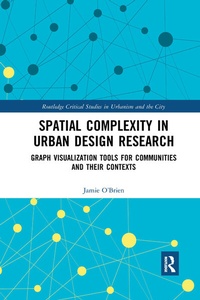
Spatial Complexity in Urban Design Research
Graph Visualization Tools for Communities and their Contexts
1st Edition
Published on 18. December 2020
Book
Paperback/Softback
156 pages
978-0-367-72826-7 (ISBN)
Description
This book offers state-of-the-art 'tools for thinking' for urban designers, planners and decision-makers.
Thematically it focuses on the contexts of problems in urban design and places community spaces at the heart of urban design research. The book provides practicable tools for network modelling and visualization in urban design research. Step-by-step examples take readers through methods for tracing the evolution of road networks, and their impacts on contemporary community spaces. Easy-to-follow guides to programming show how to process and plot community data sets as network graphs. They reveal how these can help to observe and represent the different ways in which community spaces are inter-connected. This book places these technological methods in the context of current theories of community formations. It considers how these cutting-edge tools for thinking in urban design research - comprising both theories and methods - could transform our understanding of community spaces as being complex, inter-dependent and socially meaningful assets.
This book is pioneering in its analysis of the urban contexts to community formations, and in its argument for professional integration between urban and knowledge practitioners. Academics and professionals within the fields of design research, urban studies, spatial analysis, urban geography and sociology will benefit from reading this book.
Thematically it focuses on the contexts of problems in urban design and places community spaces at the heart of urban design research. The book provides practicable tools for network modelling and visualization in urban design research. Step-by-step examples take readers through methods for tracing the evolution of road networks, and their impacts on contemporary community spaces. Easy-to-follow guides to programming show how to process and plot community data sets as network graphs. They reveal how these can help to observe and represent the different ways in which community spaces are inter-connected. This book places these technological methods in the context of current theories of community formations. It considers how these cutting-edge tools for thinking in urban design research - comprising both theories and methods - could transform our understanding of community spaces as being complex, inter-dependent and socially meaningful assets.
This book is pioneering in its analysis of the urban contexts to community formations, and in its argument for professional integration between urban and knowledge practitioners. Academics and professionals within the fields of design research, urban studies, spatial analysis, urban geography and sociology will benefit from reading this book.
More details
Series
Language
English
Place of publication
London
United Kingdom
Publishing group
Taylor & Francis Ltd
Target group
College/higher education
Postgraduate and Undergraduate
Dimensions
Height: 234 mm
Width: 156 mm
Weight
300 gr
ISBN-13
978-0-367-72826-7 (9780367728267)
Copyright in bibliographic data and cover images is held by Nielsen Book Services Limited or by the publishers or by their respective licensors: all rights reserved.
Schweitzer Classification
Other editions
Additional editions
Jamie O'Brien
Spatial Complexity in Urban Design Research
Graph Visualization Tools for Communities and their Contexts
Book
06/2019
1st Edition
Routledge
€215.41
Shipment within 10-20 days
Jamie O'Brien
Spatial Complexity in Urban Design Research
Graph Visualization Tools for Communities and their Contexts
E-Book
06/2019
1st Edition
Routledge
€61.99
Available for download
Jamie O'Brien
Spatial Complexity in Urban Design Research
Graph Visualization Tools for Communities and their Contexts
E-Book
06/2019
1st Edition
Routledge
€61.99
Available for download
Person
Jamie O'Brien is a design research specialist at URBED, working with spatial data analysis and visualization. He was a Research Fellow at Salford University's School of the Built Environment, and Senior Research Associate at the Bartlett Centre for Advanced Spatial Analysis, University College London (UCL). He holds a EPSRC doctorate in design from the Bartlett School of Architecture, UCL, and is Fellow of the Royal Geographical Society, member of the Design Research Society, and Fellow of the Higher Education Academy.
Content
Acknowledgements. List of figures. List of tables.1. Design research in the built environment 2. Design thinking and spatial complexity 3. A case-based approach to design research 4. Building on the past 5. Community network toolkit I 6. Community network toolkit II 7. Building and representing knowledge 8. Cases in urban community formations. Epilogue.
References. Index.
References. Index.