

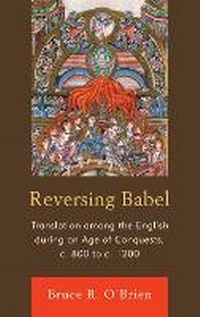
Reversing Babel
Translation Among the English During an Age of Conquests, c. 800 to c. 1200
Published on 21. July 2011
Book
Hardback
362 pages
978-1-61149-052-7 (ISBN)
Description
Reversing Babel: Translation among the English during an Age of Conquests, c. 800 to c. 1200, starts with a small puzzle: Why did the Normans translate English law, the law of the people they had conquered, from Old English into Latin? Solving this puzzle meant asking questions about what medieval writers thought about language and translation, what created the need and desire to translate, and how translators went about the work. These are the questions Reversing Babel attempts to answer by providing evidence that comes from the world in which not just Norman translators of law but any translators of any texts, regardless of languages, did their translating.
Reversing Babel reaches back from 1066 to the translation work done in an earlier conquest-a handful of important works translated in the ninth century in response to the alleged devastating effect of the Viking invasions-and carries the analysis up to the wave of Anglo-French translations created in the late twelfth century when England was a part of a large empire, ruled by a king from Anjou who held power not only in western France from Normandy in the north to the Pyrenees in the south, but also in Ireland, Scotland, and Wales. In this longer and wider view, the impact of political events on acts of translation is more easily weighed against the impact of other factors such as geography, travel, trade, community, trends in learning, ideas about language, and habits of translation. These factors colored the contact situations created in England between speakers and readers of different languages during perhaps the most politically unstable period in English history.
The variety of medieval translation among the English, and among those translators working in the greater empires of Cnut, the Normans, and the Angevins, is remarkable. Reversing Babel does not try to describe all of it; rather, it charts a course through the evidence and tries to answer the fundamental questions medieval historians should ask when their sources are
Reversing Babel reaches back from 1066 to the translation work done in an earlier conquest-a handful of important works translated in the ninth century in response to the alleged devastating effect of the Viking invasions-and carries the analysis up to the wave of Anglo-French translations created in the late twelfth century when England was a part of a large empire, ruled by a king from Anjou who held power not only in western France from Normandy in the north to the Pyrenees in the south, but also in Ireland, Scotland, and Wales. In this longer and wider view, the impact of political events on acts of translation is more easily weighed against the impact of other factors such as geography, travel, trade, community, trends in learning, ideas about language, and habits of translation. These factors colored the contact situations created in England between speakers and readers of different languages during perhaps the most politically unstable period in English history.
The variety of medieval translation among the English, and among those translators working in the greater empires of Cnut, the Normans, and the Angevins, is remarkable. Reversing Babel does not try to describe all of it; rather, it charts a course through the evidence and tries to answer the fundamental questions medieval historians should ask when their sources are
Reviews / Votes
In this thoughtful and thought-provoking work, Bruce R. O'Brien reviews evidence of translation practices in England, mainly involving English, Latin, and French, over four centuries, from the height of the first wave of Viking invasions to the aftermath of what he calls the Angevin Conquest of 1154. ... The real strength of this book, however, lies not in broad conclusions but in the many intelligent, astute, and original insights the author provides about the work of translating in medieval England. O'Brien clearly draws heavily on his own experience as an editor and translator of legal texts from the period, and it makes him a particularly skillful commentator on the subject. This will be a very important book for anyone interested in translation, languages, and cultural interaction in the medieval period. * American Historical Review * Reversing Babel is a helpful, even necessary, book and deserves a wide audience. The synthesis it presents is the product of an eye-watering quantity of reading across a mind-numbing number of disciplines. ... Reversing Babel is an admirable achievement, and deserves a large readership. * English Historical Review *More details
Language
English
Place of publication
United States
Publishing group
Bloomsbury Publishing Plc
Dimensions
Height: 239 mm
Width: 164 mm
Thickness: 27 mm
Weight
603 gr
ISBN-13
978-1-61149-052-7 (9781611490527)
Copyright in bibliographic data and cover images is held by Nielsen Book Services Limited or by the publishers or by their respective licensors: all rights reserved.
Schweitzer Classification
Other editions
Additional editions
Bruce R. O'Brien
Reversing Babel
Translation Among the English During an Age of Conquests, c. 800 to c. 1200
E-Book
04/2011
1st Edition
University of Delaware Press
€110.99
Available for download
Bruce R. O'Brien
Reversing Babel
Translation Among the English During an Age of Conquests, c. 800 to c. 1200
E-Book
04/2011
1st Edition
University of Delaware Press
€110.99
Available for download
Person
Bruce O'Brien is professor of history at the University of Mary Washington, a visiting fellow at the Institute of Historical Research in London, and was a visiting fellow at Harvard Law School. He is also chair of the literary board of the Early English Laws project.
Content
Chapter 1 List of Figures and Maps Chapter 2 Preface Chapter 3 Abbreviations Chapter 4 Introduction Chapter 5 Language and Translation in the Middle Ages Chapter 6 Language Contact in Conquered England Chapter 7 Motives Chapter 8 Methods: Practical Matters Chapter 9 Methods: Translators' Choices Chapter 10 Final Observations Chapter 11 Appendix: Principal and Representative Translations Chapter 12 Works Cited Chapter 13 Index