

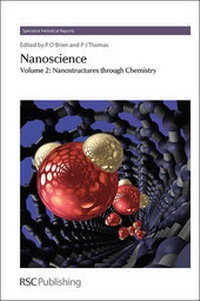
Nanoscience
Volume 2: Nanostructures through Chemistry
Will be published approx. on 2. December 2013
Book
Hardback
295 pages
978-1-84973-582-7 (ISBN)
Description
The field of nanoscience continues to grow at an impressive rate, with over 10,000 new articles a year contributing to a literature of more than half a million citations. Such a vast landscape of material requires careful searching to discover the most important discoveries. The introduction of the newest Specialist Periodical Report by the Royal Society of Chemistry: Nanoscience, provides a critical and comprehensive assesment of the most recent research and opinion. With contributions from across the globe, this new series ensures readers will be well-versed in the latest research and methodologies. Some chapters will also present a special focus in emerging countries contributing to the field, such as India and China.
Anyone practicing in any nano-allied field, or wishing to enter the nano-world will benefit from the comprehensive resource, which will be published annually.
Anyone practicing in any nano-allied field, or wishing to enter the nano-world will benefit from the comprehensive resource, which will be published annually.
More details
Series
Language
English
Place of publication
Cambridge
United Kingdom
Target group
Professional and scholarly
Product notice
Unsewn / adhesive bound
Dimensions
Height: 234 mm
Width: 156 mm
Weight
598 gr
ISBN-13
978-1-84973-582-7 (9781849735827)
Copyright in bibliographic data and cover images is held by Nielsen Book Services Limited or by the publishers or by their respective licensors: all rights reserved.
Schweitzer Classification
Other editions
Additional editions
E-Book
11/2013
1st Edition
Royal Society of Chemistry
€433.99
Available for download
Persons
Professor Paul O'Brien FRS is Professor of Inorganic Materials at the University of Manchester. Processes he pioneered have been widely adopted. His discoveries include substantial improvements in the constitution, stoichiometry and nature of precursors. He has shown how relatively stable compounds can be used to prepare high quality functional materials, and developed improved methods to convert precursors into useful functional products, devising and refining ways by which nanoparticles syntheses can be controlled within the size limits require for device use.
Dr P John Thomas is Lecturer of Physical Chemistry at Bangor University. His research is concerned with solid state chemistry including: synthesis and assembly of nanoparticles, charge transport in films of nanocrystals, interfacial phenomena and self-assembly. He is particularly interested in nanocrystalline architectures for energy generation applications. He has authored over 45 papers, a monograph on nanocrystals and contributed to a number of books and reports.
Dr P John Thomas is Lecturer of Physical Chemistry at Bangor University. His research is concerned with solid state chemistry including: synthesis and assembly of nanoparticles, charge transport in films of nanocrystals, interfacial phenomena and self-assembly. He is particularly interested in nanocrystalline architectures for energy generation applications. He has authored over 45 papers, a monograph on nanocrystals and contributed to a number of books and reports.
Content
Oxides;
Metals;
Energy and Nano;
Perspective on Photocatalytic Materials Chemistry in China;
Nanostructured Non-ITO Based Transparent Conducting Electrodes;
Nano Dimensional ZnO and its Application;
Nano in Water Splitting and Artificial Photosynthesis;
Nano in Batteries;
Indian Perspective
Metals;
Energy and Nano;
Perspective on Photocatalytic Materials Chemistry in China;
Nanostructured Non-ITO Based Transparent Conducting Electrodes;
Nano Dimensional ZnO and its Application;
Nano in Water Splitting and Artificial Photosynthesis;
Nano in Batteries;
Indian Perspective