

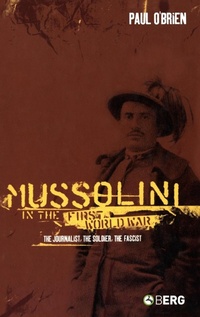
Mussolini in the First World War
The Journalist, the Soldier, the Fascist
Published on 1. November 2004
Book
Hardback
224 pages
978-1-84520-051-0 (ISBN)
Description
How did Benito Mussolini come to fascism? Standard accounts of the dictator have failed to explain satisfactorily the transition from his pre-World War I 'socialism' to his post-war fascism. This controversial new book is the first to examine closely Mussolini's political trajectory during the Great War as evidenced in his journalistic writings, speeches and war diary, as well as some previously unexamined archive material. The author argues that the 1914-18 conflict provided the catalyst for Mussolini to clarify his deep-rooted nationalist tendencies. He demonstrates that Mussolini's interventionism was already anti-socialist and anti-democratic in the early autumn of 1914 and shows how in and through the experience of the conflict the future duce fine-tuned his authoritarian and totalitarian vision of Italy in a state of permanent mobilization for war. Providing a radical new interpretation of one of the most important dictators of the twentieth century, Mussolini in the First World War will appeal to anyone who wants to learn more about the roots of fascism in modern Europe.
Reviews / Votes
'An important study of the young Mussolini, this book shows us the future fascist leader in a new light, helping us to understand better why Italy turned to fascism and how Mussolini himself - still a socialist firebrand in 1914 - became the champion of the Italian Right. This study will become essential reading for anyone wanting to understand the development of the fascist movement and its duce.' Paul Corner, Professor of European History, University of Siena'This book makes a real contribution to our knowledge of the birth of fascism in Italy. Hitherto, historians have ignored Mussolinis experience as combatant in the First World War. Paul OBrien has identified a major gap in the research, and he argues cogently for the crucial role of Mussolinis war experience. This provocative, but carefully argued, book is a welcome application of the new cultural history of the Great War and will be essential reading for those seeking to understand the origins of fascism.' Alan Kramer, cMore details
Language
English
Place of publication
London
United Kingdom
Publishing group
Bloomsbury Publishing PLC
Target group
College/higher education
Professional and scholarly
Illustrations
bibliography, index
Dimensions
Height: 240 mm
Width: 161 mm
Thickness: 17 mm
Weight
508 gr
ISBN-13
978-1-84520-051-0 (9781845200510)
Copyright in bibliographic data and cover images is held by Nielsen Book Services Limited or by the publishers or by their respective licensors: all rights reserved.
Schweitzer Classification
Other editions
Additional editions
E-Book
03/2014
1st Edition
Bloomsbury Academic
€38.49
Available for download
E-Book
03/2014
1st Edition
Berg Publishers
€38.49
Available for download
Person
Content
Introduction * Stating the Programme: Imperialism and the Aesthetic of Violence, November 1918-June 1919 * Neutral? The Cultural Politics of Neutrality and Intervention, August-November 1914 * Making the 'Man':'Mazzini', Nationalism, and the Aesthetics of Violence, November 1914-May 1915 * Mind and Matter: Mussolini and Italy at War, May-November 1915 * Digging In: Rear, Front and the Consequences of Invasion, November 1915-June 1916 * Disenchanted Warrior: Revitalisation and Collapse of the War Diary, November 1916-February 1917 * War and Revolution: Readdressing the Home Front, February-October 1917 * Caporetto and After: Reinstating the Offensive, October 1917-November 1918 * Imagining Fascism: Mussolini, the Middle Classes and the Craft of Propaganda, October 1917-November 1918 * Conclusion