

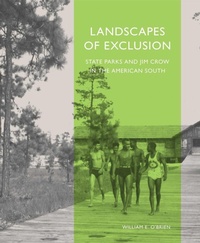
Landscapes of Exclusion
State Parks and Jim Crow in the American South
Published on 1. March 2022
Book
Paperback/Softback
208 pages
978-1-952620-35-5 (ISBN)
Description
The first-ever study of state park segregation across the Jim Crow South
Winner, J. B. Jackson Book Prize from the Foundation for Landscape Studies
Award of Merit, American Association for State and Local History
An outgrowth of earlier park movements, the state park movement in the twentieth century sought to expand public access to scenic places. But under severe Jim Crow restrictions in the South, access for Blacks was routinely and officially denied. The New Deal brought a massive wave of state park expansion, and advocacy groups pressured the National Park Service to design and construct segregated facilities for Blacks. These parks were typically substandard in relation to “white only” areas.
After World War II, the NAACP filed federal lawsuits that demanded park integration, and southern park agencies reacted with attempts to expand access to additional segregated facilities, hoping they could demonstrate that their parks achieved the “separate but equal” standard. But the courts consistently ruled in favor of integration, leading to the end of state park segregation by the mid-1960s. Even though it has largely faded from public awareness, the imprint of segregated state park design remains visible throughout the South.
William E. O'Brien illuminates this untold facet of Jim Crow history in the first-ever study of state park segregation. Emphasizing the historical trajectory of events leading to integration, his book underscores the profound inequality that persisted for decades in the number, size, and quality of state park spaces provided for Black visitors across the Jim Crow South.
Winner, J. B. Jackson Book Prize from the Foundation for Landscape Studies
Award of Merit, American Association for State and Local History
An outgrowth of earlier park movements, the state park movement in the twentieth century sought to expand public access to scenic places. But under severe Jim Crow restrictions in the South, access for Blacks was routinely and officially denied. The New Deal brought a massive wave of state park expansion, and advocacy groups pressured the National Park Service to design and construct segregated facilities for Blacks. These parks were typically substandard in relation to “white only” areas.
After World War II, the NAACP filed federal lawsuits that demanded park integration, and southern park agencies reacted with attempts to expand access to additional segregated facilities, hoping they could demonstrate that their parks achieved the “separate but equal” standard. But the courts consistently ruled in favor of integration, leading to the end of state park segregation by the mid-1960s. Even though it has largely faded from public awareness, the imprint of segregated state park design remains visible throughout the South.
William E. O'Brien illuminates this untold facet of Jim Crow history in the first-ever study of state park segregation. Emphasizing the historical trajectory of events leading to integration, his book underscores the profound inequality that persisted for decades in the number, size, and quality of state park spaces provided for Black visitors across the Jim Crow South.
More details
Language
English
Place of publication
United States
Product notice
Paperback (trade)
Unsewn / adhesive bound
Illustrations
56 Halftones, black and white
Dimensions
Height: 252 mm
Width: 214 mm
Thickness: 20 mm
Weight
612 gr
ISBN-13
978-1-952620-35-5 (9781952620355)
Copyright in bibliographic data and cover images is held by Nielsen Book Services Limited or by the publishers or by their respective licensors: all rights reserved.
Schweitzer Classification
Person
By William E. O'Brien
Content
Series Editor's Preface by Ethan Carr ix
Preface xiii
Introduction 3
1. Jim Crow Recreation 19
2. The New Deal and Early State Parks in the South 41
3. Park Service Planning Meets Resistance 73
4. Pursuing “Separate but Equal” after World War II 97
5. Going to Court 123
6. What's Become of the Parks? 149
Notes 159
Index 181
Preface xiii
Introduction 3
1. Jim Crow Recreation 19
2. The New Deal and Early State Parks in the South 41
3. Park Service Planning Meets Resistance 73
4. Pursuing “Separate but Equal” after World War II 97
5. Going to Court 123
6. What's Become of the Parks? 149
Notes 159
Index 181