

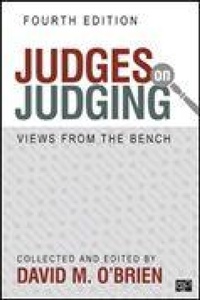
Judges on Judging
Views from the Bench
4th Edition
Published on 20. November 2012
Book
Paperback/Softback
392 pages
978-1-4522-2783-2 (ISBN)
Description
Thoroughly revised and updated for this fourth edition, Judges on Judging offers insights into the judicial philosophies and political views of those on the bench. Broad in scope, this one-of-a-kind book features "off-the-bench" writings and speeches in which Supreme Court justices, as well as lower federal and state court judges, discuss the judicial process, constitutional and statutory interpretation, judicial federalism, and the role of the judiciary.
Engaging introductory material provides students with necessary thematic and historical context making this book the perfect supplement to present a nuanced view of the judiciary.
Engaging introductory material provides students with necessary thematic and historical context making this book the perfect supplement to present a nuanced view of the judiciary.
More details
Edition
4th Revised edition
Language
English
Place of publication
Washington
United States
Publishing group
SAGE Publications Inc
Target group
College/higher education
Edition type
Revised edition
Product notice
Paperback (trade)
Dimensions
Height: 229 mm
Width: 152 mm
Thickness: 21 mm
Weight
527 gr
ISBN-13
978-1-4522-2783-2 (9781452227832)
Copyright in bibliographic data and cover images is held by Nielsen Book Services Limited or by the publishers or by their respective licensors: all rights reserved.
Schweitzer Classification
Other editions
New editions
Book
08/2016
5th Edition
CQ Press
€117.90
Shipment within 15-20 days
Previous edition
Book
09/2008
3rd Edition
CQ Press
€55.89
Article exhausted; check for reprint
Person
David M. O'Brien is the Leone Reaves and George W. Spicer Professor at the University of Virginia. Prior to teaching at the University of Virginia, he taught at the University of California, Santa Barbara, and the University of Puget Sound, where he was chairman of the Department of Politics. He served as a research associate in the Office of the Administrative Assistant to the Chief Justice and, in 1982-1983, as a judicial fellow at the Supreme Court. He also has been a visiting fellow at the Russell Sage Foundation in New York (1981-1982); has been a Fulbright lecturer in constitutional studies at Oxford University, England (1987-1988); has been a Fulbright researcher in Japan (1993-1994); has held the Fulbright Chair for Senior Scholars at the University of Bologna in Italy (1999); and was a visiting professor at Florida International University (2002) and at the Institut d'Etudes Politique, Universite Lumiere-Lyon II in Lyon, France (2006).
Among his many books are Storm Center: The Supreme Court in American Politics, eleventh edition (2017), which won the American Bar Association's Silver Gavel Award; Constitutional Law and Politics: Struggles for Power and Governmental Accountability and Civil Rights and Civil Liberties, tenth edition, two volumes (2017); Animal Sacrifice and Religious Freedom: Church of the Lukumi Babalu Aye v. City of Hialeah (2004); To Dream of Dreams: Religious Freedom and Constitutional Politics in Postwar Japan (1996); Supreme Court Watch, published annually since 1991; Congress Shall Make No Law: The First Amendment, Unprotected Expression, and the U.S. Supreme Court (2010); Judicial Roulette (1988); What Process Is Due? Courts and Science Policy Disputes (1987); The Public's Right to Know: The First Amendment and the Supreme Court (1981); and Privacy, Law, and Public Policy (1979). He has coauthored The Judicial Process: Law, Court and Judicial Politics (2015), Courts and Judicial Policymaking (2008) Government by the People (22nd ed. 2008), and Abortion and American Politics (1993); edited or coedited several books, including The Lanahan Readings on Civil Rights and Civil Liberties, third edition (2010) and Judicial Independence in the Age of Democracy: Critical Perspectives from Around the World (2001); and contributed more than 100 articles and chapters in professional journals and books.
Among his many books are Storm Center: The Supreme Court in American Politics, eleventh edition (2017), which won the American Bar Association's Silver Gavel Award; Constitutional Law and Politics: Struggles for Power and Governmental Accountability and Civil Rights and Civil Liberties, tenth edition, two volumes (2017); Animal Sacrifice and Religious Freedom: Church of the Lukumi Babalu Aye v. City of Hialeah (2004); To Dream of Dreams: Religious Freedom and Constitutional Politics in Postwar Japan (1996); Supreme Court Watch, published annually since 1991; Congress Shall Make No Law: The First Amendment, Unprotected Expression, and the U.S. Supreme Court (2010); Judicial Roulette (1988); What Process Is Due? Courts and Science Policy Disputes (1987); The Public's Right to Know: The First Amendment and the Supreme Court (1981); and Privacy, Law, and Public Policy (1979). He has coauthored The Judicial Process: Law, Court and Judicial Politics (2015), Courts and Judicial Policymaking (2008) Government by the People (22nd ed. 2008), and Abortion and American Politics (1993); edited or coedited several books, including The Lanahan Readings on Civil Rights and Civil Liberties, third edition (2010) and Judicial Independence in the Age of Democracy: Critical Perspectives from Around the World (2001); and contributed more than 100 articles and chapters in professional journals and books.
Content
Introduction
I. JUDICIAL REVIEW AND AMERICAN POLITICS: HISTORICAL AND POLITICAL PERSPECTIVES
1. The Doctrine of Judicial Review: Mr. Marshall, Mr. Jefferson, and Mr. Marbury - Chief Justice Warren E. Burger, Supreme Court of the United States
2. The Supreme Court in the American System of Government - Justice Robert H. Jackson, Supreme Court of the United States
3. The Two Faces of Judicial Activism - Judge William Wayne Justics, U.S. District Court, Eastern District of Texas
II. THE DYNAMICS OF THE JUDICIAL PROCESS
4. Advice and Consent in Theory and Practice - Judge Roger J. Miner, U.S. Court of Appeals, Second Circuit
5. The "Fight" Theory versus the "Truth" Theory - Judge Jerome Frank, U.S. Court of Appeals, Second Circuit
6. The Adversary Judge: The Experience of the Trial Judge - Judge Marvin E. Frankel, U.S. District Court, Southern District of New York
7. The Business of the U.S. District Courts - Judge D. Brock Hornby, U.S. District Court, District of Maine
8. What I Ate for Breakfast and Other Mysteries of Judicial Decision Making - Judge Alex Kozinski, U.S. Court of Appeals, Ninth Circuit
9. Whose Federal Judiciary Is It Anyway? - Judge Stephen Reinhardt, U.S. Court of Appeals, Ninth Circuit
10. What Really Goes on at the Supreme Court - Justice Lewis F. Powell Jr., Supreme Court of the United States
11. The Supreme Court's Conference - Chief Justice William H. Rehnquist, Supreme Court of the United States
12. Deciding What to Decide: The Docket and the Rule of Four - Justice John Paul Stevens, Supreme Court of the United States
13. The Role of Oral Argument - Justice John M. Harlan II, Supreme Court of the United States
14. The Dissent: A Safeguard of Democracy - Justice William O. Douglas, Supreme Court of the United States
III. THE JUDICIARY AND THE CONSTITUTION
15. Commentaries on the Constitution of the United States - Justice Joseph Story, Supreme Court of the United States
16. The Path of Law - Justice Oliver Wendell Holmes Jr., Supreme Court of the United States
17. The Judge as a Legislator - Justice Benjamin N. Cardozo, Supreme Court of the United States
18. The Notion of a Living Constitution - Chief Justice William H. Rehnquist, Supreme Court of the United States
19. A Relativistic Constitution - Judge William Wayne Justice, U.S. District Court, Eastern District of Texas
20. The Jurisprudence of Judicial Restraint: A Return to the Moorings - Judge J. Clifford Wallace, U.S. Court of Appeals, Ninth Circuit
21. Tradition and Morality in Constitutional Law - Judge Robert H. Bork. U.S. Court of Appeals, District of Columbia Circuit
22. What Am I, a Potted Plant? The Case Against Strict Constructionism - Judge Richard A. Posner, U.S. Court of Appeals, Seventh Circuit
23. Originalism: The Lesser Evil - Justice Antonin Scalia, Supreme Court of the United States
24. Judging - Justice Clarence Thomas, Supreme Court of the United States
25. The Constitution: A Living Document - Justice Thurgood Marshall, Supreme Court of the United States
26. The Constitution of the United States: Contemporary Ratification - Justice William J. Brennan Jr., Supreme Court of the United States
27. On Constitutional Interpretation - Justice David H. Souter, Supreme Court of the United States
28. Speaking in a Judicial Voice: Reflections on Roe v. Wade - Justice Ruth Bader Ginsburg, Supreme Court of the United States
29. Our Democratic Constitution - Justice Stephen G. Breyer, Supreme Court of the United States
30. Against Constitutional Theory - Judge Richard A. Posner, U.S. Court of Appeals, Seventh Circuit
IV. OUR DUAL CONSTITUTIONAL SYSTEM: THE BILL OF RIGHTS AND THE STATES
31. The Bill of Rights - Justice Hugo L. Black, Supreme Court of the United States
32. Guardians of Our Liberties-State Courts No Less Than Federal - Justice William J. Brennan Jr., Supreme Court of the United States
33. First Things First: Rediscovering the States' Bills of Rights - Justice Hans A. Linde, Oregon State Supreme Court
34. What Does-and Does Not-Ail State Constitutional Law - Judge Jeffrey S. Sutton, U.S. Court of Appeals, Sixth Circuit
Appendix A: Constitution of the United States, Article III
Appendix B: The Federalist, No. 78, Alexander Hamilton
Appendix C: Selected Bibliography of Off-the-Bench Commentaries
Appendix D: Time Chart of Members of the Supreme Court of the United States
About the Editor
I. JUDICIAL REVIEW AND AMERICAN POLITICS: HISTORICAL AND POLITICAL PERSPECTIVES
1. The Doctrine of Judicial Review: Mr. Marshall, Mr. Jefferson, and Mr. Marbury - Chief Justice Warren E. Burger, Supreme Court of the United States
2. The Supreme Court in the American System of Government - Justice Robert H. Jackson, Supreme Court of the United States
3. The Two Faces of Judicial Activism - Judge William Wayne Justics, U.S. District Court, Eastern District of Texas
II. THE DYNAMICS OF THE JUDICIAL PROCESS
4. Advice and Consent in Theory and Practice - Judge Roger J. Miner, U.S. Court of Appeals, Second Circuit
5. The "Fight" Theory versus the "Truth" Theory - Judge Jerome Frank, U.S. Court of Appeals, Second Circuit
6. The Adversary Judge: The Experience of the Trial Judge - Judge Marvin E. Frankel, U.S. District Court, Southern District of New York
7. The Business of the U.S. District Courts - Judge D. Brock Hornby, U.S. District Court, District of Maine
8. What I Ate for Breakfast and Other Mysteries of Judicial Decision Making - Judge Alex Kozinski, U.S. Court of Appeals, Ninth Circuit
9. Whose Federal Judiciary Is It Anyway? - Judge Stephen Reinhardt, U.S. Court of Appeals, Ninth Circuit
10. What Really Goes on at the Supreme Court - Justice Lewis F. Powell Jr., Supreme Court of the United States
11. The Supreme Court's Conference - Chief Justice William H. Rehnquist, Supreme Court of the United States
12. Deciding What to Decide: The Docket and the Rule of Four - Justice John Paul Stevens, Supreme Court of the United States
13. The Role of Oral Argument - Justice John M. Harlan II, Supreme Court of the United States
14. The Dissent: A Safeguard of Democracy - Justice William O. Douglas, Supreme Court of the United States
III. THE JUDICIARY AND THE CONSTITUTION
15. Commentaries on the Constitution of the United States - Justice Joseph Story, Supreme Court of the United States
16. The Path of Law - Justice Oliver Wendell Holmes Jr., Supreme Court of the United States
17. The Judge as a Legislator - Justice Benjamin N. Cardozo, Supreme Court of the United States
18. The Notion of a Living Constitution - Chief Justice William H. Rehnquist, Supreme Court of the United States
19. A Relativistic Constitution - Judge William Wayne Justice, U.S. District Court, Eastern District of Texas
20. The Jurisprudence of Judicial Restraint: A Return to the Moorings - Judge J. Clifford Wallace, U.S. Court of Appeals, Ninth Circuit
21. Tradition and Morality in Constitutional Law - Judge Robert H. Bork. U.S. Court of Appeals, District of Columbia Circuit
22. What Am I, a Potted Plant? The Case Against Strict Constructionism - Judge Richard A. Posner, U.S. Court of Appeals, Seventh Circuit
23. Originalism: The Lesser Evil - Justice Antonin Scalia, Supreme Court of the United States
24. Judging - Justice Clarence Thomas, Supreme Court of the United States
25. The Constitution: A Living Document - Justice Thurgood Marshall, Supreme Court of the United States
26. The Constitution of the United States: Contemporary Ratification - Justice William J. Brennan Jr., Supreme Court of the United States
27. On Constitutional Interpretation - Justice David H. Souter, Supreme Court of the United States
28. Speaking in a Judicial Voice: Reflections on Roe v. Wade - Justice Ruth Bader Ginsburg, Supreme Court of the United States
29. Our Democratic Constitution - Justice Stephen G. Breyer, Supreme Court of the United States
30. Against Constitutional Theory - Judge Richard A. Posner, U.S. Court of Appeals, Seventh Circuit
IV. OUR DUAL CONSTITUTIONAL SYSTEM: THE BILL OF RIGHTS AND THE STATES
31. The Bill of Rights - Justice Hugo L. Black, Supreme Court of the United States
32. Guardians of Our Liberties-State Courts No Less Than Federal - Justice William J. Brennan Jr., Supreme Court of the United States
33. First Things First: Rediscovering the States' Bills of Rights - Justice Hans A. Linde, Oregon State Supreme Court
34. What Does-and Does Not-Ail State Constitutional Law - Judge Jeffrey S. Sutton, U.S. Court of Appeals, Sixth Circuit
Appendix A: Constitution of the United States, Article III
Appendix B: The Federalist, No. 78, Alexander Hamilton
Appendix C: Selected Bibliography of Off-the-Bench Commentaries
Appendix D: Time Chart of Members of the Supreme Court of the United States
About the Editor