

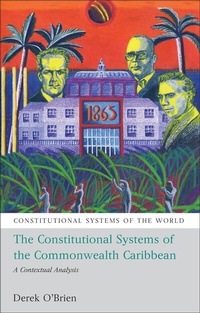
The Constitutional Systems of the Commonwealth Caribbean
A Contextual Analysis
1st Edition
Published on 22. May 2014
Book
Paperback/Softback
328 pages
978-1-84946-152-8 (ISBN)
Description
The Commonwealth Caribbean comprises a group of countries (mainly islands) lying in an arc between Florida in the north and Venezuela in the south. Varying widely in terms of their size, population, ethnic composition and economic wealth, these countries are, nevertheless, linked by their shared experience of colonial rule under the British Empire and their decision, upon attaining independence, to adopt a constitutional system of government based on the so-called 'Westminster model'.
Since independence these countries have, in the main, enjoyed a sustained period of relative political stability, which is in marked contrast to the experience of former British colonies in Africa and Asia. This book seeks to explore how much of this is due to their constitutional arrangements by examining the constitutional systems of these countries in their context and questioning how well the Westminster model of democracy has successfully adapted to its transplantation to the Commonwealth Caribbean.
While taking due account of the region's colonial past and its imprint on postcolonial constitutionalism, the book also considers notable developments that have occurred since independence. These include the transformation of Guyana from a parliamentary democracy to a Cooperative Republic with an executive president; the creation of a Caribbean Single Market and Economy and its implications for national sovereignty; and the replacement of the Judicial Committee of the Privy Council by the Caribbean Court of Justice as the final court of appeal for a number of countries in the region. The book also addresses the resurgence of interest in constitutional reform across the region in the last two decades, which has culminated in demands for radical reforms of the Westminster model of government and the severance of all remaining links with colonial rule.
Since independence these countries have, in the main, enjoyed a sustained period of relative political stability, which is in marked contrast to the experience of former British colonies in Africa and Asia. This book seeks to explore how much of this is due to their constitutional arrangements by examining the constitutional systems of these countries in their context and questioning how well the Westminster model of democracy has successfully adapted to its transplantation to the Commonwealth Caribbean.
While taking due account of the region's colonial past and its imprint on postcolonial constitutionalism, the book also considers notable developments that have occurred since independence. These include the transformation of Guyana from a parliamentary democracy to a Cooperative Republic with an executive president; the creation of a Caribbean Single Market and Economy and its implications for national sovereignty; and the replacement of the Judicial Committee of the Privy Council by the Caribbean Court of Justice as the final court of appeal for a number of countries in the region. The book also addresses the resurgence of interest in constitutional reform across the region in the last two decades, which has culminated in demands for radical reforms of the Westminster model of government and the severance of all remaining links with colonial rule.
Reviews / Votes
[The Constitutional Systems of the Commonwealth Caribbean] was far from a 'dry read' and while chapter six was very much written from a lawyer's perspective (from which I learnt a great deal, incidentally) much of the book was very accessible to students and the general public who have an interest in such issues. Indeed I consider that one of the great strengths of the book is its ability to provide a commentary on these matters that is intelligible to the general reader. Its other great strength is its comparative aspect which as you know is lacking in the region. You have now provided it and if it seems there is always an exception (one constitution that provides differently) that in itself is interesting to note. * Endorsement from Professor Paul Sutton, Hull University, June 2014 *More details
Series
Language
English
Place of publication
Oxford
United Kingdom
Publishing group
Bloomsbury Publishing PLC
Target group
Professional and scholarly
Product notice
Hardback (stationery)
Dimensions
Height: 214 mm
Width: 134 mm
Thickness: 20 mm
Weight
440 gr
ISBN-13
978-1-84946-152-8 (9781849461528)
Copyright in bibliographic data and cover images is held by Nielsen Book Services Limited or by the publishers or by their respective licensors: all rights reserved.
Schweitzer Classification
Other editions
Additional editions

E-Book
12/2014
1st Edition
Hart Publishing
€31.99
Available for download
E-Book
12/2014
1st Edition
Hart Publishing
€31.99
Available for download
Person
Content
1. CONSTITUTIONAL HISTORY
2. THE HEAD OF STATE
3. ELECTORAL SYSTEMS
4. THE EXECUTIVE
5. PARLIAMENT
6. THE CONSTITUIONAL ROLE OF THE COURTS
7. THE CONSTITUIONAL IMPLICATIONS
8. POST-INDEPENDENCE CONSTITUIONAL REFORM
2. THE HEAD OF STATE
3. ELECTORAL SYSTEMS
4. THE EXECUTIVE
5. PARLIAMENT
6. THE CONSTITUIONAL ROLE OF THE COURTS
7. THE CONSTITUIONAL IMPLICATIONS
8. POST-INDEPENDENCE CONSTITUIONAL REFORM