

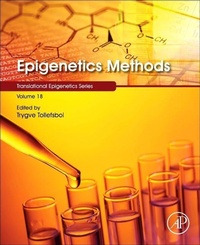
Epigenetics Methods: Volume 18
Volume 18
Published on 2. July 2020
Book
Paperback/Softback
736 pages
978-0-12-819414-0 (ISBN)
Description
In recent years, the field of epigenetics has grown significantly, driving new understanding of human developmental processes and disease expression, as well as advances in diagnostics and therapeutics. As the field of epigenetics continues to grow, methods and technologies have multiplied, resulting in a wide range of approaches and tools researchers might employ.
Epigenetics Methods offers comprehensive instruction in methods, protocols, and experimental approaches applied in field of epigenetics. Here, across thirty-five chapters, specialists offer step-by-step overviews of methods used to study various epigenetic mechanisms, as employed in basic and translational research. Leading the reader from fundamental to more advanced methods, the book begins with thorough instruction in DNA methylation techniques and gene or locus-specific methylation analyses, followed by histone modification methods, chromatin evaluation, enzyme analyses of histone methylation, and studies of non-coding RNAs as epigenetic modulators. Recently developed techniques and technologies discussed include single-cell epigenomics, epigenetic editing, computational epigenetics, systems biology epigenetic methods, and forensic epigenetic approaches. Epigenetics methods currently in-development, and their implication for future research, are also considered in-depth.
In addition, as with the wider life sciences, reproducibility across experiments, labs, and subdisciplines is a growing issue for epigenetics researchers. This volume provides consensus-driven methods instruction and overviews. Tollefsbol and contributing authors survey the range of existing methods; identify best practices, common themes, and challenges; and bring unity of approach to a diverse and ever-evolving field.
Epigenetics Methods offers comprehensive instruction in methods, protocols, and experimental approaches applied in field of epigenetics. Here, across thirty-five chapters, specialists offer step-by-step overviews of methods used to study various epigenetic mechanisms, as employed in basic and translational research. Leading the reader from fundamental to more advanced methods, the book begins with thorough instruction in DNA methylation techniques and gene or locus-specific methylation analyses, followed by histone modification methods, chromatin evaluation, enzyme analyses of histone methylation, and studies of non-coding RNAs as epigenetic modulators. Recently developed techniques and technologies discussed include single-cell epigenomics, epigenetic editing, computational epigenetics, systems biology epigenetic methods, and forensic epigenetic approaches. Epigenetics methods currently in-development, and their implication for future research, are also considered in-depth.
In addition, as with the wider life sciences, reproducibility across experiments, labs, and subdisciplines is a growing issue for epigenetics researchers. This volume provides consensus-driven methods instruction and overviews. Tollefsbol and contributing authors survey the range of existing methods; identify best practices, common themes, and challenges; and bring unity of approach to a diverse and ever-evolving field.
More details
Series
Language
English
Place of publication
San Diego
United States
Publishing group
Elsevier Science Publishing Co Inc
Target group
Professional and scholarly
Human geneticists; human genomicists; translational researchers in genomic medicine, epigenetics, aging, developmental and molecular biology; life science researchers; oncologists; immunologists; bioengineers; developmental biologists; pharmacologists in industry and academia
Product notice
Paperback (trade)
Unsewn / adhesive bound
Illustrations
Approx. 120 illustrations (50 in full color)
Dimensions
Height: 235 mm
Width: 191 mm
Thickness: 52 mm
Weight
1470 gr
ISBN-13
978-0-12-819414-0 (9780128194140)
Copyright in bibliographic data and cover images is held by Nielsen Book Services Limited or by the publishers or by their respective licensors: all rights reserved.
Schweitzer Classification
Other editions
New editions
Trygve O. Tollefsbol
Epigenetics Methods
Book
08/2025
2nd Edition
Academic Press
€230.50
Shipment within 15-20 days
Additional editions
Person
Dr. Tollefsbol is a Distinguished Professor at the University of Alabama at Birmingham. He holds doctorates in molecular biology and osteopathic medicine, trained with National Academy of Science members and has over 200 peer-reviewed publications. Reports highlighting the translatability to the lay public of the discoveries made in his laboratory have appeared in international media representing >50 million readers. Dr. Tollefsbol has been featured as an Investigator in the Spotlight by the NIH as well as a Scientist in the Spotlight by ScienceNow. He is an Associate Editor for Frontiers in Genetics, a contributor to Lewin's GENES classic textbook and Lead Editor for Elsevier's Translational Epigenetics Series. Dr. Tollefsbol has been named a "Highly Ranked Scholar? worldwide (ScholarGPS). He has been invited for numerous endowed keynote presentations, his research has been highlighted in eScience News and ScienceDaily and he has published 20 scholarly books on topics related to his research.
Content
1. Modelling candidate genes vs genetic variants
2. Disease in a dish: Cellular models to understand human conditions
3. The Yeast, a versatile model system to study human disease
4. The worm, how can it help?
5. Understanding human genetic disease with the fly
6. The fish as a model for human diseases
7. The mouse model
8. Large animal models of rare genetic disorders
9. Crisper/Cas technology
10. Integrative modeling and novel technologies in human genomics
2. Disease in a dish: Cellular models to understand human conditions
3. The Yeast, a versatile model system to study human disease
4. The worm, how can it help?
5. Understanding human genetic disease with the fly
6. The fish as a model for human diseases
7. The mouse model
8. Large animal models of rare genetic disorders
9. Crisper/Cas technology
10. Integrative modeling and novel technologies in human genomics