

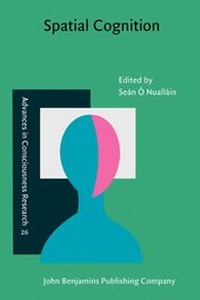
Spatial Cognition
Foundations and applications
Published on 23. November 2000
Book
Paperback/Softback
366 pages
978-90-272-5146-6 (ISBN)
Description
Spatial Cognition brings together psychology, computer science, linguistics and geography, discussing how people think about space (our internal cognitive maps and spatial perception) and how we communicate about space, for instance giving route directions or using spatial metaphors. The technological applications adding dynamism to the area include computer interfaces, educational software, multimedia, and in-car navigation systems. On the experimental level, themes as varied as gender differences in orientation and - of course, wholly unrelated - the role of the hippocampus in rodent navigation are described. Much detailed analysis and computational modeling of the structure of short term memory (STM) is discussed. The papers were presented at the 1998 annual meeting of the Cognitive Science Society of Ireland, Mind III. (Series B)
More details
Series
Language
English
Place of publication
Amsterdam
Netherlands
Target group
Professional and scholarly
Dimensions
Height: 220 mm
Width: 150 mm
Weight
590 gr
ISBN-13
978-90-272-5146-6 (9789027251466)
Copyright in bibliographic data and cover images is held by Nielsen Book Services Limited or by the publishers or by their respective licensors: all rights reserved.
Schweitzer Classification
Other editions
Additional editions
E-Book
11/2000
1st Edition
John Benjamins Publishing Company
€88.99
Available for download
Person
Content
1. Introduction: Spatial Cognition - Foundations and Applications (by O Nuallain, Sean); 2. Part I: Epistemological Issues; 3. Men and Women, Maps and Minds: Cognitive bases of sex-related differences in reading and interpreting maps (by Allen, Gary L.); 4. A Theoretical Framework for the Study of Spatial Cognition (by Tirassa, Maurizio); 5. Describers and Explorers: A method for investigating cognitive maps (by Carassa, Antonella); 6. The Functional Separability of Self-Reference and Object-to-Object Systems in Spatial Memory (by Sholl, M. Jeanne); 7. In Search for an Overall Organizing Principle in Spatial Mental Models: A question of inference (by Hornig, Robin); 8. Describing the Topology of Spherical Regions using the 'RCC' Formalism (by Gotts, Nicholas Mark); 9. Cognitive Mapping in Rats and Humans: The tent-maze, a place learning task in visually disconnected environments (by Grobety, Marie-Claude); 10. Spatial Cognition Without Spatial Concepts (by Smith, Arnold); 11. Space Under Stress: Spatial understanding and new media technologies (by Speed, Chris); 12. Part II: Software Applications: Multimedia, GIS, diagrammatic reasoning and beyond; 13. CHAMELEON meets spatial cognition (by Mc Kevitt, Paul); 14. SONAS: Multimodal, Multi-User Interaction with a Modelled Environment (by O Nuallain, Sean); 15. Designing Real-Time Software Advisors for 3D Spatial Operations (by Eisenberg, Mike); 16. Using Spatial Semantics to Discover and Verify Diagrammatic Demonstrations of Geometric Propositions (by Lindsay, Robert K.); 17. Formal Specifications of Image Schemata for Interoperability in Geographic Information Systems (by Frank, Andrew U.); 18. Using a Spatial Display to Represent the Temporal Structure of Multimedia Documents (by Betrancourt, Mireille); 19. Part III: Language and Space; 20. A Computational Multi-layered Model for the Interpretation of Locative Expressions (by Anibaldi, Luca); 21. The Composition of Conceptual Structure for Spatial Motion Imperatives (by Gurney, John); 22. Modelling Spatial Inferences in Text Understanding (by Schmid, Ute); 23. Linguistic and Graphical Representations and the Characterisation of Individual Differences (by Stenning, Keith); 24. Part IV: Memory, Consciousness and Space; 25. Given-New Versus New-Given?: An analysis of reading times for spatial descriptions (by Baguley, Thom S.); 26. A Connectionist Model of the Processes Involved in Generating and Exploring Visual Mental Images (by Bollaert, Mathias); 27. Working Memory and Mental Synthesis: A dual-task approach (by Pearson, David G.); 28. Subject Index