

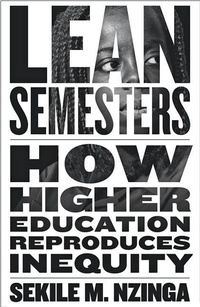
Lean Semesters
How Higher Education Reproduces Inequity
Published on 8. December 2020
Book
Hardback
224 pages
978-1-4214-3876-4 (ISBN)
Description
Addressing in depth the reality that women of color, particularly Black women, face compounded exploitation and economic inequality within the neoliberal university.
More Black women are graduating with advanced degrees than ever before. Despite the fact that their educational and professional opportunities should be expanding, highly educated Black women face strained and worsening economic, material, and labor conditions in graduate school and along their academic career trajectory. Black women are less likely to be funded as graduate students, are disproportionately hired as contingent faculty, are trained and hired within undervalued disciplines, and incur the highest levels of educational debt.
In Lean Semesters, Sekile M. Nzinga argues that the corporatized university-long celebrated as a purveyor of progress and opportunity-actually systematically indebts and disposes of Black women's bodies, their intellectual contributions, and their potential en masse. Insisting that "shifts" in higher education must recognize such unjust dynamics as intrinsic, not tangential, to the operation of the neoliberal university, Nzinga draws on candid interviews with thirty-one Black women at various stages of their academic careers. Their richly varied experiences reveal why underrepresented women of color are so vulnerable to the compounded forms of exploitation and inequity within the late capitalist terrain of this once-revered social institution.
Amplifying the voices of promising and prophetic Black academic women by mapping the impact of the current of higher education on their lives, the book's collective testimonies demand that we place value on these scholars' intellectual labor, untapped potential, and humanity. It also illuminates the ways past liberal feminist "victories" within academia have yet to become accessible to all women. Informed by the work of scholars and labor activists who have interrogated the various forms of inequity produced and reproduced by institutions of higher education under neoliberalism, Lean Semesters serves as a timely and accessible call to action.
More Black women are graduating with advanced degrees than ever before. Despite the fact that their educational and professional opportunities should be expanding, highly educated Black women face strained and worsening economic, material, and labor conditions in graduate school and along their academic career trajectory. Black women are less likely to be funded as graduate students, are disproportionately hired as contingent faculty, are trained and hired within undervalued disciplines, and incur the highest levels of educational debt.
In Lean Semesters, Sekile M. Nzinga argues that the corporatized university-long celebrated as a purveyor of progress and opportunity-actually systematically indebts and disposes of Black women's bodies, their intellectual contributions, and their potential en masse. Insisting that "shifts" in higher education must recognize such unjust dynamics as intrinsic, not tangential, to the operation of the neoliberal university, Nzinga draws on candid interviews with thirty-one Black women at various stages of their academic careers. Their richly varied experiences reveal why underrepresented women of color are so vulnerable to the compounded forms of exploitation and inequity within the late capitalist terrain of this once-revered social institution.
Amplifying the voices of promising and prophetic Black academic women by mapping the impact of the current of higher education on their lives, the book's collective testimonies demand that we place value on these scholars' intellectual labor, untapped potential, and humanity. It also illuminates the ways past liberal feminist "victories" within academia have yet to become accessible to all women. Informed by the work of scholars and labor activists who have interrogated the various forms of inequity produced and reproduced by institutions of higher education under neoliberalism, Lean Semesters serves as a timely and accessible call to action.
More details
Series
Language
English
Place of publication
Baltimore, MD
United States
Target group
Professional and scholarly
Product notice
sewn/stitched
Cloth over boards
Dimensions
Height: 201 mm
Width: 132 mm
Thickness: 20 mm
Weight
318 gr
ISBN-13
978-1-4214-3876-4 (9781421438764)
DOI
10.1353/book.77153
Copyright in bibliographic data and cover images is held by Nielsen Book Services Limited or by the publishers or by their respective licensors: all rights reserved.
Schweitzer Classification
Other editions
Additional editions
E-Book
12/2020
Johns Hopkins University Press
€20.99
Available for download
Person
Sekile M. Nzinga is the director of the Women's Center and a lecturer in gender and sexuality studies at Northwestern University. She is the editor of Laboring Positions: Black Women, Mothering and the Academy.
Content
Acknowledgments
Introduction. The University as Hyper-Producer of Inequity
Chapter 1. Mortgaging Our Brains: Black Women, Privatization, and Subprime PhDs
Chapter 2. Ain't I Precarious? Black Academic Women as Contingent
Chapter 3. Families Devalued: Black Academic Women and the Neoliberal Era's Family Tariff
Chapter 4. Jumping Mountains: Resisting the Marketized University
Conclusion. Statement of Solidarity
Appendix A. Our Truths Interview Guide
Appendix B. Resources and Organizations
Notes
Bibliography
Index
Introduction. The University as Hyper-Producer of Inequity
Chapter 1. Mortgaging Our Brains: Black Women, Privatization, and Subprime PhDs
Chapter 2. Ain't I Precarious? Black Academic Women as Contingent
Chapter 3. Families Devalued: Black Academic Women and the Neoliberal Era's Family Tariff
Chapter 4. Jumping Mountains: Resisting the Marketized University
Conclusion. Statement of Solidarity
Appendix A. Our Truths Interview Guide
Appendix B. Resources and Organizations
Notes
Bibliography
Index