

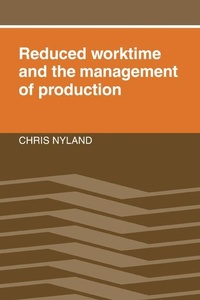
Reduced Worktime and the Management of Production
Published on 24. February 1989
Book
Hardback
232 pages
978-0-521-34547-7 (ISBN)
Description
This book examines the tendency in market economies to reduce the time workers spend at their place of employment and considers the role scientific management has played in this development. The author contends that the changing nature of worktime can be explained by changes in both the capitalistic production process and the demands that this process places on the psycho-physiological capacities of human beings. Between 1870 and 1980, the total annual worktime in major industrialized nations decreased by approximately 40 percent. This accelerated rate of worktime change is discussed in the context of the economic revival of capitalism that began in the first half of the twentieth century and culminated in the 'long boom' of 1945-1970. Professor Nyland argues that this revival is primarily explained by the rapid development and application of the process associated with scientific management. He further asserts that this science has been seriously misunderstood by most modern scholars outside socialist nations.
Reviews / Votes
"The great strength of Nyland's volume is its attempt to offer a systematic theory of why employers accepted or promoted reduced worktime." Wayne Lewchuk, Business History ReviewMore details
Language
English
Place of publication
Cambridge
United Kingdom
Target group
Professional and scholarly
Dimensions
Height: 235 mm
Width: 157 mm
Thickness: 18 mm
Weight
533 gr
ISBN-13
978-0-521-34547-7 (9780521345477)
Copyright in bibliographic data and cover images is held by Nielsen Book Services Limited or by the publishers or by their respective licensors: all rights reserved.
Schweitzer Classification
Other editions
Additional editions
Chris Nyland
Reduced Worktime and the Management of Production
Book
11/2005
Cambridge University Press
€52.50
Shipment within 15-20 days
Person
Content
Preface; 1. The history of worktime thought; 2. Empirical evidence and worktime theory; 3. Worktime and the effort bargain; 4. The rationalization of worktime; 5. The internationalization of rationalized worktimes; Conclusion; References; Index.