

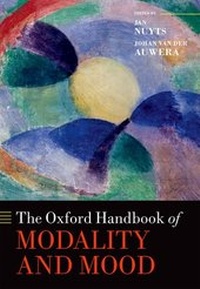
The Oxford Handbook of Modality and Mood
Published on 28. July 2016
Book
Hardback
688 pages
978-0-19-959143-5 (ISBN)
Description
This handbook offers an in depth and comprehensive state of the art survey of the linguistic domains of modality and mood. An international team of experts in the field examine the full range of methodological and theoretical approaches to the many facets of the phenomena involved. Following an opening section that provides an introduction and historical background to the topic, the volume is divided into five parts. Parts 1 and 2 present the basic linguistic facts
about the systems of modality and mood in the languages of the world, covering the semantics and the expression of different subtypes of modality and mood respectively. The authors also examine the interaction of modality and mood, mutually and with other semantic categories such as aspect, time,
negation, and evidentiality. In Part 3, authors discuss the features of the modality and mood systems in five typologically different language groups, while chapters in Part 4 deal with wider perspectives on modality and mood: diachrony, areality, first language acquisition, and sign language. Finally, Part 5 looks at how modality and mood are handled in different theoretical approaches: formal syntax, functional linguistics, cognitive linguistics and construction grammar, and formal
semantics.
about the systems of modality and mood in the languages of the world, covering the semantics and the expression of different subtypes of modality and mood respectively. The authors also examine the interaction of modality and mood, mutually and with other semantic categories such as aspect, time,
negation, and evidentiality. In Part 3, authors discuss the features of the modality and mood systems in five typologically different language groups, while chapters in Part 4 deal with wider perspectives on modality and mood: diachrony, areality, first language acquisition, and sign language. Finally, Part 5 looks at how modality and mood are handled in different theoretical approaches: formal syntax, functional linguistics, cognitive linguistics and construction grammar, and formal
semantics.
More details
Other editions
Additional editions
Jan Nuyts | Johan Van Der Auwera
The Oxford Handbook of Modality and Mood
E-Book
09/2016
1st Edition
OUP eBook
€29.49
Available for download
Jan Nuyts | Johan Van Der Auwera
The Oxford Handbook of Modality and Mood
E-Book
09/2016
1st Edition
OUP eBook
€29.49
Available for download
Persons
Jan Nuyts is a Professor in the Linguistics Department at the University of Antwerp, having previously held positions at the universities of Salzburg, Amsterdam, Berkeley, and Heidelberg, and at the Max-Planck Institute for Psycholinguistics in Nijmegen. His main research area is cognitive-functional semantics. His current focus of attention concerns the cognitive and functional structure of time-aspect-modality or qualificational categories - and the modal
categories in particular - and their linguistic expressions, synchronically and diachronically, and what one can learn from them.
Johan van der Auwera is Professor of General and English Linguistics at the University of Antwerp, and editor-in-chief of the journal Linguistics. As a student and postdoctoral researcher he spent time at the universities of Antwerp, Berkeley, Stockholm, Hanover, and Nijmegen, alongside visiting appointments in Paris, Princeton, Gothenburg, Hong Kong, Kyoto, and Bangkok. His current research focuses on grammatical semantics and typology (including areal typology and dialectology), with
special reference to mood, modality, negation, indefinites, and impersonals.
categories in particular - and their linguistic expressions, synchronically and diachronically, and what one can learn from them.
Johan van der Auwera is Professor of General and English Linguistics at the University of Antwerp, and editor-in-chief of the journal Linguistics. As a student and postdoctoral researcher he spent time at the universities of Antwerp, Berkeley, Stockholm, Hanover, and Nijmegen, alongside visiting appointments in Paris, Princeton, Gothenburg, Hong Kong, Kyoto, and Bangkok. His current research focuses on grammatical semantics and typology (including areal typology and dialectology), with
special reference to mood, modality, negation, indefinites, and impersonals.
Content
1 Jan Nuyts: Surveying modality and mood: An introduction; 2 Johan van der Auwera and Alfonso Zamorano Aguilar: The history of modality and mood; Part I: Semantics of Modality and Mood; 3 Jan Nuyts: Analyses of the modal meanings; 4 Mario Squartini: Interactions between modality and other semantic categories; 5 Irina Nikolaeva: Analyses of the semantics of mood; Part II: The Expression of Modality and Mood; 6 Heiko Narrog: The expression of non-epistemic modal categories; 7 Kasper Boye: The expression of epistemic modality; 8 Alexandra Y. Aikhenvald: The linguistic marking of sentence types; 9 Caterina Mauri and Andrea Sanso: The linguistic marking of (ir)realis and subjunctive; 10 Andrej Malchukov and Viktor Xrakovskij: The linguistic interaction of mood with modality and other categories; Part III: Sketches of Modality and Mood Systems; 11 Marianne Mithun: Modality and mood in Iroquoian; 12 Zygmunt Frayzyngier: Modality and mood in Chadic; 13 Hilary Chappell and Alain Peyraube: Modality and mood in Sinitic; 14 Frantisek Lichtenberk: Modality and mood in Oceanic; 15 Daniel Van Olmen and Johan van der Auwera: Modality and mood in Standard Average European; Part IV; 16 Debra Ziegeler: The diachrony of modality and mood; 17 Bjorn Hansen and Umberto Ansaldo: Areality in modality and mood; 18 Maya Hickmann and Dominique Bassano: Modality and mood in first language acquisition; 19 Barbara Shaffer and Terry Janzen: Modality and mood in American Sign Language; Part V; 20 Katrin Axel-Tober and Remus Gergel: Modality and mood in formal syntactic approaches; 21 Karin Aijmer: Modality and mood in functional linguistic approaches; 22 Ronny Boogaart and Egbert Fortuin: Modality and mood in cognitive linguistics and construction grammars; 23 Magdalena Kaufmann and Stefan Kaufmann: Modality and mood in formal semantics