

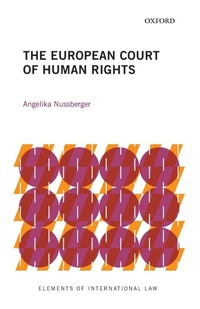
The European Court of Human Rights
Published on 13. August 2020
Book
Paperback/Softback
256 pages
978-0-19-884965-0 (ISBN)
Description
The European Court of Human Rights, by Angelika Nussberger is the first title in a new series, The Elements of International Law. Providing a fresh, objective, and non-argumentative approach to the discipline of international law, this series is an accessible go-to source for practicing international lawyers, judges and arbitrators, government and military officers, scholars, teachers, and students.
In this volume, Professor Nussberger explores the Court's uniqueness as an international adjudicatory body in the light of its history, structure, and procedure, as well as its key doctrines and case law. This book also shows the role played by the Court in the development of modern international law and human rights law. Tracing the history of the Court from its political context in the 1940s to the present day, Nussberger engages with pressing questions about its origins and internal workings. What was the best model for such an international organization? How should it evolve within more and more diverse legal cultures? How does a case move among different decision-making bodies? These questions help frame the six parts of the book, whilst the final section reflects on the past successes and failures of the Court, shedding light on possible future directions.
In this volume, Professor Nussberger explores the Court's uniqueness as an international adjudicatory body in the light of its history, structure, and procedure, as well as its key doctrines and case law. This book also shows the role played by the Court in the development of modern international law and human rights law. Tracing the history of the Court from its political context in the 1940s to the present day, Nussberger engages with pressing questions about its origins and internal workings. What was the best model for such an international organization? How should it evolve within more and more diverse legal cultures? How does a case move among different decision-making bodies? These questions help frame the six parts of the book, whilst the final section reflects on the past successes and failures of the Court, shedding light on possible future directions.
Reviews / Votes
The book offers a very focused and concentrated narrative combined with a deep analysis and very personal sight of a judge at the Court and of a distinguished scholar ... The extensive list of references on the Court and the Convention system makes the book a perfect guide on the matter for specialists and students. * Maria Filatova, HSE University, Mezhdunarodnoe Pravosudie (International Jurisprudence) *More details
Series
Language
English
Place of publication
Oxford
United Kingdom
Target group
Professional and scholarly
Dimensions
Height: 216 mm
Width: 140 mm
Thickness: 14 mm
Weight
327 gr
ISBN-13
978-0-19-884965-0 (9780198849650)
Copyright in bibliographic data and cover images is held by Nielsen Book Services Limited or by the publishers or by their respective licensors: all rights reserved.
Schweitzer Classification
Person
Angelika Nussberger is Director of the Institute of Eastern European Law and Chair of Constitutional Law, International Law and Comparative Law at the University of Cologne. From 2011 until 2019 she was a Judge at the European Court of Human Rights, serving as vice president from 2017-2019. She was also a member of the ILO expert committee from 2004-2010 and a member of the Independent International Fact-Finding Mission on the Conflict in Georgia in 2009/2010.
Content
Preface
Introduction
Abbreviations
1: The Court over Sixty Years
2: Organization, Personnel, and Procedure
3: Convention Law and Basic Doctrine
4: The Court and Domestic and International Legal Systems
5: Judgments and Efficacy
6: Successes, Problems, and Potential
Bibliography
Introduction
Abbreviations
1: The Court over Sixty Years
2: Organization, Personnel, and Procedure
3: Convention Law and Basic Doctrine
4: The Court and Domestic and International Legal Systems
5: Judgments and Efficacy
6: Successes, Problems, and Potential
Bibliography