

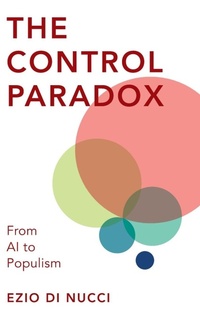
The Control Paradox
From AI to Populism
Published on 10. December 2020
Book
Hardback
244 pages
978-1-78661-578-7 (ISBN)
Description
Is technological innovation spinning out of control? During a one-week period in 2018, social media was revealed to have had huge undue influence on the 2016 U.S. presidential election and the first fatality from a self-driving car was recorded. What's paradoxical about the understandable fear of machines taking control through software, robots, and artificial intelligence is that new technology is often introduced in order to increase our control of a certain task. This is what Ezio Di Nucci calls the "control paradox."
Di Nucci also brings this notion to bear on politics: we delegate power and control to political representatives in order to improve democratic governance. However, recent populist uprisings have shown that voters feel disempowered and neglected by this system. This lack of direct control within representative democracies could be a motivating factor for populism, and Di Nucci argues that a better understanding of delegation is a possible solution.
Di Nucci also brings this notion to bear on politics: we delegate power and control to political representatives in order to improve democratic governance. However, recent populist uprisings have shown that voters feel disempowered and neglected by this system. This lack of direct control within representative democracies could be a motivating factor for populism, and Di Nucci argues that a better understanding of delegation is a possible solution.
More details
Language
English
Place of publication
United Kingdom
Publishing group
Bloomsbury Publishing PLC
Target group
Professional and scholarly
Illustrations
6 b/w photos;
Dimensions
Height: 235 mm
Width: 157 mm
Thickness: 19 mm
Weight
555 gr
ISBN-13
978-1-78661-578-7 (9781786615787)
Copyright in bibliographic data and cover images is held by Nielsen Book Services Limited or by the publishers or by their respective licensors: all rights reserved.
Schweitzer Classification
Other editions
Additional editions
E-Book
12/2020
1st Edition
Rowman & Littlefield Publishers
€35.49
Available for download
E-Book
12/2020
1st Edition
Rowman & Littlefield Publishers
€35.49
Available for download
Person
Ezio Di Nucci is professor of bioethics and director of the Centre for Medical Science and Technology Studies at the University of Copenhagen. His recent monographs include Ethics in Healthcare (2018), Ethics Without Intention (2014) and Mindlessness (2013).
Content
Part I: Introducing the Paradox
Introduction: The Control Paradox for Dummies
Chapter One: The Paradox
Chapter Two: Control and the Empowerment Illusion
Part II: Control and Delegation
Chapter Three: The Concept of Control and Direct Control
Chapter Four: Social Control and Technological Control
Chapter Five: Delegating Control and the Practice of Delegation
Part III: The Technological Paradox
Chapter Six: Control, Drones and Autonomous Weapons
Chapter Seven: VAR, Authority and Loss of Control
Chapter Eight: Self-Driving Cars and Meaningful Human Control
Chapter Nine: Smartphones from Empowerment to Surveillance: Local Control and Global Control
Chapter Ten: Health Data & Healthcare Algorithms (or: Medical AI)
Part IV: The Political Paradox
Chapter Eleven: Taking Back Control: From Brexit to Trump and the Control Paradox of Representative Democracy
Chapter Twelve: Delegating Responsibility?
References
Introduction: The Control Paradox for Dummies
Chapter One: The Paradox
Chapter Two: Control and the Empowerment Illusion
Part II: Control and Delegation
Chapter Three: The Concept of Control and Direct Control
Chapter Four: Social Control and Technological Control
Chapter Five: Delegating Control and the Practice of Delegation
Part III: The Technological Paradox
Chapter Six: Control, Drones and Autonomous Weapons
Chapter Seven: VAR, Authority and Loss of Control
Chapter Eight: Self-Driving Cars and Meaningful Human Control
Chapter Nine: Smartphones from Empowerment to Surveillance: Local Control and Global Control
Chapter Ten: Health Data & Healthcare Algorithms (or: Medical AI)
Part IV: The Political Paradox
Chapter Eleven: Taking Back Control: From Brexit to Trump and the Control Paradox of Representative Democracy
Chapter Twelve: Delegating Responsibility?
References