

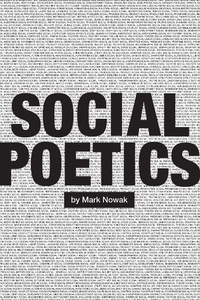
Social Poetics
Will be published approx. on 23. April 2020
Book
Paperback/Softback
288 pages
978-1-56689-567-5 (ISBN)
Description
A people's history of the poetry workshop from a poet and labor activist heralded by Adrienne Rich for "regenerating the rich tradition of working-class literature."
Social Poetics documents the imaginative militancy and emergent solidarities of a new, insurgent working class poetry community rising up across the globe. Part autobiography, part literary criticism, part Marxist theory, Social Poetics presents a people's history of the poetry workshop from the founding director of the Worker Writers School. Nowak illustrates not just what poetry means, but what it does to and for people outside traditional literary spaces, from taxi drivers to street vendors, and other workers of the world.
Social Poetics documents the imaginative militancy and emergent solidarities of a new, insurgent working class poetry community rising up across the globe. Part autobiography, part literary criticism, part Marxist theory, Social Poetics presents a people's history of the poetry workshop from the founding director of the Worker Writers School. Nowak illustrates not just what poetry means, but what it does to and for people outside traditional literary spaces, from taxi drivers to street vendors, and other workers of the world.
Reviews / Votes
Praise for Social Poetics"[A]n invaluable archive of an otherwise little-documented field." -Poetry Foundation
"If a creative writing text ever raised a call to the barricades, it's this one. . . . The work deserves a place on the shelf of any thinking teacher in the field. Anyone can use a breath of fresh air, a bracing reminder of art's power to change the world." -The Brooklyn Rail
"Nowak's focus on workshops, from Attica to the Worker Justice Center of New York, powerfully re-envisions what literary communities might look like, and how they can expand the range of poetic expression, enliven social movements and foster solidarity across oceans." -In These Times
"[B]oth an attempt to recuperate a forgotten literary canon (literature made for and inside working-class struggle) and an effort to summon forth new structures of organization, expression, and literary culture." -Poetry Northwest
"Social Poetics focuses on the history of poetry workshops from the perspective of working-class people who attempted to spark social change despite being largely overlooked by society." -Chronogram
"Nowak's writing is attuned to the needs of today in what feels like a new horizon taking shape, part of a larger appreciation for the poetics of relationality and experience." -Full Stop
"Mark Nowak testifies to the urgency and intimacy of poetry in our prisons, union halls, and workers' centers. Social Poetics tracks what happens when people gather around poems: conjunctions, dialogues, imaginative militancy, solidarities. This supple, comprehensive book is a study in the poetics of bearing witness, bearing tools, and bearing possibilities." -Terrance Hayes
"SNowak crafts a transformative workshop for the collective. This is an important record of how the people's power, poetry, and history maintain us and the beauty of our world(s)." -Joy James
More details
Language
English
Place of publication
MN
United States
Product notice
Paperback (trade)
Illustrations
10 B&W illustrations
Dimensions
Height: 228 mm
Width: 154 mm
Thickness: 22 mm
Weight
450 gr
ISBN-13
978-1-56689-567-5 (9781566895675)
Copyright in bibliographic data and cover images is held by Nielsen Book Services Limited or by the publishers or by their respective licensors: all rights reserved.
Schweitzer Classification
Other editions
Additional editions
Person
Mark Nowak is the author of Coal Mountain Elementary, Shut Up Shut Down, and Revenants. He is the recipient of the Freedom Plow Award for Poetry & Activism and fellowships from the Lannan and Guggenheim foundations. Nowak has led poetry workshops for workers and trade unions in the US, South Africa, the UK, Panama, the Netherlands, and elsewhere. He is currently a professor of English at Manhattanville College and the founding director of the Worker Writers School.