

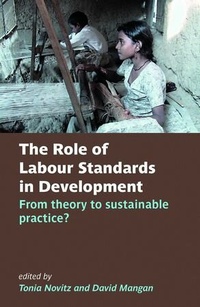
The Role of Labour Standards in Development
From theory to sustainable practice
1st Edition
Published on 27. October 2011
Book
Paperback/Softback
300 pages
978-0-19-726491-1 (ISBN)
Description
This edited collection examines the multi-faceted ways in which labour standards can play a role in the achievement of development. A variety of critical perspectives are presented here, with contributions from a number of different disciplines, including law, politics, and economics. The book begins by considering potential theoretical connections between work and development, acknowledging controversy over how the latter should be approached, interpreted and rendered 'sustainable'. The remainder of the collection is devoted to an analysis of the part that protection of labour standards can play in developmental terms, with reference to concrete issues: anti-discrimination, child labour, trade relations, and social dialogue. The book concludes with a final chapter, reflecting on how theory has been and could be put into practice.
The theme that transcends all the contributions to this collection is that of human agency. The authors are not merely interested in the realisation of an individual person's 'functioning' in society (which development will assist), but also with the ways that people can be engaged in the very process of defining what development aims should and can be. They do not wish to see economic, social and environmental development objectives as being determined by technical experts and implemented according to their prescriptions. Rather, they consider development in procedural as well as substantive terms, and in participatory as well as material terms.
The theme that transcends all the contributions to this collection is that of human agency. The authors are not merely interested in the realisation of an individual person's 'functioning' in society (which development will assist), but also with the ways that people can be engaged in the very process of defining what development aims should and can be. They do not wish to see economic, social and environmental development objectives as being determined by technical experts and implemented according to their prescriptions. Rather, they consider development in procedural as well as substantive terms, and in participatory as well as material terms.
Reviews / Votes
The multi-disciplinary nature of the book, as well as the practical approach taken by many of the authors, is to be commended... While the essays in this book depart from a common basis, they move in different directions and cover a wide variety of topics and approaches. * Rebecca Zahn, International and Comparative Law Quarterly *More details
Series
Language
English
Place of publication
Oxford
United Kingdom
Target group
Professional and scholarly
Academics in labour law, environment, industrial relations, economics, human geography; policy makers in government, trade unions and NGOs.
Dimensions
Height: 234 mm
Width: 157 mm
Thickness: 17 mm
Weight
432 gr
ISBN-13
978-0-19-726491-1 (9780197264911)
Copyright in bibliographic data and cover images is held by Nielsen Book Services Limited or by the publishers or by their respective licensors: all rights reserved.
Schweitzer Classification
Persons
Professor Tonia Novitz first studied law in New Zealand and qualified there as a Barrister and Solicitor, specialising in employment law and civil litigation. She then studied at Balliol College, Oxford, where she was awarded the BCL and completed her doctorate. She has been a visiting fellow at the International Institute for Labour Studies (Geneva), a Jean Monnet Fellow and a Marie Curie Fellow at the European University Institute (Florence) and a senior visiting fellow at the University of Melbourne.
David Mangan is Lecturer in the Law of Obligations at the University of Leicester. Research and teaching interests include employment, tort and contract law with an emphasis on professional services. He has been a consultant in public sector labour relations and is a barrister and solicitor in Canada. His doctorate was recently completed at the London School of Economics. Publications have dealt with employment, tort and education law.
David Mangan is Lecturer in the Law of Obligations at the University of Leicester. Research and teaching interests include employment, tort and contract law with an emphasis on professional services. He has been a consultant in public sector labour relations and is a barrister and solicitor in Canada. His doctorate was recently completed at the London School of Economics. Publications have dealt with employment, tort and education law.
Content
Introduction
Part I: Theoretical Connections between Work and Development
Comparative institutional advantage in the context of development
Human freedom and human capital; re-imagining labour law for development
Part II: Addressing social exclusion and discrimination
Gender, equality and capabilities
Problems of gender, violence, development and labour
Promoting social inclusion through anti-discrimination law
Part III: Child poverty and child labour as an obstruction to development
Understanding the economics of child labour
Child labour: What "responsibility" might entail for "responsive" corporations
Part IV: Development through trade and/or aid?
The very basis of our existence: labour and the neglected environmental dimension of sustainable development
Development, the movement of persons, and labour law: trade and aid vs. reasonable labour market access
Part V: Achieving development through social dialogue, corporate social responsibility and other participatory strategies
Corporate Social Responsibility and Participatory Labour Laws
How social dialogue and CSR have met up with traditional international supervision in realizing FPRW
Big trade unions and big business: how might international framework agreements promote sustainable development at a local level?
Afterword
Part I: Theoretical Connections between Work and Development
Comparative institutional advantage in the context of development
Human freedom and human capital; re-imagining labour law for development
Part II: Addressing social exclusion and discrimination
Gender, equality and capabilities
Problems of gender, violence, development and labour
Promoting social inclusion through anti-discrimination law
Part III: Child poverty and child labour as an obstruction to development
Understanding the economics of child labour
Child labour: What "responsibility" might entail for "responsive" corporations
Part IV: Development through trade and/or aid?
The very basis of our existence: labour and the neglected environmental dimension of sustainable development
Development, the movement of persons, and labour law: trade and aid vs. reasonable labour market access
Part V: Achieving development through social dialogue, corporate social responsibility and other participatory strategies
Corporate Social Responsibility and Participatory Labour Laws
How social dialogue and CSR have met up with traditional international supervision in realizing FPRW
Big trade unions and big business: how might international framework agreements promote sustainable development at a local level?
Afterword