

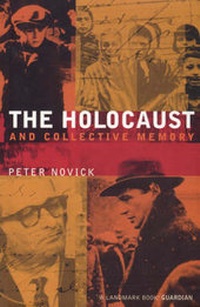
The Holocaust and Collective Memory
1st Edition
Published on 5. February 2001
Book
Paperback/Softback
384 pages
978-0-7475-5255-0 (ISBN)
Description
How and when did the Holocaust come to loom so large in postwar Jewish and American and international life? Peter Novick's controversial new book sets out to answer this question. In the first decades after World War II, the Holocaust was little talked about, but after the Six-Day War (1967) and the Yom Kippur War (1973) it began to assume central importance as a defining factor of Jewishness. With the release of Claude Lanzmann's documentary "Shoah" (1985), the Holocaust had become the moral issue of the twentieth century. In a book likely to provoke heated debate, Novick asks whether defining Jewishness in terms of victimhood alone does not hand Hitler a posthumous victory, and whether claiming uniqueness for the Holocaust does not render other atrocities (Biafra, Rwanda, Kosovo) 'not so bad'.
Reviews / Votes
'It should be required reading for all those who believe that the memorialising of the Holocaust is because its memory is only now surfacing amongst the survivors' IRISH TIMES 'Eloquently angry, at times bitterly funny, but scrupulously researched book' SCOTSMAN 'In this powerful and provocative book, Peter Novick offers a fascinating analysis of the shifting ways in which the Holocaust has been perceived by the American-Jewish world. It deserves the widest possible readership' JEWISH CHRONICLEMore details
Person
Peter Novick is a professor of history at the University of Chicago. He is the author of THE RESISTANCE VERSUS VICHY: The Purge of Collaborators in Liberated France (1968) and THAT NOBLE DREAM: The Objectivity Question and the American Historical Profession, which won the American Historical Association's book Prize in 1988.