

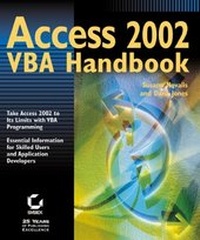
Access 2002 VBA Handbook
1st Edition
Published on 5. November 2001
Book
Paperback/Softback
880 pages
978-0-7821-4013-2 (ISBN)
Description
How Far Can You Go with Access 2002?
The answer depends on your knowledge of VBA programming. If you really want to get the most out of Access, the Access 2002 VBA Handbook is essential reading. If you are an experienced user of Access, you get the step-by-step instruction you need to be dramatically more productive. And if you are a more experienced developer, you get the advanced VBA programming skills you need to build the Access applications your users require. Coverage includes
* Running queries to find specific records
* Automating complex and time-consuming procedures
* Importing data from existing data sources
* Synchronizing forms and tables
* Understanding the ADO and DAO models
* Understanding the essentials of Visual Basic for Applications (VBA)
* Customizing the Access user interface
* Creating procedures to change Access's default error-handling processes
* Accessing data using OLE DB and ODBC
* Creating VBA procedures for navigating a database or project
* Writing VBA procedures using object properties and methods
* Creating relationships between forms
* Executing commands using SQL statements in VBA code
* Using ActiveX controls in your VBA procedures
The answer depends on your knowledge of VBA programming. If you really want to get the most out of Access, the Access 2002 VBA Handbook is essential reading. If you are an experienced user of Access, you get the step-by-step instruction you need to be dramatically more productive. And if you are a more experienced developer, you get the advanced VBA programming skills you need to build the Access applications your users require. Coverage includes
* Running queries to find specific records
* Automating complex and time-consuming procedures
* Importing data from existing data sources
* Synchronizing forms and tables
* Understanding the ADO and DAO models
* Understanding the essentials of Visual Basic for Applications (VBA)
* Customizing the Access user interface
* Creating procedures to change Access's default error-handling processes
* Accessing data using OLE DB and ODBC
* Creating VBA procedures for navigating a database or project
* Writing VBA procedures using object properties and methods
* Creating relationships between forms
* Executing commands using SQL statements in VBA code
* Using ActiveX controls in your VBA procedures
More details
Edition
1., Auflage
Language
English
Place of publication
New York
United States
Publishing group
John Wiley & Sons Inc
Target group
Professional and scholarly
Edition type
Revised edition
Illustrations
illustrations
Dimensions
Height: 22.9 cm
Width: 19.3 cm
Thickness: 51 mm
Weight
1480 gr
ISBN-13
978-0-7821-4013-2 (9780782140132)
Schweitzer Classification
Other editions
Previous edition
Susann Novalis
Access 2000 VBA Handbook
Book
08/1999
1st Edition
Sybex Inc.,U.S.
€47.90
Article exhausted; check for reprint
Persons
Susann Novalis, Ph.D., is a Professor of Mathematics and Associate Dean of the College of Science and Engineering at San Francisco State University. She is the author of Access 2000 VBA Handbook and Access 97 Macro & VBA Handbook, both from Sybex. She has also published articles in Access Visual Basic Advisor and Internet Advisor. Dana Jones is a consultant with MCW Technologies, a Microsoft Solution Provider, and has written for SmartAccess.
Content
Introduction.
Chapter 1: Automating a Database without Programming.
Chapter 2: Getting Started with Objects and Events.
Chapter 3: Introducing the Access Object Model.
Chapter 4: Communicating with Forms.
Chapter 5: VBA Programming Essentials.
Chapter 6: Understanding the ADO Object Model.
Chapter 7: Writing Procedures.
Chapter 8: Using Variables.
Chapter 9: Controlling Execution.
Chapter 10: Dealing with Errors in VBA.
Chapter 11: Navigating with Access VBA.
Chapter 12: Maintaining Data with Access VBA.
Chapter 13: Working with Groups of Records Using Access VBA.
Chapter 14: Creating and Modifying Database Objects.
Chapter 15: Expanding Access.
Appendix A:Glossary.
Appendix B:Data Access Object (DAO) Model.
Index.
Chapter 1: Automating a Database without Programming.
Chapter 2: Getting Started with Objects and Events.
Chapter 3: Introducing the Access Object Model.
Chapter 4: Communicating with Forms.
Chapter 5: VBA Programming Essentials.
Chapter 6: Understanding the ADO Object Model.
Chapter 7: Writing Procedures.
Chapter 8: Using Variables.
Chapter 9: Controlling Execution.
Chapter 10: Dealing with Errors in VBA.
Chapter 11: Navigating with Access VBA.
Chapter 12: Maintaining Data with Access VBA.
Chapter 13: Working with Groups of Records Using Access VBA.
Chapter 14: Creating and Modifying Database Objects.
Chapter 15: Expanding Access.
Appendix A:Glossary.
Appendix B:Data Access Object (DAO) Model.
Index.