

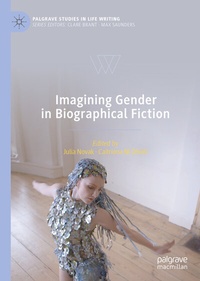
Imagining Gender in Biographical Fiction
Description
The introduction of this book is available open access under a CC BY 4.0 license at link.springer.com
Chapter 1 is available open access under a Creative Commons Attribution 4.0 International License via link.springer.com.
Reviews / Votes
"This volume provides new insights into gender issues in very diverse texts from the field of biographical fiction and establishes intriguing links between gender and genre, besides uncovering the gender bias of traditional biography. The wide range of topics with different theoretical approaches not only mirrors the complexity and broadness of gender issues related to biofiction but also shows the necessity of bringing together research on this topic in one volume. Its contributors come from different countries and research communities, which is an additional asset in providing necessary interdisciplinary perspectives on biographical fiction." (Franziska Gygax, Professor Emerita of Anglophone Linguistics and Literary Studies, University of Basel, Switzerland)"A fascinating exploration of the intimate interaction of gendered history and biographical fiction. Imagining Gender in Biographical Fiction ... intelligently and incisively interrogates the deliberate use of fiction to recentre marginalised female historical figures." (Farah Mendlesohn, author of Creating Memory: Historical Fiction and the English Civil Wars (2022) and Founder of the Historical Fiction Research Network, UK)
More details
Other editions
Additional editions
Persons
Caitríona Ní Dhúill is Professor in German at University College Cork, Ireland. She is the author of Metabiography: Reflecting on Biography (Palgrave Macmillan, 2020) and Sex in Imagined Spaces: Gender and Utopia from More to Bloch (2010). She is co-editor of the journal Austrian Studies, and guest co-editor of a double special issue of Poetics Today (2016) on negative futures. She has published numerous articles and book chapters on gender theory, utopian theory, modernist literature and life writing.
Julia Novak holds a tenure-track professorship for Anglophone Literature and Mediality at the University of Vienna. Her work on life writing and biofiction has appeared in journals such as Biography; Contemporary Women's Writing; a/b: Auto/Biography Studies; Life Writing; and the Journal of Postcolonial Writing. She has co-edited a special issue on "Women's Lives on Screen" for the European Journal of Life Writing (2021), of which she is an editor, as well as Experiments in Life Writing: Intersections of Auto/Biography and Fiction (Palgrave 2017); Life Writing and Celebrity (Routledge 2020); and the inaugural issue of the Journal of Historical Fictions (2017).
Content
Part I. Recovery, Revision, Ventriloquism: Imagining Historical Women.
2. "Everything Is Out of Place": Virginia Woolf, Women, and (Meta-)Historical Biofiction.3. Fictional Futures for a Buried Past: Representations of Lucia Joyce.4. Imagining Jiang Qing: The Biographer's Truth in Anchee Min's Becoming Madame Mao.
Part II. Re-imagining the Early Modern Subject.
5. From Betrayed Wife to Betraying Wife: Re-writing Katherine of Aragon as Catalina in Philippa Gregory's The Constant Princess.6. Jean Plaidy and Philippa Gregory Fighting for Gender Equality Through Katherine Parr's Narrative.- 7. Australian Women Writing Tudor Lives.
Part III. Writing the Writer: History, Voyeurism, Victimisation.
8. Biofiction, Compulsory Sexuality, and Celibate Modernism in Colm Tóibín's The Master and David Lodge's Author, Author.9. In Poe's Shadow: Frances Sargent Osgood.10. Stanislawa Przybyszewska as a Case of Posthumous Victimisation: On the Ethics of Biofiction.
Part IV. Creativity and Gender in the Arts and Sciences.
11. Re-visiting the Renaissance Virtuosa in Biofiction on Sofonisba Anguissola.12. The "Mother of the Theory of Relativity"? Re-imagining Mileva Maric´ in Marie Benedict's The Other Einstein (2016).
Part V. Queering Biofiction.
13. Visceral Biofiction: Herculine Barbin, Intersex Embodiment, and the Biological Imaginary in Aaron Apps's Dear Herculine.14. "A Way Out of the Prison of Gender": Interview with Novelist Patricia Duncker.