

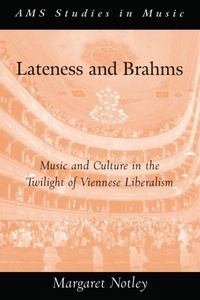
Lateness and Brahms
Music and Culture in the Twilight of Viennese Liberalism
Published on 3. November 2016
Book
Paperback/Softback
256 pages
978-0-19-062842-0 (ISBN)
Description
Lateness and Brahms takes up the fascinating, yet understudied problem of how Brahms fits into the culture of turn-of-the-century Vienna. Brahms's conspicuous and puzzling absence in previous scholarly accounts of the time and place raises important questions, and as Margaret Notley demonstrates, the tendency to view him in neutralized, ahistorical terms has made his music seem far less interesting than it truly is.
In pursuit of an historical Brahms, Notley focuses on the later chamber music, drawing on various documents and perspectives, but with particular emphasis on the relevance of Western Marxist critical traditions.
In pursuit of an historical Brahms, Notley focuses on the later chamber music, drawing on various documents and perspectives, but with particular emphasis on the relevance of Western Marxist critical traditions.
Reviews / Votes
Lateness and Brahms brilliantly explores the ideological intertwinings between Austrian political life and the various genres of 'absolute' music, which have often been regarded as only abstract or purely aesthetic. Notley flings open the doors of cultural context and reception for Brahms at the end of his career. Uncovering the key debates surrounding this composer and his musical traditions, she restores crucial factors of local framing and connotation obvious to his contemporaries but largely lost to later generations. A rich tapestry of close reading and cultural interpretation, this indispensable book not only obliges us to rethink late Brahms and his world but also challenges us to confront how we have constructed other composers in our own histories and narratives. This is music and cultural history at its best. * James Hepokoski, Yale University * In this fascinating book, we learn about Brahms's late instrumental works through a variety of prisms * political, analytical, social, historical, cultural and moreand emerge with an altered understanding of compositions forever important to all who value music at its most elevated. The juxtaposition of Vienna's artistic flowering at the fin-de-siecle with what Notley calls 'coarse politics' in the twilight of Viennese Liberalism makes for an extraordinary tale, here set in the context of her delineation of 'lateness' as the over-arching phenomenon of this repertory. Borrowing from fellow Vienna resident Sigmund Freud, Notley finds that stylistic change was 'overdetermined' in the composer's late years, that the extraordinary harmonic and tonal subtleties of this music are both an expression of their time and alienated from it. The best scholarship makes us hear music differently and know its creators in greater depth, and Notley has done both.Susan Youens, University of Notre Dame *More details
Series
Language
English
Place of publication
New York
United States
Target group
College/higher education
Professional and scholarly
Dimensions
Height: 234 mm
Width: 156 mm
Thickness: 15 mm
Weight
438 gr
ISBN-13
978-0-19-062842-0 (9780190628420)
Copyright in bibliographic data and cover images is held by Nielsen Book Services Limited or by the publishers or by their respective licensors: all rights reserved.
Schweitzer Classification
Other editions
Additional editions
Book
12/2006
Oxford University Press Inc
€95.40
Shipment within 15-20 days
Person
Margaret Notley, an Associate Professor of Music History at the University of North Texas, has published widely on a number of topics. Her article "Late-Nineteenth-Century Chamber Music and the Cult of the Classical Adagio" won the 2000 Alfred Einstein Award given by the American Musicological Society.
Content
Introduction, Lateness and Brahms
Chapter 1: Brahms as Liberal, Bruckner as Other
Chapter 2: Brahms and the Problem of Late Style
Chapter 3: Themes and First Movements: Questions of Lateness and Individualism
Chapter 4: Music Pedagogy, Musicology, and Brahm's Collection of Octaves and Fifths: Historical Decline, Personal Renewal
Chapter 5: Volksconcerte and Concepts of Genre in Brahm's Vienna
Chaper 6: Adagios in Brahms's Late Chamber Music: Genre Aesthetics and Cultural Critique
Epilogue, The Twilight of Liberalism
Appendix, Brahms's Multimovement Works: Dates of Completion and Tempo Designations for the Slow Movements
Bibiography
Index
Chapter 1: Brahms as Liberal, Bruckner as Other
Chapter 2: Brahms and the Problem of Late Style
Chapter 3: Themes and First Movements: Questions of Lateness and Individualism
Chapter 4: Music Pedagogy, Musicology, and Brahm's Collection of Octaves and Fifths: Historical Decline, Personal Renewal
Chapter 5: Volksconcerte and Concepts of Genre in Brahm's Vienna
Chaper 6: Adagios in Brahms's Late Chamber Music: Genre Aesthetics and Cultural Critique
Epilogue, The Twilight of Liberalism
Appendix, Brahms's Multimovement Works: Dates of Completion and Tempo Designations for the Slow Movements
Bibiography
Index