

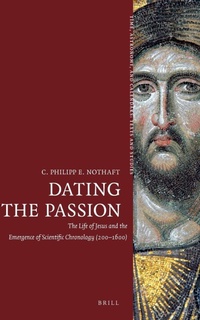
Dating the Passion
The Life of Jesus and the Emergence of Scientific Chronology (200-1600)
Published on 6. October 2011
Book
Hardback
332 pages
978-90-04-21219-0 (ISBN)
Description
The beginnings of scientific chronology are usually associated with the work of the great Renaissance philologist Joseph Scaliger (1540-1609), but this perspective is challenged by the existence of a vivid pre-modern computistical tradition, in which technical chronological questions, especially regarding the life of Jesus, played an essential role. Christian scholars such as Roger Bacon made innovative breakthroughs in the field of historical dating by applying astronomical calculations, critical exegesis, and the study of the Jewish calendar to chronological problems. Drawing on a wide selection of sources that range from late antiquity to 1600, this book uses the history of the date of Christ's Passion to shed new light on the medieval contribution to science and scholarship.
More details
Series
Language
English
Place of publication
Leiden
Netherlands
Product notice
sewn/stitched
Cloth over boards
Dimensions
Height: 244 mm
Width: 165 mm
Thickness: 18 mm
Weight
739 gr
ISBN-13
978-90-04-21219-0 (9789004212190)
DOI
10.1000/b10330
Copyright in bibliographic data and cover images is held by Nielsen Book Services Limited or by the publishers or by their respective licensors: all rights reserved.
Schweitzer Classification
Person
C. Philipp E. Nothaft, Ph.D. (2011) in History, University of Munich, is a research assistant at the Department of Hebrew & Jewish Studies, University College, London. He has published several articles on the history of scholarship and chronology.
Content
Chapter One: From Astronomy to the Crucifixion and Back
Chapter Two: The Origins of Computistical Chronography
Chapter Three: The Crisis of Computistical Chronography in the Early Middle Ages
Chapter Four: All Coherence Restored? The Age of the Critical Computists
Chapter Five: New Foundations: Chronology and the Twelfth-Century Renaissance
Chapter Six: A Science of Time: Roger Bacon and his Successors
Chapter Seven: Time for Controversy: Catholic Chronologers and the Date of the Passion in the Fifteenth and Sixteenth Century
Chapter Eight: The Life of Jesus and the Emergence of Scientific Chronology
Chapter Two: The Origins of Computistical Chronography
Chapter Three: The Crisis of Computistical Chronography in the Early Middle Ages
Chapter Four: All Coherence Restored? The Age of the Critical Computists
Chapter Five: New Foundations: Chronology and the Twelfth-Century Renaissance
Chapter Six: A Science of Time: Roger Bacon and his Successors
Chapter Seven: Time for Controversy: Catholic Chronologers and the Date of the Passion in the Fifteenth and Sixteenth Century
Chapter Eight: The Life of Jesus and the Emergence of Scientific Chronology